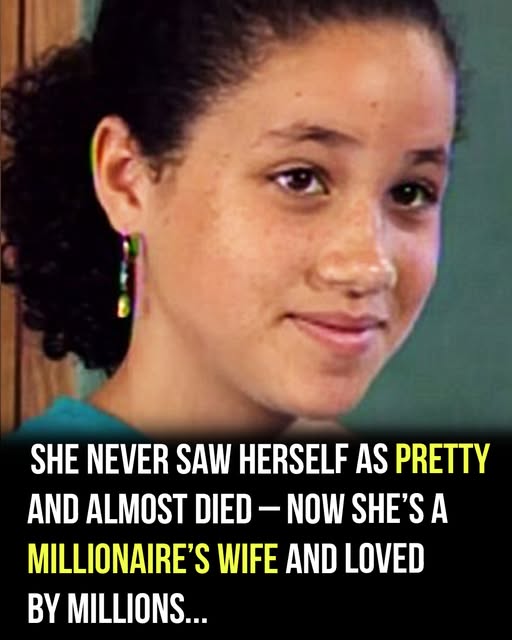
Long before she captured the world’s attention as a royal and a television star, Meghan Markle was just a quiet girl in Los Angeles, heating up microwave meals and trying to figure out where she belonged.
Born to a Black mother and a white father, Meghan didn’t fit the mold of a Hollywood fairytale. Instead, she grew up in the gray areas — too Black for some, too white for others, and constantly feeling like an outsider in a world that didn’t quite know what to make of her.
“My dad is Caucasian and my mom is African American. I’m half Black and half white,” she once explained, words that reflect the identity struggles that shaped her early years.
TV trays, tough love, and tougher questions
Meghan often described herself as a “latchkey kid,” returning to an empty house after school while her mother, Doria Ragland, worked as a makeup artist and her father, Thomas Markle Sr., spent long hours on TV sets.
“I grew up with a lot of fast food and also a lot of TV tray dinners,” she once said. “‘Jeopardy!’ was on, and I had microwave kids’ meals. That was normal.”
But not everyone agrees with Meghan’s version of events. Her father has publicly disputed some of her recollections, especially about their home life and family routines — a rift that hints at the deeper complexities of her personal story.
Still, those early years — filled with solitude, self-reflection, and quiet strength — laid the foundation for a woman who would one day stand center stage, commanding headlines, challenging tradition, and rewriting what it means to belong.

Meghan’s father, Thomas Markle Sr., has pushed back against some of her memories, insisting he was deeply involved in her upbringing — even saying he personally picked her up from school every day or arranged a car when he couldn’t.
But what truly left a lasting impression on Meghan wasn’t the debate over daily routines — it was the way the world reacted when she stepped out in public with her mother.
A daughter questioned, a mother mistaken
With lighter skin and features that often led strangers to see her as white, Meghan grew up watching the world struggle to make sense of her family. The confusion — and judgment — often landed hardest on her mother, Doria Ragland.
“I remember my mom telling me stories about taking me to the grocery store,” Meghan recalled. “A woman looked at her and said, ‘Whose child is that?’ My mom said, ‘It’s my child.’ And the woman replied, ‘No, you must be the nanny. Where’s her mom?’”
Moments like that weren’t rare — they were constant reminders that the world didn’t always have space for families who didn’t fit its expectations.
After her parents divorced, Meghan split time between their homes until the age of nine, when her father became her primary caregiver while her mother continued to build her professional life. Despite the challenges, Meghan’s upbringing was shaped by two working parents and one central lesson: strength often grows in silence, and identity is something you build — not something others define.

Meghan lived full-time with her father until she left for college at eighteen, but both parents left distinct imprints on her life.
After the divorce, her mother, Doria Ragland, moved to a predominantly Black neighborhood outside the Valley — a cultural shift that, at first, felt like a jolt. But within that new environment, Doria found her community: a circle of strong, supportive women who helped her raise Meghan through the ups and downs.
“We had a nice network of women who really helped me raise Meg,” Doria shared in Meghan’s Netflix docuseries. “She was always so easy to get along with — congenial, making friends. She was a very empathetic child, very mature.”
But their bond wasn’t always textbook mother-daughter.
“I remember asking her, ‘Did I feel like your mom?’” Doria recalled with a wry smile. “And she told me I felt more like her older, controlling sister.”
Not the pretty one — just the smart one
Adolescence brought the usual storm of insecurity — but for Meghan, it was amplified by the sense that she didn’t quite belong anywhere.
“I was a big nerd growing up,” she admitted. “People don’t understand that about me. Like, I was not the pretty one. My identity was wrapped up in being the smart one.”
That sharp mind became her compass. At just 11 years old, she challenged a sexist TV commercial — a small but powerful stand that hinted at the fearless woman she’d become.
Despite tight finances, her family found ways to make memories that felt rich.
“I grew up on the $4.99 salad bar at Sizzler,” Meghan recalled. “I knew how hard my parents worked to afford that… and I felt lucky.”
Those simple moments — and the quiet strength instilled by both her parents — would shape the resilience she’d need when her life became anything but ordinary.

Meghan never forgot what it felt like to live with just enough — and sometimes not even that.
“As a Girl Scout, when my troop went out for a big celebration, it was right back to that same $4.99 salad bar or The Old Spaghetti Factory,” she remembered. “Because that’s what those families could afford.”
But fate had a twist in store.
Everything shifted when her father, Thomas Markle Sr., won $750,000 in the lottery. That windfall became a springboard, helping to fund the education and training that would launch Meghan’s future.
“That money allowed her to go to the best schools and get the best training,” her half-brother later said. “She doesn’t stop until she gets what she wants.”
Big hustle. Bigger vision.
Long before she was walking red carpets, Meghan was already laying the groundwork for her future. Even as a child, she had her sights set high.
At just 11, she wrote a letter to her principal declaring that one day, she’d make their school famous. And she meant it.
By 13, Meghan was already juggling jobs — babysitting, selling donuts at a stand called Little Orbit, doing whatever she could to earn her own way. Her ambition wasn’t a spark; it was a steady flame. One that burned through every obstacle.
Even then, it was clear: Meghan didn’t just dream — she worked for it.

Meghan’s first taste of Hollywood didn’t come through auditions — it came from tagging along with her father on set.
He worked as a lighting director for Married… with Children, and Meghan, in her Catholic school uniform, spent hours watching the chaos unfold from behind the scenes.
“A really funny and perverse place for a little girl in a Catholic school uniform to grow up,” she once joked. But beneath the laughter, teenage Meghan was still trying to figure out who she was.
“I wasn’t Black enough…”
In her blog years later, Meghan reflected on those confusing years:
“My teens were even worse — grappling with how to fit in. Being biracial, I fell somewhere in between.”
That sense of in-betweenness followed her into early adulthood — and her acting career. Casting directors didn’t know what to do with someone who didn’t fit neatly into one box.
“I wasn’t Black enough for the Black roles and I wasn’t white enough for the white ones,” she explained. Her look was labeled “ethnically ambiguous,” and the roles she was offered were few and far between.
By her twenties, the pressure to be perfect — to look, act, and speak a certain way — became overwhelming.
“It was a constant battle with myself… to be as cool, as hip, as smart, as ‘whatever’ as everyone else,” she admitted.
But by 33, something clicked.
“I am 33 years old today. And I am happy,” she wrote. “To figure out how to be kind to yourself… to feel [happiness] — it takes time.”
From Suits to St. George’s Chapel
That once-invisible girl eventually found her voice — and millions of people listened. As Rachel Zane on the hit series Suits, Meghan captivated audiences with her wit and warmth.
Then, in 2016, her life changed forever when she met Prince Harry.
Two years later, the world watched as she walked down the aisle at Windsor Castle. By 2021, she was a mother to two children: Prince Archie and Princess Lilibet. But fairy tales often come with their own shadows.
A Royal Birth — and a Private Health Crisis
In April 2025, Meghan launched her podcast Confessions of a Female Founder. In its very first episode, she revealed a deeply personal and harrowing chapter that few had heard before: a life-threatening health scare after childbirth.
“We both had very similar experiences — though we didn’t know each other at the time — with postpartum,” she told Bumble founder Whitney Wolfe Herd. “We both had preeclampsia. Postpartum preeclampsia. It’s so rare and so scary.”
She spoke of the quiet suffering — trying to stay strong, to show up for her family, even as her own health faltered.
“In the quiet, you’re still trying to show up for people — mostly for your children — but those things are huge medical scares.”

Whitney Wolfe Herd didn’t hesitate. “I mean — life or death, truly,” she said, echoing the gravity of what Meghan had faced.
Meghan survived the terrifying bout of postpartum preeclampsia. But the road didn’t get easier. Not long after, she endured another deeply personal loss — a miscarriage — which she later opened up about in a raw, widely shared essay. It was a moment of vulnerability that reminded the world: behind the headlines is a human being.
From fast food to front pages, her path defied every script
Meghan Markle’s story isn’t a fairy tale. It’s far more powerful. It’s the story of a biracial girl raised on TV dinners and second glances, who carved out space in rooms that weren’t built for her. A woman who faced rejection in Hollywood, judgment in the tabloids, and heartbreak in private — yet kept showing up.
From donut stands to red carpets. From self-doubt to self-definition.
And now, with a microphone in hand and two children by her side, Meghan is telling her story — no longer filtered through tabloids or tradition, but in her own voice.
On her own terms.