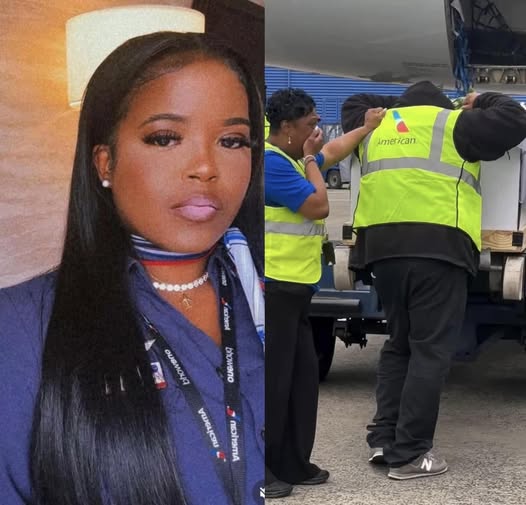
On what started as a routine winter evening in the skies above Washington, D.C., an American Airlines flight bound for Reagan National Airport was moments from landing when fate intervened in the most devastating way. Just as the aircraft, arriving from Wichita, Kansas, prepared to touch down, it collided mid-air with a U.S. military Black Hawk helicopter over the Potomac River — a tragic accident that stunned a nation and claimed 67 lives.
Among those aboard was Danasia Elder, a devoted flight attendant from Charlotte, North Carolina, whose radiant spirit lit up every room she entered. Cherished by colleagues, friends, and family alike, Danasia was known for her unwavering kindness, her love for her faith, and the joy she found in her husband and their two young children, Kayden and Dallas. Her brother-in-law, Brandon Payne, described her as “full of life,” someone who thrived on helping others, embraced every adventure, and greeted each day with gratitude.
Danasia was not alone in the cabin. Ian Epstein, also from Charlotte, shared her dedication to service. A seasoned professional at 52, Ian’s decades of experience and warm demeanor made him a trusted presence for passengers and crew. Together, they formed a flight team bonded by years of shared commitment.
In the cockpit, Captain Jonathan Campos, 34, was recognized for his steady hand and calm leadership, while First Officer Samuel Lilley, 28, had recently earned praise for his quick thinking during a challenging in-flight emergency. These four — crew and pilots — embodied the skill and professionalism that millions of travelers entrust with their lives every day.
The collision struck shortly after 8:45 p.m. beneath clear winter skies. Both aircraft were operating on assigned routes through one of the country’s busiest and most tightly controlled airspaces. The Potomac River corridor, with its intricate maze of restricted zones and dense traffic, demands flawless coordination — a fact that makes this rare and tragic collision all the more shocking.
Aviation experts stress that accidents of this nature are exceedingly rare, thanks to advanced radar, rigorous communication protocols, and close cooperation between civilian and military controllers. The circumstances — clear weather, proximity to the airport — have only intensified investigators’ resolve to understand what went wrong.
In the hours and days that followed, the nation watched as recovery teams braved icy waters along the Potomac’s banks. Using sonar and diving equipment, they painstakingly retrieved debris and the crucial flight recorders needed to piece together the final moments of both aircraft.
The National Transportation Safety Board (NTSB), alongside the FAA and the Department of Defense, launched a thorough investigation focused on flight data, air traffic control communications, weather conditions, and any possible mechanical issues. The goal: to reconstruct a timeline and ensure such a tragedy never repeats.
While investigators work, communities across the country are gathering to remember those lost. Memorials are planned in Charlotte, Wichita, and Washington, D.C., where friends, family, and strangers alike honor the lives behind the headlines.
At Charlotte Douglas International Airport, a growing wall of flowers, notes, and ribbons pays tribute to Danasia and Ian. Passengers recall Danasia’s infectious smile that eased anxious travelers, and Ian’s genuine kindness that made every person feel truly seen.
This tragedy is a poignant reminder of the human lives behind aviation statistics — the families left to navigate unbearable grief and the airline workers who now lean on one another for support in this close-knit community.
American Airlines’ leadership has pledged steadfast support for all affected, offering counseling, logistical help, and a promise to stand with the families through every step of this heartbreaking journey.
Looking ahead, experts believe this disaster will lead to vital changes: enhanced civilian-military airspace coordination, upgraded collision-avoidance technology tailored for diverse aircraft, and renewed training focused on complex airspace challenges. History shows that from great tragedy often comes stronger safety.
For the loved ones of Danasia, Ian, Jonathan, and Samuel, the deepest legacy is the lives they lived — marked by service, kindness, and courage. Danasia’s family plans a travel scholarship in her name to inspire young adventurers, while friends of Ian have created a fund supporting youth mentorship and animal rescue. Colleagues of the pilots seek to honor their sacrifice with national recognition.
As the investigation unfolds, the nation holds its breath — hoping for answers that bring comfort, closure, and a safer future.
Though the skies over the Potomac were forever changed that winter night, the dedication of those who serve above the clouds continues to inspire and remind us of the preciousness of every flight, every crew, and every passenger.