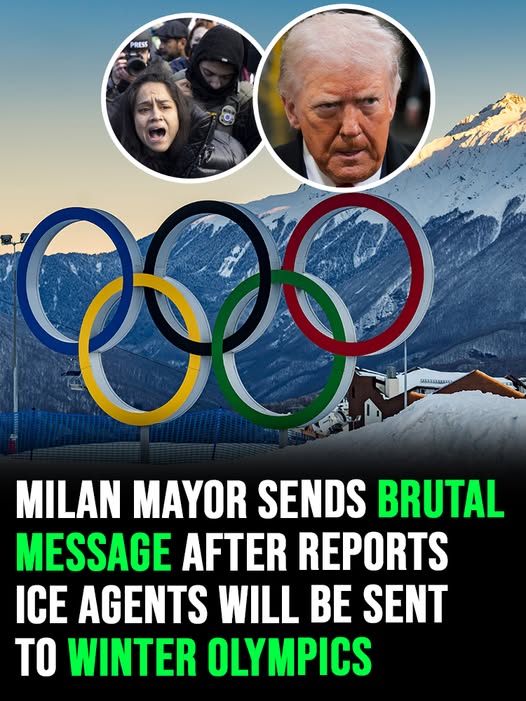
With the opening ceremony of the 2026 Winter Olympics just days away, a fierce diplomatic row has erupted in northern Italy. Giuseppe Sala, the Mayor of Milan, has issued a scathing condemnation of a plan to deploy agents from the U.S. Immigration and Customs Enforcement (ICE) to assist with security during the international event.
The games, scheduled to run from February 6 to 22 across Milan and Cortina d’Ampezzo, typically require a massive, coordinated security apparatus to protect athletes, diplomats, and spectators. However, the inclusion of ICE—an agency primarily tasked with border and immigration enforcement within the United States—has triggered an unprecedented backlash from local Italian leadership.
“A Militia That Kills”
Mayor Sala did not mince words when addressing the agency’s presence. Citing the agency’s polarizing reputation and a string of recent high-profile shootings involving federal agents in the U.S., Sala characterized the group as fundamentally incompatible with Italian civil standards.
“This is a militia that kills, a militia that enters into the homes of people, signing their own permission slips,” Sala stated, according to reports from People Magazine. “It is clear they are not welcome in Milan, without a doubt.”
The Mayor’s rhetoric reflects a deep-seated concern regarding the agency’s operational methods. He argued that the presence of such a force on Italian soil would undermine the host nation’s established security protocols. “I believe [ICE agents] shouldn’t come to Italy because they don’t guarantee they conform to our democratic way of ensuring security,” he added.
Efforts to De-escalate
The controversy has forced both the U.S. Embassy in Rome and Italian national authorities into a defensive posture. In an effort to calm the mounting public and political anger, officials have issued statements clarifying the narrow scope of the proposed mission.
Authorities insist that the ICE contingent would be restricted to specific, non-enforcement tasks, including:
- Protecting the U.S. delegation: Ensuring the personal safety of American athletes and high-ranking diplomats.
- Counter-transnational crime: Monitoring potential international criminal threats that could target the games.
- Liaison duties: Working under the strict command of Italian law enforcement.
Crucially, officials emphasized that the agents would have zero authority to enforce immigration laws on Italian soil, and that the overarching command of Olympic security would remain firmly in the hands of the Italian government.
A Collision of Domestic and International Optics
Despite these assurances, the tension remains palpable. The dispute highlights a growing disconnect between the U.S. government’s view of ICE as a versatile security asset and the international community’s perception of the agency as a controversial paramilitary force.
As Milan prepares to welcome the world, the question of whether these agents will be permitted to cross the border remains unresolved. With the clock ticking down to the first event on February 6, the standoff between the Milanese municipal government and federal planners serves as a sobering reminder of how domestic controversies can spill onto the global stage.