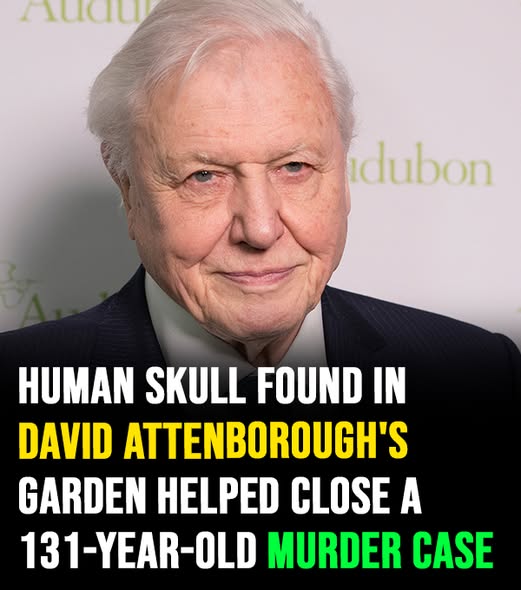
Sir David Attenborough is a man whose name is synonymous with the wonders of the living world, yet in 2010, the legendary broadcaster found himself at the center of a story concerning the dead. What began as a routine home refurbishment in Southwest London evolved into the final chapter of a macabre murder mystery that had remained unsolved for 131 years.
In 2009, Attenborough purchased a property in Richmond, an area known for its tranquil vistas and historic charm. It was the last place anyone would expect to find the remnants of a Victorian-era horror story. However, in October 2010, the silence of the garden was broken when contractors, excavating the soil for backyard renovations, unearthed a human skull.
The discovery sent immediate shockwaves through the local community, prompting an exhaustive police investigation that would eventually link the world’s most famous naturalist to one of London’s most notorious 19th-century crimes.

The Barnes Mystery: A Maid’s Betrayal
Forensic analysis and historical cross-referencing revealed that the skull belonged to Julia Martha Thomas, a wealthy widow in her 50s who vanished in 1879. The culprit was her own housemaid, Kate Webster, an Irish immigrant with a lengthy criminal record whom Thomas had hired without a proper background check—a fatal oversight in the Victorian era.
On March 2, 1879, after Thomas expressed dissatisfaction with Webster’s performance and terminated her employment, the situation turned violent. Webster later confessed to a struggle that escalated into a brutal slaying.
What followed was a sequence of events so gruesome it earned the title of “The Barnes Mystery.” Webster did not merely kill her employer; she sought to erase her existence. She dismembered the body, boiled portions of the remains, and burned the bones in the fireplace. Darker reports from the era even suggested that Webster may have attempted to sell rendered body fat to unsuspecting neighbors and local publicans.
A Century-Long Search Ends in a Garden
While many of Thomas’s remains were found in the River Thames shortly after the murder, her head remained a phantom piece of evidence. For over 130 years, it was widely believed that Webster had successfully disposed of the skull in the river.
The appearance of the cranium in Sir David Attenborough’s garden—located near the site of the original murder—provided the definitive “missing piece” of the puzzle. Using modern forensic techniques, including radiocarbon dating and meticulous examination of dental records and historical archives, coroner Alison Thompson confirmed the identity of the remains.
“This is a fascinating case,” Chief Superintendent Clive Chalk stated at the time. “It shows how old-fashioned detective work, historical documents, and modern technology can combine to solve a mystery thought lost to history.”

The Finality of Justice
The discovery proved that Thomas had not been entirely committed to the Thames; instead, part of her had remained buried beneath the soil of Richmond for generations, waiting for the light of day. For the residents of London, the closure of the case served as a haunting reminder that the past is never truly buried.
The case remains one of the most bizarre intersections of celebrity and true crime in British history—a Victorian tragedy finally put to rest in the backyard of the man who has spent his life explaining the mysteries of the earth.