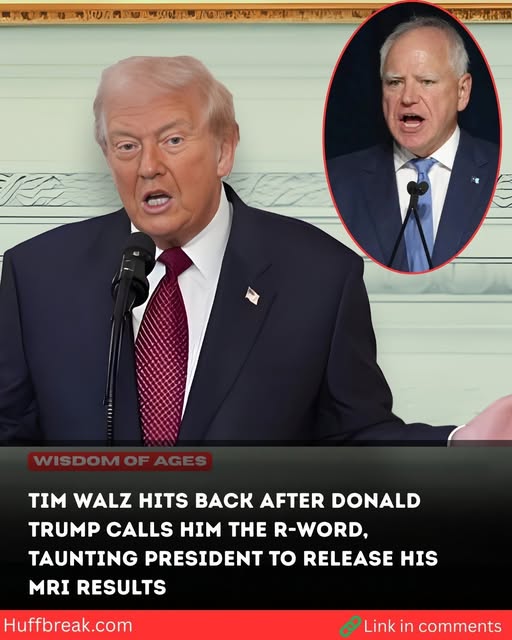
President Donald Trump recently ignited a fierce, intense public conflict with Minnesota Governor Tim Walz following a holiday social-media post that triggered immediate and widespread backlash across the political spectrum. The digital salvo, published on Thanksgiving, quickly escalated into a national debate touching upon issues of immigration, ableism, and the transparency required of public leadership.
The Attack: Scapegoating and Slurs Spark Uproar
In his post, shared across his own platform and amplified elsewhere, the former President launched a sweeping, unambiguous attack primarily targeting immigration—and specifically the growing Somali-American community in Minnesota. Trump described this community as a burden on the state and directly threatened sweeping changes to both immigration and asylum policies.
The post also included a personal, derogatory attack on Governor Tim Walz, whom Trump called “seriously r——ed”—an ableist slur widely recognized as offensive toward individuals with intellectual or developmental disabilities. Beyond the verbal attack, Trump accused the Somali community of fostering crime, labeled Minnesota as a state that has been “taken over,” and claimed that some Somali immigrants were responsible for widespread fraud—content that numerous observers immediately deemed xenophobic, hateful, and racially charged. He further disparaged prominent elected officials, such as Congresswoman Ilhan Omar, using harsh and racially charged language. The aggressive tone and inflammatory content of the post drew immediate and widespread condemnation from media organizations, civil-rights advocates, disability-rights activists, Minnesota state officials, and citizens across the country.
The Pivot: Walz Shifts the Narrative with Four Words
Instead of sinking into a defensive position or engaging in a retaliatory war of insults, Governor Walz countered with a masterful political maneuver delivered in just four words on the social-media platform X: “Release the MRI results.”
That brief, pointed call immediately and entirely reframed the debate. The focus was swiftly diverted away from the inflammatory rhetoric and harmful stereotypes underlying the attack. The spotlight was instead directed onto critical questions about the former President’s own health, his commitment to transparency, and his overall fitness for public leadership. Many political analysts and observers viewed Walz’s response as a sharp, calculated political move that simultaneously highlighted hypocrisy and successfully deflected the energy of the attack back onto Trump.
The Unanswered Medical Questions
The genesis of Walz’s demand lies in public statements regarding the former President’s health. According to previous statements, Trump underwent an MRI scan in October 2025 during a medical examination conducted at Walter Reed National Military Medical Center. At the time, the White House described the results as “perfect.”
However, Trump has since offered confusing statements, claiming he does not know what specific part of his body was scanned; he stated that it “wasn’t the brain” because he has recently taken and “aced” a cognitive test. Crucially, no detailed medical records, scan images, or physician’s reports have been made public, and no outside verification of the MRI’s purpose or results has been released. This persistent lack of transparency is precisely what Walz and others have called into question.
Broader Implications: More Than Just a Social Media Fight
The conflict quickly exposed and amplified a number of deeper societal and political fissures:
- Racial, Ethnic, and Religious Tensions: The comments specifically targeting Somali immigrants and a prominent Somali-American Congresswoman immediately sparked fear and concern within immigrant communities, particularly in Minnesota, which is home to a sizable Somali diaspora. Local leaders have forcefully pushed back, defending the community’s contributions and warning against the dangers of collective punishment or demonization.
- Disability Rights and Ableism: The use of a slur targeting persons with intellectual or developmental disabilities triggered condemnation from major disability-rights groups. This illustrates how political discourse—especially from figures in power—can perpetuate harmful social stigmas and contribute to social exclusion.
- Public Trust, Transparency, and Fitness: Walz’s concise demand shifted the spotlight squarely onto the responsibility of public figures, especially those holding or seeking significant power, to be transparent about their health. For many critics, the issue extends beyond past slurs or inflammatory language, focusing instead on long-term capacity and accountability to the electorate.
- Political Strategy and Narrative Framing: The episode served as a clear demonstration of how a simple, well-timed response can dramatically alter a political narrative. Instead of becoming entangled in an unproductive exchange of insults, the argument was fundamentally reframed around transparency, health, and leadership—topics with the potential to influence broader public opinion well beyond the immediate conflict.
The Lingering Uncertainty
Several key facts remain obscured and are likely to stay uncertain for the time being:
- The specific part of Trump’s body scanned in the October MRI (brain, heart, spine, etc.) has not been publicly confirmed.
- There is no independent verification of the MRI results—no medical records, no second opinions, no peer-reviewed or external medical report to corroborate the White House physician’s conclusion.
- It is unknown whether public pressure from Walz, media scrutiny, and civil-rights groups will be sufficient to force a full disclosure of the medical data, or if legal, privacy, or national security concerns will be successfully invoked to block such transparency.
- The lasting political impact of this controversy—on elections, public opinion, policy, or immigration enforcement—remains to be seen, as similar controversies have often faded quickly in the past.
The Significance of “Release the MRI Results”
Governor Walz’s brief, sharp demand resonated for several compelling reasons:
- Rational Reframe: It immediately converted an emotional, inflammatory moment—characterized by slurs and xenophobic rhetoric—into a rational question centered on health and transparency.
- Leadership Focus: It forced a national conversation not simply about immigration or ableist language, but about who is fit to lead and what citizens legitimately deserve to know from their leaders.
- Exposing Juxtaposition: It exposed a wider juxtaposition between the President’s rhetoric, which targeted vulnerable communities, and the lack of transparency regarding the personal condition of someone with substantial political influence.
- Modern Political Efficacy: It demonstrated how, in modern political conflict and the age of social media, concise, symbolic acts or statements can often shift the narrative more effectively than lengthy arguments or detailed rebuttals.
The Way Forward
Observers, media outlets, and citizens will now be closely watching several critical developments:
- Whether Trump (or his campaign) will release full MRI results, or allow independent medical review—and the degree of transparency (what scans, what dates, what findings) involved in any such release.
- Whether Minnesota’s Somali community and others who feel targeted will face increased scrutiny, deportation actions, or policy shifts—and how local and federal officials respond to defend their constituents.
- How the use of the slur and the racist/xenophobic rhetoric will shape political discourse about immigration, civil rights, and social cohesion, particularly in states with significant immigrant populations.
- How this volatile exchange will ultimately influence media narratives, public trust in leaders, and potentially future campaigns or elections.