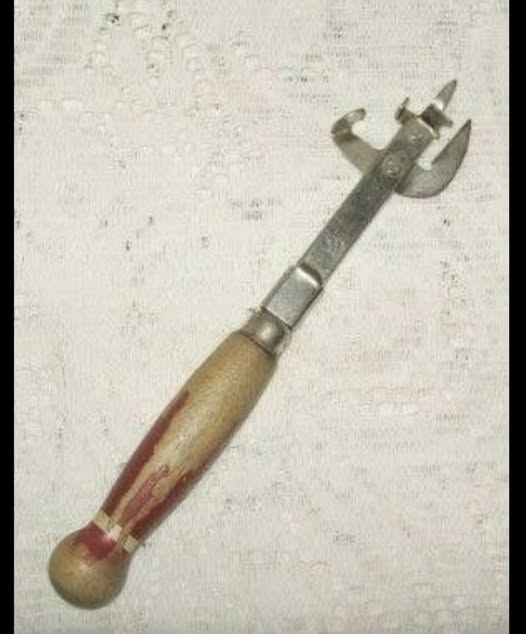
Online users recently found themselves on a digital treasure hunt after a mysterious, weapon-like object turned up in a kitchen drawer.
At first glance, the metal tool looked more suited to a toolbox—or even a medieval armory—than a grandma’s kitchen. Some people instantly recognized it and shared battle-scar-style memories. Others had absolutely no idea what they were looking at.
Curious? Let’s unpack the mystery.
It all started when a Reddit user posted a photo of the unusual item they discovered while cleaning out their grandmother’s house.
<blockquote>“[What is this thing?] Found it while cleaning out grandma’s house,” the user wrote. “She had it in her kitchen, we assume it is some sort of can opener multitool but have no idea how it would be used.”</blockquote>
The internet did what it does best—speculate.
Within hours, theories flooded the comments. Some guessed it was a 19th-century can opener. Others suggested it might be a fishing tool or camping gadget. A few joked that it looked dangerous enough to double as a weapon.
<blockquote>“I’m not a food container expert so I wouldn’t know,” one user admitted.</blockquote>
Another chimed in with a more confident guess:
<blockquote>“Old school can opener… puncture into can and lever forward one step at a time to cut the top off. Makes great jagged edges you can cut yourself on and get tiny metal shards into the contents.”</blockquote>
That comment struck a nerve.
Suddenly, people weren’t just identifying the object—they were reliving childhood injuries.
<blockquote>“Still have a scar where it slipped and embedded in my arm when younger!!!” one commenter shared.</blockquote> <blockquote>“I’ll never forget [when] this went right through my hand trying to open tin,” another recalled.</blockquote>
As it turns out, the “weapon” in question was indeed a vintage can opener—an old-school design that demanded strength, patience, and a steady hand. It also left behind more than a few scars for those who underestimated it.
The history of the humble can opener is surprisingly dramatic.
Canned food existed long before a practical way to open it did. Early cans were so sturdy that people often had to rely on brute force—think chisels and hammers—to get inside.
In 1858, American inventor Ezra Warner created one of the first dedicated can openers. His design featured a curved blade that pierced the lid and a lever to pry it open. It was effective but far from user-friendly. The U.S. military adopted it during the Civil War, though it wasn’t particularly suited for everyday home kitchens.
Then, in 1870, William Lyman introduced a rotating cutting wheel. This innovation made opening cans much easier and safer, laying the foundation for the modern can opener we recognize today.
Over time, the tool continued to evolve:
- Lever-type opener (1858): Ezra Warner’s original military-style design.
- Rotary opener (1870): William Lyman’s cutting wheel concept.
- Keyed cans (early 1900s): Built-in keys that rolled back the lid, common on sardine tins.
- Electric openers (1930s): A bulky but convenient leap into automation.
- Ergonomic handheld openers (1950s onward): Streamlined, safer, and easier to use.
Today’s can openers are far more refined. With improved engineering and safety features, most models minimize jagged edges and reduce the risk of slipping. Some even leave smooth rims that eliminate sharp metal altogether.
Still, nostalgia runs deep.
<blockquote>“Wanted to buy a new one, you cannot find them now,” one Facebook user wrote.</blockquote> <blockquote>“Still the best can opener!!” another insisted.</blockquote>
And perhaps the most accurate summary came from a third commenter:
<blockquote>“I still have one and use it on occasion. Dangerous bugger if not used properly.”</blockquote>
What began as a simple kitchen clean-out turned into a lesson in culinary history—and a reminder that not all vintage tools were gentle.
So next time you stumble upon a mysterious object tucked away in a drawer, don’t assume it’s junk—or a weapon. It might just be a relic from a time when even opening a can required courage.