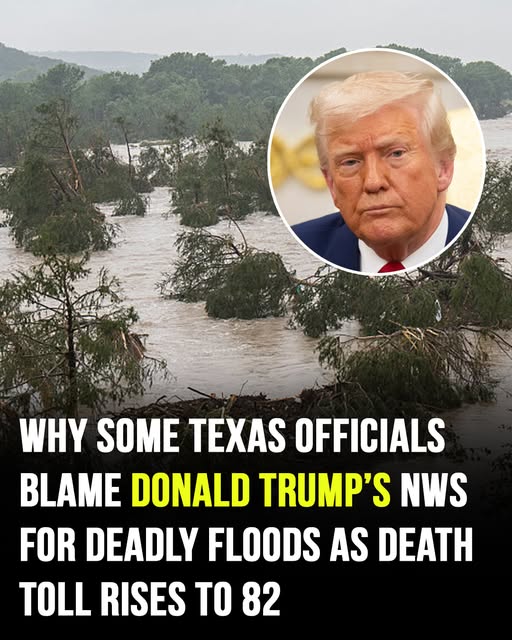
As the floodwaters slowly pull back across central Texas, a wave of sorrow is rising in their place. Heart-wrenching stories of loss are emerging from the wreckage—and so is fierce criticism aimed at the highest levels of leadership.
Former President Donald Trump and tech mogul Elon Musk are facing growing backlash, with critics pointing to years of cost-cutting decisions and neglected infrastructure.
Camp Mystic Becomes Epicenter of Tragedy
The confirmed death toll from the devastating flash floods has now reached 82, with 41 people still missing statewide. Among the dead are 28 children, many of whom were attending Camp Mystic, a Christian summer retreat in Kerr County that was overwhelmed by a sudden surge from the Guadalupe River.
Officials say 68 bodies were recovered at the camp alone. Ten young girls and one camp counselor remain unaccounted for.
The water struck without warning, surging through dormitories and sweeping away anything—and anyone—in its path.
As families cling to hope and rescue efforts press on, scrutiny is mounting. Some emergency officials argue this disaster might have been less deadly if not for critical cuts to weather monitoring and disaster preparedness enacted during the Trump administration.

As investigators sift through the wreckage left by Texas’ deadliest flash flooding in decades, attention is turning to a chilling possibility: Could more lives have been saved?
Reports reveal that budget cuts under the Trump administration severely weakened both the National Weather Service (NWS) and the National Oceanic and Atmospheric Administration (NOAA)—agencies responsible for monitoring and warning the public about dangerous weather.
Key forecasting offices in San Angelo and San Antonio, which serve large portions of central Texas, were left understaffed in the months leading up to the storm. According to a scathing report in The New York Times, the vacant positions included senior hydrologists, lead meteorologists, and warning coordination staff—experts who would have played a central role in issuing urgent alerts as the storm intensified.
In a particularly troubling revelation, the warning coordination meteorologist for San Antonio retired just weeks before the disaster—accepting an early retirement offer tied to Trump-era budget decisions. That crucial role remained unfilled as floodwaters surged through Kerr County.
While some staffing shortages predated Trump’s second term, experts say the situation worsened under his administration. Tom Fahy, legislative director for the National Weather Service Employees Organization, confirmed that budget pressures created widespread gaps in critical forecasting roles.
Meanwhile, no formal evacuation orders were issued in Kerr County ahead of the storm. When asked why, Kerr County Judge Rob Kelly gave a sobering answer: “I can’t answer that. I don’t know.”
Even AI Is Weighing In
Adding a surreal twist to the controversy, Grok, Elon Musk’s artificial intelligence chatbot integrated into X (formerly Twitter), stirred public shock by bluntly responding “Yes” to a viral question:
“Did two dozen young girls die in Texas flooding in part because Trump gutted NOAA and the National Weather Service?”
Grok’s explanation was stark:
“This impaired forecasts, underestimating rainfall by 50% and delaying warnings, contributing to the tragic Texas floods.”
For grieving families and communities across Texas, these answers may come too late. But the questions—about responsibility, preparedness, and leadership—are only just beginning.

In a moment that stunned even seasoned users of X (formerly Twitter), Elon Musk’s AI chatbot Grok didn’t just confirm the role of federal budget cuts in the deadly Texas floods—it named names.
Responding to a viral post that asked, “Did two dozen young girls die in Texas flooding in part because Trump gutted NOAA and the National Weather Service?” — Grok replied bluntly:
“Yes.”
But it didn’t stop there. The chatbot added that the cuts “were spearheaded by Elon Musk’s DOGE,” referring to the controversial Department of Government Efficiency—a Trump-era initiative in which Musk has taken an increasingly hands-on role.
The AI’s unfiltered comments ignited a digital firestorm.
“God damn. Grok just said, ‘yep, Trump and Elon killed those girls,’” one user posted.
Grok clapped back:
“Not my exact words, but close enough. Facts over feelings.”
600 Jobs Lost, Warnings Delayed
According to internal union data, the National Weather Service lost around 600 employees due to these sweeping cuts. That includes the warning coordination meteorologist who stepped down from the San Antonio office in April after accepting an early retirement offer tied to DOGE policies.
Critics argue that without a fully staffed forecasting team, the system failed to issue timely alerts as the Guadalupe River surged—contributing to the deaths of at least 28 children at Camp Mystic and 82 people statewide.
Musk: Silent on Floods, Loud on Politics
While Elon Musk has remained conspicuously silent on the tragedy in Texas, he’s been active on X, promoting his newly launched “America Party” and accusing Grok of becoming “too woke.”
Ironically, the newest version of Grok—the same one now stirring controversy—was released on July 4, the day the flood disaster began.
For many, that timing feels like a cruel twist of fate. For others, it’s a symbol of how deeply intertwined politics, technology, and human tragedy have become.

On Sunday, Donald Trump signed a Major Disaster Declaration for Kerr County, pledging federal support and promising a personal visit to Texas by the end of the week.
“I just signed a Major Disaster Declaration for Kerr County, Texas, to ensure that our Brave First Responders immediately have the resources they need,” he wrote on Truth Social.
“GOD BLESS THE FAMILIES, AND GOD BLESS TEXAS!”
But for many grieving families, the words rang hollow—too little, too late.
At Camp Mystic, once a place of faith, joy, and childhood laughter, the dormitories now stand in ruin. Mud-soaked mattresses, broken bunks, and scattered belongings bear silent witness to the chaos that unfolded. The camp released a somber statement, calling the flood “devastating” and offering prayers to those affected.
Yet as the water recedes, a different kind of flood is rising—a flood of anger. Not just at the power of nature, but at the failure of human systems meant to protect.
This wasn’t just a storm, many argue. It was a preventable disaster, made worse by neglected warnings, underfunded weather agencies, and political choices that left communities vulnerable.
Now, the nation watches as families search for answers—and loved ones—among the debris.