Deep within Egypt’s Great Pyramid, archaeologists have uncovered ancient inscriptions that may finally reveal the true identity of the monument’s 4,500-year-old architect.
For centuries, stories passed down from the ancient Greeks have painted a vivid picture of 100,000 slaves toiling for two decades in grueling three-month shifts to construct this wonder of the world.
But recent discoveries inside the pyramid are rewriting that narrative. Evidence now points to skilled, well-compensated workers—far from slaves—who built the pyramid, enjoying a day off every ten days.
Using cutting-edge imaging technology, renowned Egyptologist Dr. Zahi Hawass and his team explored hidden chambers above the King’s Chamber. There, they uncovered previously unseen markings left by work gangs dating back to the 13th century BC, shedding new light on the lives of those who built this enduring marvel.
Archaeologists have uncovered more incredible evidence near Egypt’s Great Pyramid that challenges long-held beliefs about its builders. Just south of the pyramid, they discovered tombs believed to be the eternal resting places of the skilled craftsmen who constructed the monument. These tombs bear 21 hieroglyphic titles—such as “overseer of the side of the pyramid” and “craftsman”—and statues depicting workers hauling massive stones.
“[These findings] confirm that the builders were not slaves,” Egyptologist Dr. Zahi Hawass explained during an episode of the Matt Beall Limitless podcast. “If they had been slaves, they would never have been buried in the shadow of the pyramids. Slaves wouldn’t have prepared their tombs for eternity like kings and queens did.”
Adding to the discovery, remnants of a rubble-and-mud ramp used to transport limestone from a quarry just 1,000 feet away were found southwest of the monument. These finds provide new insight into the pyramid’s construction techniques.
With support from Matt Beall, Dr. Hawass is now preparing an expedition to send a robot inside the Great Pyramid—a groundbreaking excavation that will be the first in modern history.
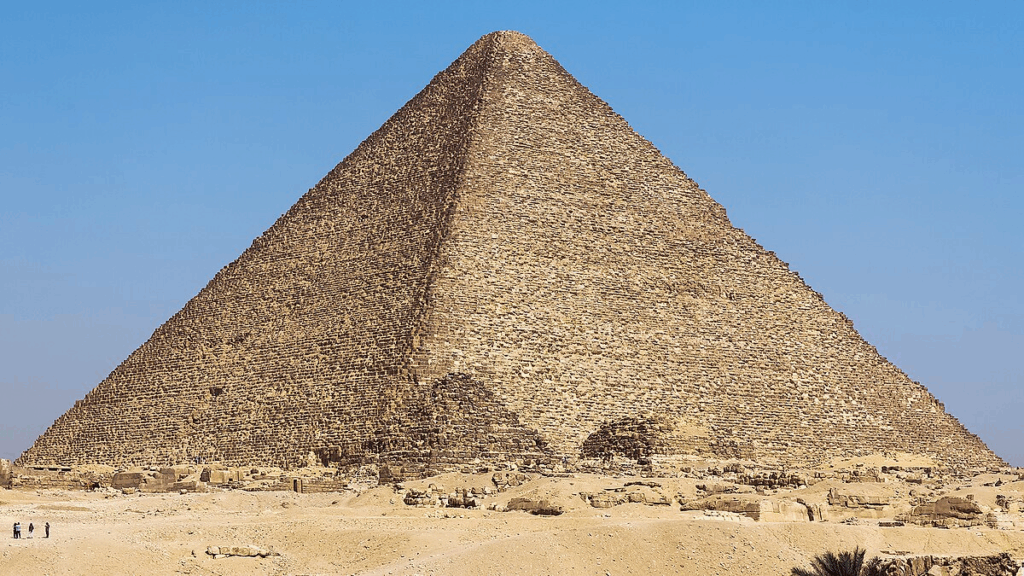
Pharaoh Khufu, who ruled during Egypt’s Fourth Dynasty in the Old Kingdom, commissioned the Great Pyramid of Giza—the largest pyramid in Egypt. Alongside the Great Sphinx, it stands on the Giza Plateau with the Pyramids of Khafre and Menkaure. These structures remain shrouded in mystery due to their perfect astrological alignment, unknown construction methods, and debated purposes.
Some skeptics once questioned the authenticity of inscriptions found inside the pyramid in the 19th century, speculating they could be forgeries made long after its construction.
“There was debate about whether the writings were genuine, but now you’re saying you’ve discovered three more cartouches within the King’s Chamber,” Beall asked Dr. Hawass.
“These inscriptions were found in chambers that are extremely difficult and dangerous to access,” Dr. Hawass explained. “They use writing styles only trained Egyptologists can interpret accurately. It’s nearly impossible that anyone recently could have forged them. You must climb 45 feet and crawl through tight spaces just to reach these chambers.”
While some European tourists in the late 18th and early 19th centuries carved their names inside the pyramid, Dr. Hawass stressed, “The inscriptions we found are clearly much older—original graffiti left by the ancient Egyptian workers.”
Alongside the inscriptions, the tombs of the pyramid builders revealed tools used in the construction—flint implements, pounding stones, and more.
“The base of the Great Pyramid is solid bedrock, carved 28 feet deep into the ground,” Dr. Hawass said. “The builders cut into the rock on all four sides until they created a perfectly level platform of solid stone—no blocks, just bedrock. You can still see this on the south side of Khufu’s pyramid.”
He described how workers operated in teams: some shaped stones, others chopped, and many hauled materials on wooden sleds dragged across the sand.
Dr. Hawass also shared evidence of ramps used to transport stones. “The ramp started from the pyramid’s southwest corner and connected to the quarry. At the site labeled C2, we uncovered remnants of the ramp—stone rubble mixed with sand and mud. When they dismantled the ramp, traces were left behind, which we excavated.”
Excavations east of the pyramid have uncovered what Dr. Hawass’ colleague Mark Lehner calls “the worker’s city.” The team found facilities such as fish-sorting areas, a large bread bakery, barracks, and the workers’ village.
“There’s a popular myth that the workers survived only on garlic, onions, and bread, but we found thousands of animal bones at the site,” Dr. Hawass said. “An expert from the University of Chicago analyzed them and determined that Egyptians slaughtered 11 cows and 33 goats daily to feed the laborers—enough to sustain around 10,000 workers per day.”
The conversation shifted to Dr. Hawass’s upcoming expedition exploring the mysterious Big Void inside the Great Pyramid, discovered in 2017.
“I am funding the exploration of the Big Void,” Matt Beall shared, revealing he’s helping develop a tiny robot just a centimeter wide to navigate a small hole bored into the pyramid’s side.
The Big Void lies at least 100 feet below the Grand Gallery—a soaring passage connecting the Queen’s and King’s Chambers near the pyramid’s center.
Dr. Hawass hopes the expedition will uncover Pharaoh Khufu’s hidden tomb within this vast emptiness.
“I think it’s unlikely that it’s a tomb, just because there’s never been a tomb found in any of the main pyramids,” Beall commented.
The groundbreaking exploration is expected to take place in January or February of next year.