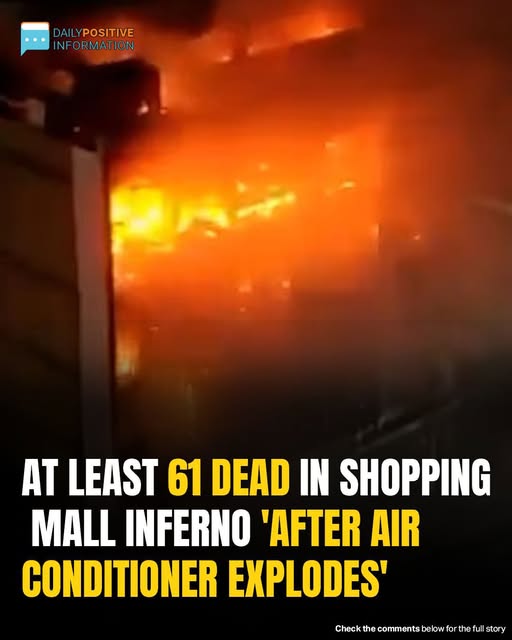
A devastating fire ripped through a newly opened shopping mall in Kut, Iraq, on Sunday night, claiming the lives of at least 61 people and leaving scores injured. The blaze reportedly erupted after an air conditioning unit exploded inside the six-story Corniche Hypermarket Mall.
The mall, which had only recently opened to the public, was bustling with men, women, and children when disaster struck. One survivor recounted hearing a sudden blast, followed by thick smoke and panic as the fire quickly spread from the first floor and consumed the entire building.
Terrifying footage circulating on social media shows the mall engulfed in flames, with plumes of smoke billowing into the night sky. In one heart-stopping clip, several people can be seen stranded on the rooftop as the fire surged upward. Their fate remains uncertain.
Authorities have launched a full investigation into the cause of the inferno, as grief and outrage grip the local community. The tragedy has raised serious concerns about fire safety regulations and emergency response preparedness in public spaces.
A catastrophic fire that tore through the newly opened Corniche Hypermarket Mall in Kut, Iraq, has left at least 61 people dead, including women and children, with dozens more injured or still unaccounted for. The tragedy unfolded late Wednesday night, reportedly sparked by an exploding air conditioner on the building’s lower floors.
“We couldn’t escape”
“We went to the mall to have dinner and escape the power cuts at home,” said Dr. Nasir al-Quraishi, who lost five members of his family in the blaze. “An air conditioner exploded on the second floor, then the fire erupted – and we couldn’t escape.”
The six-story building, only five days into operation, quickly became a death trap. Many victims, according to Iraq’s Interior Ministry, died from smoke inhalation while seeking refuge in restrooms. Fourteen charred bodies remain unidentified.
Rescue Amid Ruin
Civil defense teams battled the inferno through the night, rescuing more than 45 people trapped inside the building, which housed a restaurant and a supermarket. Ambulances continued to ferry victims to overcrowded hospitals in Kut—160 kilometers southeast of Baghdad—until 4:00 a.m.
This morning, firefighters were still combing through the blackened skeleton of the mall, where searchers hoped to find survivors—or recover more bodies. Shocking images show the structure completely gutted, with smoke-stained walls and twisted metal.
Grief and Outrage
Social media videos showed distraught relatives outside local hospitals—many sobbing, collapsing from grief, or crying out for loved ones. “Oh my father, oh my heart,” one man wailed, pounding his chest in agony.
The fire is the latest in a long series of preventable tragedies in Iraq, where safety regulations are often ignored. Authorities have launched a criminal investigation, and local officials have vowed accountability.
Governor Miyahi announced three days of mourning and said legal action would be taken against both the mall’s owner and the construction contractor. “This tragedy is a major shock,” he said, “and it requires a serious review of all safety measures.”
Prime Minister Mohammed Shia al-Sudani has ordered a thorough investigation to identify lapses and prevent similar disasters in the future.
Iraq’s most senior Shiite cleric, Grand Ayatollah Ali Sistani, offered his condolences to the grieving families.
Deadly fires like the one that gutted the Corniche Hypermarket Mall are tragically common in Iraq, where the construction industry routinely flouts safety regulations and decades of war have left the country’s infrastructure crumbling.
As summer temperatures soar past 50°C (122°F), the risk of fire grows exponentially—exacerbated by faulty wiring, overloaded electrical systems, and poor emergency planning.
In September 2023, at least 100 people were killed when a fire broke out at a crowded wedding hall, sending guests into a desperate stampede for the exits. Just two years earlier, in July 2021, more than 60 patients perished in a horrific blaze that swept through the Covid ward of a southern Iraq hospital.
These tragedies follow a grim pattern: preventable deaths fueled by neglect, corruption, and a lack of enforcement. For many Iraqis, the latest fire is not just a national disaster—it is a symbol of systemic failure.