
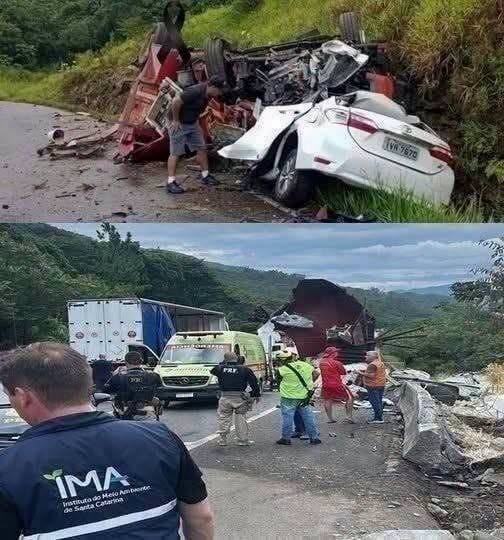
Nine Lives Lost on the Road Home: The BR-251 Tragedy That Left Brazilian Families Grieving and Raised Urgent Questions About Highway Safety
An Ordinary Journey That Never Reached Its Destination
For the passengers traveling north through Minas Gerais on the night of May 13, 2025, the journey was supposed to end somewhere familiar. Their van had left the Triângulo Mineiro region and was heading toward Ceará, a northeastern state where relatives, neighbors, and ordinary routines awaited. Some passengers were returning to communities they knew well. Others were traveling between places separated by a vast distance, following one of the long road routes that connect Brazil’s interior with the Northeast.
There is a particular kind of anticipation attached to a long trip home. It grows as the kilometers pass and each hour brings a traveler closer to the people and places that matter. A familiar street, the smell of a family meal, a conversation postponed until the next visit—these are small things, but they can make a tiring ride worthwhile. Whatever plans the passengers had made, none could have expected that the journey would end in catastrophe on a highway in northern Minas Gerais.
At approximately 9:30 p.m., near the community of Barrocão in the municipality of Grão Mogol, the van collided head-on with a large truck on federal highway BR-251. The crash killed nine occupants of the van, including eight adults and a four-year-old boy. Ten people were injured: eight from the van and two from the truck, according to contemporary reports from emergency authorities. The truck occupants sustained minor injuries, while some of the people rescued from the van were in serious condition.
These numbers describe the scale of the incident, but they do not describe the lives interrupted by it. Nine people were not simply absent from a passenger list. Nine sets of relationships, responsibilities, memories, and possibilities were abruptly cut short. The injured faced their own difficult uncertainty, with hospital treatment and, for some, a long road toward physical and emotional recovery.
The tragedy also raised questions that reach far beyond one night and one stretch of road. Investigators examined how the vehicles came to collide. Reporting indicated that the truck had entered the opposite lane, and transport regulators confirmed that the van lacked authorization for interstate passenger transport. Taken together, those details turned a devastating collision into a wider public discussion about road design, commercial transport oversight, and what safety means for people whose lives depend on long-distance travel.
To understand why the accident mattered so deeply, it helps to look beyond the wreckage—to the geography of the route, the people traveling it, the emergency response, the families waiting for news, and the systems intended to prevent such a disaster.
A Highway That Connects Distant Worlds
Brazil is a country of extraordinary distances. For many families, work, education, medical care, and loved ones may be separated by hundreds or even thousands of kilometers. Road transportation therefore serves more than a practical purpose. It is an essential connection between regions, communities, and opportunities that would otherwise feel impossibly far apart.
BR-251 is part of that national road network. In northern Minas Gerais, the highway carries traffic through an important corridor used by passenger vehicles and commercial trucks. Drivers may share the same roadway while traveling for very different reasons. A freight operator might be transporting goods or returning from a delivery. A family might be crossing several state borders to visit relatives. A van may carry people whose destinations are scattered among smaller towns rather than concentrated in a major urban center.
This mixture of vehicles creates a complicated environment. Heavy trucks require more room to maneuver and more distance to stop. Smaller passenger vehicles have less mass and can suffer severe damage in a head-on collision with a truck. On roads where opposing lanes are not separated by a physical barrier, an unexpected movement across the center line can become deadly within moments.
The location near Grão Mogol also matters. This is not a short urban commute with medical assistance always only a few blocks away. A nighttime collision outside a large city can require emergency teams to travel considerable distances, coordinate among multiple jurisdictions, and work in terrain that complicates access to the vehicles. Those challenges do not diminish the commitment of responders, but they can make every rescue more demanding.
It is tempting to describe a highway as dangerous solely because a terrible crash occurred there. A more useful approach is to ask which risks are persistent and which can be reduced. Road width, visibility, lane separation, surface conditions, speed management, vehicle maintenance, driver alertness, and effective enforcement all influence the likelihood and severity of a crash. None should be assumed to have caused this particular incident without evidence. Yet all are relevant to the broader question of protecting future travelers.