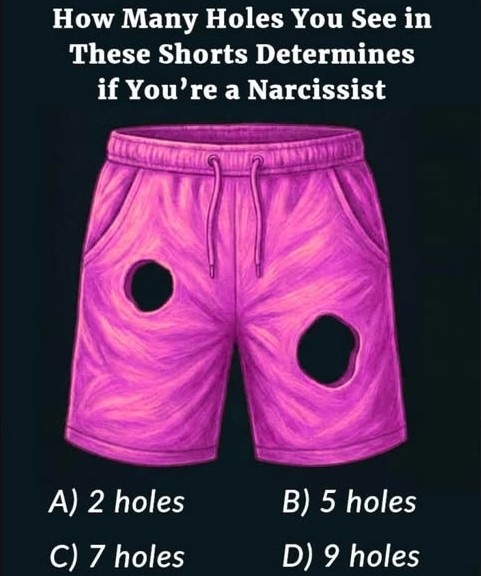
At first glance, the viral image seems harmless—a worn pair of shorts with visible damage. But when paired with the caption, “How many holes you see determines if you’re a narcissist,” it quickly grabs attention. The puzzle spreads so fast because it challenges perception, nudges the ego, and invites viewers to test how confident they are in what they see.
Despite the dramatic framing, the image isn’t meant to diagnose anyone. Its appeal lies in how differently people interpret the same visual information—and how quickly we jump to conclusions. Most viewers answer almost immediately, spotting the two torn areas on the legs and confidently saying “two.” This reflects instinctive perception: the brain prioritizes the most obvious shapes and delivers a fast, straightforward answer.
The conversation deepens when others note that the shorts already have openings by design: two leg holes and a waist hole. Adding these to the two tears brings the total to five, which feels like the most complete answer. Some go further, counting holes through both front and back fabric layers, pushing the total to seven or even nine, depending on interpretation.
The narcissism claim fuels debate, not truth. Choosing two reflects instinctive thinking, five shows structural awareness, and seven or more indicates layered reasoning. None of these reveal personality traits. What the puzzle truly shows is how people think, analyze, and defend their reasoning. That discussion, more than the shorts themselves, is why the image captivates and spreads so widely.