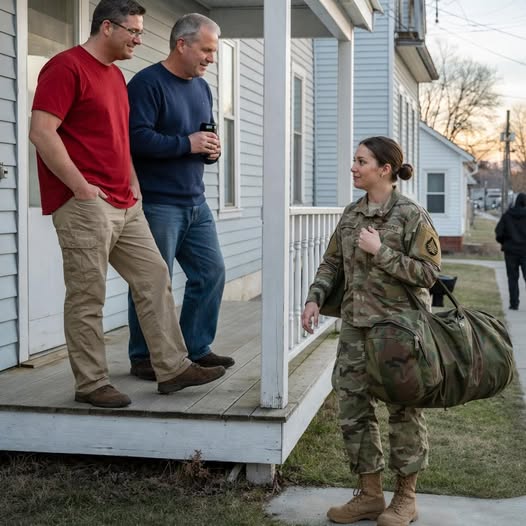
I had barely stepped out of the taxi before I saw them.
My father and my older brother, Chad, stood on my front porch like they belonged there, like two men guarding a prize they’d already pocketed. They weren’t surprised to see me. They looked pleased. Chad’s mouth pulled into that lazy, sideways smirk he’d worn since high school whenever he thought he’d gotten one over on someone. My father’s stance was solid and stubborn, arms folded across his chest, chin lifted, as if he were the injured party.
The taxi pulled away, tires whispering over the street. The sound faded, leaving late afternoon quiet in its place, broken only by a distant dog barking and the soft rasp of wind through the trees.
My seabag cut into my shoulder through the fabric of my blouse. The olive drab canvas felt like home in a way my own neighborhood suddenly didn’t. My desert combat boots were still dusted with that fine red grit from Okinawa, ground so deep into the seams no amount of scrubbing on the plane could get it out. I stood at the edge of the driveway I’d resurfaced myself three summers ago, staring at the house I’d bought eight years earlier with a VA home loan and rebuilt room by room on leave weekends, on nights when everyone else rested, on mornings when my hands were raw and my knees ached.
The lawn had been cut recently. I’d paid a neighborhood kid to mow it while I was gone. The mailbox I’d installed after closing sat at the curb, slightly crooked the way it had always been, because I’d never bothered to fix the angle. Familiar details. Normal details.
And then there were my father and Chad, leaning into that familiarity like it was theirs.
I took two steps toward the porch before my father spoke, like he couldn’t wait another second to land the blow.
“You’re homeless now, Maria.”
No hello. No welcome home. No I missed you. No mention that I’d just spent six months stationed overseas. Just that sentence, tossed at me with casual cruelty, like he was announcing the weather.
My body went rigid. The strap of my seabag tightened against my shoulder as if the weight of it doubled.
“What are you talking about?” I managed.
Chad snorted, lifting a beer bottle to his lips. My eyes flicked to the label and then to the case inside the garage fridge I’d stocked before deploying. The sight of him drinking my beer in my doorway made something sharp twist in my chest.
“We sold your house, sis,” he said, voice thick with contempt. “Try to keep up with current events.”
They laughed. Both of them. Dad’s laugh was short, satisfied. Chad’s was longer, uglier, like he’d been waiting to enjoy this.
The sound didn’t match the scene in my head, the one I’d carried through long duty days and humid Okinawa nights. In my mind, coming home meant relief. It meant stepping onto my own porch and feeling the world slow down for a minute. It meant being able to breathe.
I stared at them, trying to reconcile the men in front of me with the idea of family.
“Your brother needed help,” my father said, as if he were explaining something obvious. “Family sacrifices for family, Maria. You weren’t here anyway. You didn’t need the place.”
Then, because he couldn’t resist pressing harder, he added, “You Marines bounce around from base to base. What real difference does owning a house make when you’re never here?”
I felt the anger rise fast, hot behind my ribs, the kind that made my hands want to curl into fists. My training told me to respond. My instincts told me to protect what was mine.
But the urge to explode didn’t take over.
Something else slid into place instead. Cold. Steady. Calculated.
A smile spread across my face before I even decided to make it. It wasn’t wide or bright. It was slow and controlled, the kind of smile that meant I’d just spotted the weakness in someone’s position.
Their laughter died immediately.
Dad’s brows pulled together. Chad’s smirk faltered.
My father’s voice sharpened. “What’s so funny?”
I held his gaze and kept smiling, letting the silence stretch long enough that Chad shifted his weight and frowned like he didn’t like not being in control.
“The house you sold,” I said, slow and careful, “was actually…”
I stopped there, not because I didn’t know what I was going to say, but because they didn’t deserve the comfort of understanding this quickly.
And because to explain why that smile belonged on my face, I have to go back.
Months earlier, Okinawa had been humid and bright, salt in the air, sunlight glittering off the water beyond the base. I’d been halfway through a routine six-month rotation, the kind that wasn’t supposed to feel like survival. After two combat deployments where mornings began with real uncertainty, the predictability of shore duty overseas felt almost luxurious. It meant training exercises, equipment maintenance, paperwork. It meant I could think about the future without my body bracing for impact.
And because I finally had room in my head to plan, I checked in on my house constantly.
That two-bedroom craftsman bungalow wasn’t just a property. It was stability in a life built on movement. I’d bought it after my second deployment, using a VA home loan, and then I’d poured myself into it the way some people pour themselves into relationships. I stripped wallpaper until my fingers cramped. I refinished hardwood floors until my arms shook. I updated wiring, renovated bathrooms, rebuilt the kitchen with my own hands and a few fellow Marines who traded muscle for beer and laughter on weekends.
That house was my proof. Proof that a kid from a broken home could build something solid. Proof that the chaos I’d grown up with didn’t have to be the only story.
Before deploying to Okinawa, I’d given my father limited power of attorney. It was supposed to cover emergencies only. Roof leak. Furnace failure. A legal signature that couldn’t wait. Practical things. Safety measures.
I had never imagined he’d treat it like a license to gut my life.
At first, the calls home felt normal enough, just slightly off around the edges.
My father sounded irritated more often than not, like my voice was an interruption. When I asked how the house was doing, he’d answer too quickly.
“Fine. Everything’s fine.”
Then he’d shift the subject, and I’d hear something in the background. Dishes clattering. Voices that didn’t belong to him. Activity that suggested his small apartment was crowded.
Chad, meanwhile, had apparently moved back in with him after losing yet another job. That part was predictable. Chad had been “figuring things out” for most of his adult life. Whenever I asked directly what his plan was, my father would get defensive.
“He just needs time,” he’d say. “Stop being so judgmental, Maria. Not everyone has their life together like you do.”
Once, during a call, I heard someone in the background shout, “Did she send the money yet?” and the line disconnected so fast it felt deliberate. When I called back, it went straight to voicemail.
I told myself not to spiral. I told myself I was reading too much into it. I was overseas. I was tired. The last thing I wanted was to believe my family saw me as a bank account with a uniform.
Two weeks before my flight home, my father sent a text that made my stomach clench.
Call us before you come home.
No punctuation. No explanation.
My instincts, honed by years of doing threat assessments and trusting that quiet inner alarm, told me something was wrong. But that final week overseas was chaos. Inspections. Transfer paperwork. Final briefings. Packing. Shipping. I tried calling. Twice it went to voicemail. I left messages. I sent texts asking what he meant.
Nothing.
I told myself if it was urgent, he’d keep trying. I told myself my flight was already booked and I’d be home soon enough to handle whatever minor problem he’d built up in his head.
Then I landed, rode back to my neighborhood, and stepped into a reality where my father and brother were on my porch laughing like they’d just pulled off the greatest trick of their lives.
Back on the porch, Chad lifted his bottle in a mock toast.
“Don’t look so shocked,” he said. “You were gone. Dad had power of attorney. Easy process. You’ll get over it.”
I studied him. Chad’s eyes had that restless look I’d seen before, the one that showed up when he was lying or cornered. He was trying to act like this was no big deal because admitting the size of it would mean facing what he’d done.
My smile didn’t shift.
“Is that what he told you?” I asked.
My father’s jaw tightened. “What’s that supposed to mean?”
I didn’t answer right away. I set my seabag down on the lawn carefully, as if I were placing equipment before an inspection. I brushed dust from my sleeve. I walked toward the porch at a measured pace.
They watched me like they expected tears. Like they expected shouting. Like they expected me to break into the version of myself they were prepared to dismiss.
But the closer I got, the more I felt something steadier than rage.
Because I already knew something they didn’t.
I stopped on the porch boards I’d rebuilt with pressure-treated lumber. I didn’t reach for the door. I just stood there, looking at both of them, letting the quiet build until my father shifted uncomfortably.
“Well?” he demanded. “Aren’t you going to react? Yell?”
I tilted my head slightly and asked, “When exactly did you sell it?”
“Three weeks ago,” he said, defensive now, like my question was an accusation instead of a fact. “It was the right thing to do. Your brother needed help.”
“There it is,” I murmured, more to myself than to him. Need. Always Chad’s need. Chad’s emergencies. Chad’s bottomless appetite for other people’s sacrifices.
“And you didn’t think you should call me first?” I asked. “Before you sold my property?”
He scoffed. “You were overseas. Busy playing Marine. You don’t understand real-world problems.”
That landed hard, not because it hurt my pride, but because of how casually he dismissed the life I’d built.
“I called every week,” I said evenly. “Sometimes more. Left messages when you didn’t answer. Sent texts. Strange how you couldn’t return a call but had time to sell a house.”
Chad rolled his eyes. “Here comes the guilt trip.”
I turned to him. “Did you know? Did you watch while he signed? Or were you too drunk to notice what was happening?”
Chad shrugged, too practiced at pretending he wasn’t accountable. “Dad said it was legal. Why wouldn’t I believe him?”
My father cut in quickly, eager to control the narrative. “We put the money to excellent use. Your brother’s debt is handled. He’s safe from those people.”
Debt. The word sat heavy. Safe from those people. The way Dad said it told me everything he wasn’t saying.
“You want to tell me the whole truth now,” I said, voice low, “or should I find out through legal discovery?”
“What truth?” Chad snapped, irritation flashing. “It’s just a house.”
“Really,” I said. “Because when I left, it was paid off. Clear title. No liens. For you to sell fast enough to pay emergency debt, you needed cash buyers. That means desperation. Whose desperation was I funding?”
Chad’s eyes flickered away.
I could feel the shift. The moment when they realized I wasn’t lost. I wasn’t confused. I was tracking.
“Gambling?” I asked, calm. “Drugs? Loan sharks? Which one is it this time?”
My father’s face flushed. “Stop talking to your brother like he’s a criminal!”
“My house is gone,” I said, my calm turning sharper. “The home I bought with my own money and rebuilt with my own hands is gone. So yes, I’m asking questions.”
“You were gone!” he shouted, and the sound cracked through the quiet neighborhood. “Always gone! Always deployment this, duty station that! You think you’re better than everyone because you wear that uniform!”
The anger inside me surged, but I kept my voice steady.
“I’ve served for thirteen years,” I said. “And every time I came back, I came back here. To this house. The anchor that made the moving bearable.”
Dad waved a hand dismissively. “You’ll buy another one somewhere. You make more money than Chad ever could. You’ll be fine.”
He pointed at Chad like he was a helpless child instead of a nearly forty-year-old man who’d spent decades wrecking his own life and letting other people clean up the debris.
And then the front door opened.
A woman stepped onto my porch holding a coffee mug that read Home Sweet Home. Blonde hair in a messy bun. Gray sweatpants. Bare feet. She looked comfortable in a way that made my skin go cold.
She blinked at the three of us, confused, like she’d walked into the wrong scene.
“Who are you?” I asked.
Her expression softened into uncertain friendliness. “I’m Emily Morrison. The new owner. I bought this place three weeks ago.”
For a moment, the world tilted. Not in a dramatic way. In the quiet, sickening way of realizing something irreversible has been done. This wasn’t a plan. This wasn’t a threat. This had been closed. Signed. Recorded. Finished.
My father winced like he couldn’t stand the sound of the truth out loud. Chad shifted like a man trying to find an exit.
Emily lifted her mug a fraction, as if it might protect her. “Is there a problem?”
And that was when my smile widened again, not because I enjoyed her fear, but because I could see exactly what had happened to her.
She’d been pulled into their mess.
“Congratulations on your purchase,” I said, voice polite enough to be believable. “Did they tell you everything about this property?”
Emily blinked. “Everything? I got the inspection report and the disclosures…”
I looked at my father. His face had gone pale. Chad’s mouth tightened.
I turned back to her. “Did they mention the house isn’t actually in their legal names?” I asked gently. “That they didn’t have the authority to sell it?”
The silence that followed felt like pressure, like the air got heavier.
Emily’s mug froze halfway to her mouth. “What do you mean?”
“My father says a lot of things,” I replied. “Can you tell me who handled the sale? Which attorney or title company processed it?”
Emily glanced at my father, searching for reassurance, then back at me. “A man named Gerald Benson. A family friend. He said he was helping to keep costs down. To make it quick.”
Benson. The name landed with a cold, familiar weight. The kind of man who lived in the gray edges of legality, always just barely clean enough to avoid charges, always close enough to dirt to smell like it.
“Did you have an independent attorney?” I asked Emily. “Someone representing you?”
She shook her head slowly. “No. Benson said it wasn’t necessary. He said it was a family transaction.”
Quick. Simple. No independent representation. The classic setup.
I softened my voice. “Emily, I’m genuinely sorry. But they didn’t have the legal right to sell this place.”
I reached into the cargo pocket of my uniform and pulled out the folded document I’d carried since landing. I’d stopped at the county recorder’s office during my layover and pulled property records, reading them with the same focus I’d used on mission briefs.
Emily’s eyes moved over the seals and signatures as I held it out.
“This house was purchased using a VA home loan,” I said. “That means federal protections apply. Selling a federally backed property without proper authorization, without VA approval, and without the veteran’s explicit written consent is not a simple family dispute. It’s a federal issue.”
Emily’s face drained of color. Her hand trembled against her chest.
My father’s mouth opened, but nothing came out. Chad’s swagger evaporated entirely, replaced by the look of someone who just realized the ground beneath him isn’t solid.
“Power of attorney,” I continued, voice clipped and factual now, “does not automatically grant the right to sell federally protected property. Not without specific filings and approvals. None of which happened here.”
Emily swallowed hard. “Are you saying I don’t own this house?”
“I’m saying,” I replied carefully, “that you were sold a lie. And you need a real estate fraud attorney immediately.”
My father stepped closer, voice shaking. “Maria, don’t do this. Please. We’re family.”
I looked at him, and for a second I saw flashes of the man he used to be, the man who woke early to make me breakfast, the man who cried at my boot camp graduation.
But that man wasn’t standing here now.
“That didn’t stop you,” I said quietly. “Family didn’t matter when you needed quick cash for Chad.”
“It was for your brother!” he shouted, desperation rising. “He would’ve been hurt! Those people don’t mess around!”
“And what about me?” I asked, and the pain finally edged into my voice. “When did I become expendable? When did my service become something you could use against me instead of something you respected?”
His face crumpled into something he couldn’t defend. He had no words left.
Emily spoke again, small and frightened. “What happens next?”
“You get your own attorney,” I said firmly. “You stop speaking to them outside legal channels. You document everything you have. Every email. Every text. Every detail you remember.”
She nodded, eyes glossy, like she’d been dropped into deep water without warning.
My father pointed at me, voice rising. “You’re ruining everything! After everything we did for you!”
I shook my head. “No. You ruined it when you decided my absence was an opportunity.”
I lifted my seabag again and swung it over my shoulder.
“Where are you going?” Dad demanded.
“I’m going home,” I said.
“You don’t have one anymore!” Chad shouted, a desperate nastiness in his voice.
I turned back, and my smile returned, controlled and sharp.
“That’s exactly what you think,” I said. “But you’re wrong. The house you sold wasn’t actually mine.”
Both of them blinked, thrown off balance. Even Emily’s fear paused in confusion.
“Three years ago,” I continued, “I transferred the deed into an LLC I created for real estate investment purposes. The legal owner is Shadow Mountain Holdings, LLC. I’m the sole member, but that’s not public information. What you sold was property you had no legal connection to.”
My father’s face went stark white.
Chad’s mouth fell open slightly, then shut, like he couldn’t decide which emotion to choose first.
“Every signature you forged,” I said, voice steady, “every document Benson filed, every claim you made, it’s fraud. Criminal fraud.”
I looked at Emily, gentler again. “The good news is the sale is void. You’ll get your money back. The bad news is you’re going to be a witness.”
Then I looked back at my father and Chad.
“The worse news is for you,” I said. “Because federal prosecutors take this seriously.”
My father grabbed the porch railing like his legs suddenly didn’t work.
“You set us up,” he whispered.
“No,” I said firmly. “I protected myself three years ago because I didn’t fully trust you with Chad around. I hoped I’d never need that protection.”
I walked toward the rental car parked down the street.
“Maria!” my father called, voice breaking. “Please. We can fix this!”
I stopped and turned one last time.
“No, Dad,” I said. “You can prepare for the consequences.”
His voice cracked further. “You’d send your own father to prison?”
“You’d steal your own daughter’s home?” I asked. “I guess we both have to live with our choices.”
The weeks that followed moved with grinding inevitability.
I stayed in base housing while everything sorted out. I contacted the VA inspector general and filed a detailed complaint. Military legal assistance connected me with federal prosecutors. I sat with local police for nearly four hours giving a statement that filled thirty pages.
Emily hired a sharp attorney who filed to void the sale. Within two weeks, the court ruled the transaction fraudulent from inception. She got her money back from escrow before it was fully released, plus damages.
Benson was arrested on fraud, forgery, and conspiracy. He tried to run and made it less than two states before they picked him up at a truck stop.
My father and Chad were charged as co-conspirators.
The hardest part wasn’t the paperwork or the hearings. It was sitting in the prosecutor’s office and hearing the full story.
Chad had racked up nearly eighty thousand dollars in gambling debts to dangerous people. Instead of letting him face the consequences, my father decided to “borrow” my house. They waited until I was overseas and couldn’t intervene. They planned it. They timed it.
Three months after that porch confrontation, I sat in a courtroom and watched my father plead guilty to fraud and conspiracy. He got three years probation, five hundred hours of community service, and full restitution.
Chad got eighteen months in prison, partly because he’d forged documents directly and partly because he had a prior fraud conviction I hadn’t even known existed.
Benson got five years in federal prison.
When the judge finalized the last order, I walked out of the courthouse into sunlight that felt too bright. I got into my car and drove to my actual house, the one my family never knew about. A smaller property on the other side of town, purchased years earlier under the LLC structure as an investment rental.
I hadn’t told them because I’d learned young that information was power, and they’d already taken enough from me without knowing every asset I had.
I stood on that porch, my real porch, and felt something settle in my chest. Not peace. Not forgiveness.
Acceptance.
My father called from prison one evening about six months later. I’d been expecting it. I answered.
“Maria,” he said quietly. “I’m sorry.”
“I know,” I said.
“I thought I was saving Chad,” he admitted. “I was so scared of losing him that I lost you instead.”
“You didn’t lose me because you helped him,” I said, voice even. “You lost me because you stole from me. There’s a difference.”
He was quiet a long moment.
“I understand that now,” he said. “Too late, but I understand.”
We talked a few more minutes. It wasn’t reconciliation. It wasn’t a warm ending. It was acknowledgment, plain and heavy.
After I hung up, I looked around my living room. Photos from deployments. My dress uniform hanging in the closet. An American flag folded in a shadow box. Evidence of a life built on service, sacrifice, and hard-earned self-protection.
That night I sat on the back deck and watched the stars come out one by one. The same stars I’d seen from Okinawa, from desert deployments, from training ranges across the world.
Constant. Reliable. Honest.
Unlike people, unlike family, the stars never pretended.
I had protected myself by being smarter than the people who wanted to use me. I had won by preparing for betrayal years before it arrived. And I had survived by learning one quiet, brutal truth.
Sometimes the people who claim to love you are the ones you need the most protection from.
The house they tried to sell was never mine.
But the home I built, the one secured, the one beyond their reach, was always mine.
And it always would be.