The garage door was open.
It was such a small thing, just a slab of metal rolled up like a careless yawn, but it punched the air out of me the moment I saw it through the kitchen window. I stood at the sink with my coffee cup warming my palms, watching morning light spill into the empty rectangle of the garage like it was spilling into a wound.
Dennis never left that door open.
In forty-three years of marriage, I could count the times he’d forgotten something on one hand, and even then he’d come back, muttering to himself, correcting the world the way he always did. Dennis was steady. Dennis was routine. Dennis was the kind of man who clicked doors shut and checked locks twice because he believed in taking care of what you built.
But Dennis was gone.
Eight months, three weeks, and two days. I’d learned to measure time that way, as if precision could keep grief from drifting into everything.
I set the coffee down on the counter. The ceramic made a soft clink that sounded too loud in the quiet kitchen. The house smelled like brewed coffee and the lemon cleaner I’d been using more than usual lately, as if shining surfaces could make the emptiness less obvious.
I walked toward the back door and opened it.
April air drifted in, warm for spring, with that damp, hopeful smell of new leaves and soil waking up. The yard was still, the grass just starting to brighten. In another life, Dennis would already be out there, sleeves rolled, humming off-key as he polished chrome or adjusted a bolt like it mattered to the balance of the universe.
My slippers scuffed over the porch steps. The concrete felt cold even through the thin soles, and that cold traveled up into my legs, sharp and real.
Inside the garage, the darkness looked heavier than it should have. The space seemed wrong, as if the air itself knew something had been taken.
The oil stain in the middle of the floor was still there. Dark, circular, familiar. Twenty years of one car sitting in the same spot leaves a mark. The stain was like a shadow of something living.
But the spot was empty.
My stomach tightened. I moved forward slowly, as if I might still be dreaming and a sudden movement would shake the dream into the right shape.
The workbench along the back wall was exactly how Dennis left it. Tools hung on the pegboard, each one outlined in black marker like a child’s tracing of a body at a crime scene. His red toolbox sat closed. On the workbench, his work journal lay open, its spine creased from years of use, pages filled with his careful handwriting.
The one thing that should have been here, the center of Dennis’s last great devotion, was gone.
The 1967 Shelby GT500.
Dennis’s car.
Not just a car, not just metal and leather and horsepower. It was the thing he saved for, the thing he worked on in every spare weekend, the thing he talked about with a brightness in his eyes that made him look young again. It was his twenty-year project, his long love letter to patience and precision, his promise to himself that retirement would contain joy.
I picked up the work journal. My fingers trembled. The paper smelled faintly of oil and old ink, of Dennis’s hands.
The last entry was dated three weeks before he died. His handwriting looked a little shakier than usual, the loops slightly less confident, the words pressed into the page as if he’d been writing through fatigue.
Almost done. Twenty years on this beauty. Can’t wait to teach Carol to drive her properly. Our retirement road trip starts next summer.
I stared at the line about teaching me to drive.
Dennis had been so excited about that. He’d teased me for years. He’d said I’d only driven grocery-getters and sensible sedans, and that the Shelby would make me feel alive in a way I’d forgotten was possible. He’d promised we would take it up the coast, windows down, no schedule, just the two of us and the sound of an engine that didn’t apologize for being powerful.
I closed the journal carefully and put it back where it had been, exactly where Dennis would have wanted it. The garage still smelled like him. Motor oil. Old leather. That orange hand soap that never quite washed out from under his nails.
Then I heard an engine outside.
A car door closed with a hard thud. Tires rolled over gravel. I stepped to the garage opening and saw my son’s black BMW pulling into the driveway like it owned the place.
Brian got out first. Thirty-eight years old, shoulders hunched, hands shoved into his jacket pockets. His eyes flicked toward the garage and then away, as if the empty space inside it was too bright to look at.
Then the passenger door opened.
Vanessa stepped out.
Perfect as always. Sleek dark hair, designer sunglasses, a coat that looked expensive even from ten feet away. She moved like someone who never doubted she belonged wherever she stood. Two years married to my son, and I still felt like I’d never met the real her, only the version she presented like a polished product.
Brian walked toward me and stopped at the edge of the driveway.
“Mom,” he said. His voice was too careful. “I need to talk to you about something.”
My own voice came out steady, though my chest felt like it had been cinched tight with wire.
“Where’s the car, Brian?”
His jaw tightened. He swallowed. His eyes stayed fixed somewhere over my shoulder, anywhere but my face.
“That’s what I need to talk about,” he said.
“Where is it?” I asked again, and this time my voice carried steel.
Brian exhaled through his nose. “I sold it yesterday.”
For a moment, the words didn’t register. Sold it. Like it was a lawn mower. Like it was a set of old dishes you drop off at a thrift store.
Then the meaning hit, and my body reacted before my mind could catch up. A hot pulse surged into my face. My hands went cold.
“You sold it,” I repeated.
Brian nodded once, small and quick. “I needed the money.”
Vanessa moved closer, her hand sliding onto Brian’s arm like she was managing him. Her nails were perfect, painted a bright red that reminded me sharply of how different her life had always looked compared to mine.
“Vanessa has been planning this Paris trip for months,” Brian continued, words tumbling out like he’d rehearsed them. “It’s important. For her business connections.”
The tightness in my chest spread. It felt like grief expanding into rage, like both were fighting for space.
“That was your father’s car,” I said.
“It was just sitting there,” he snapped, defensiveness flashing. “Dad’s gone, Mom. You don’t even drive it.”
The way he said Dad’s gone landed like an insult. As if Dennis’s absence was an inconvenience.
“How much did you get?” I asked.
Brian hesitated, then lifted his chin slightly. “Fifteen thousand.”
My mouth went dry.
“Fifteen thousand,” I echoed.
He nodded again. “That’s fair for a car that old.”
Fifteen thousand for a documented 1967 Shelby GT500. For twenty years of meticulous restoration. For museum-quality work. For Dennis’s dream.
I felt something in me go quiet, not calm exactly, but focused. The kind of focus that comes when you realize pleading won’t change anything, and you need to understand the mechanics of what’s been done.
“When did you take it?” I asked.
Brian’s eyes flicked toward the garage. “Yesterday afternoon. You were at the store.”
He still had his key from when he lived here. And Dennis, trusting to a fault where family was concerned, always left the garage unlocked.
“You should have asked me,” I said.
Brian’s lips twisted. “Would you have said yes?”
“No.”
Vanessa stepped forward then, her smile perfectly polite, perfectly practiced.
“Carol,” she said, voice light, “we’re not discussing this. It’s done. The car is sold. We leave for Paris tomorrow.”
I looked at her. Really looked. Behind the sunglasses, behind the smooth hair, behind the calm tone. There was something hard there. Something that didn’t care what it broke as long as it got what it wanted.
“This is between me and my son,” I said.
“I’m his wife,” Vanessa replied pleasantly. “What’s between you and him is between all of us.”
Brian shifted his weight like a boy caught between parents. He didn’t correct her. He didn’t defend me. He simply stood there while his wife drew a line through my grief.
“Brian needed that money,” Vanessa continued. “The car was sitting unused. It made sense to sell it.”
“It was his father’s,” I said again, because I needed them to understand the weight of that.
Vanessa’s head tilted slightly, and her voice went flat as a countertop.
“His father is dead.”
The words were so blunt they felt obscene.
“And Brian is trying to build a life,” she added, sweet again. “Surely you understand.”
Brian glanced at his watch, then toward the BMW. “We should go. Still need to pack.”
Vanessa tugged his arm gently. “We have an early flight.”
They turned away as if the conversation was finished. Brian glanced back once, saw me standing in the open mouth of Dennis’s garage, arms crossed, slippers on, face still. For a second, something like shame flickered in his eyes.
Then he got in the car.
Vanessa rolled down her window as they backed out.
“Take care of yourself, Carol,” she called. “We’ll see you when we get back.”
The BMW turned the corner and disappeared.
The silence that followed was enormous.
I walked back into the garage and stood on the oil stain in the center of the floor. The emptiness felt loud. My eyes drifted to Dennis’s journal. I picked it up again, opened it, and read his last words once more, as if repetition could change reality.
Can’t wait to teach Carol to drive her properly. Our retirement road trip starts next summer.
My throat tightened. I’d thought eight months of widowhood had wrung me dry, that my body couldn’t possibly hold more tears. But standing there, staring at the empty space my son had created, I felt them rise anyway, hot and sudden.
I didn’t cry loudly. I didn’t sob. I just stood in the smell of oil and leather and old love and let tears slip down my face, one after another, like a leak I couldn’t fix.
That night I barely slept.
Every time I closed my eyes, I saw the garage empty. I saw Dennis’s hands on the steering wheel, his grin when he talked about the road trip. I saw Brian’s face as he said fifteen thousand, and Vanessa’s mouth as she said his father is dead.
By four in the morning, I gave up on sleep entirely. I went to the kitchen, made coffee I didn’t want, and sat at the table with Dennis’s journal open in front of me.
I read old entries. The early ones, where he’d written about finding parts, about sanding down rust, about the first time the engine turned over. I read the ones about teaching Brian to change the oil when he was twelve, about Brian’s pride and excitement, about father and son spending Saturday afternoons together with grease under their nails.
I read until the sky began to lighten.
At seven, the phone rang.
The sound startled me so badly I nearly knocked the coffee over.
“Hello?” My voice sounded rough.
“Mrs. Bennett?” A man’s voice, gravelly, as if he’d been crying. “This is Tom Graves from Graves Classic Auto. I have your husband’s car.”
My heart slammed hard enough to hurt.
“What?” I whispered. “The Shelby?”
“Yes,” he said quickly. “Your son brought it in on Wednesday. Mrs. Bennett, I need you to come to the dealership right now if you can. There’s something Dennis wanted you to know.”
My mind struggled to keep up. Wednesday? Yesterday was Thursday. So Brian had been planning this longer than one impulsive moment. He’d already arranged the sale days ago.
“I don’t understand,” I said, and I hated how small my voice sounded.
“Dennis was my friend,” Tom said. His voice cracked on the word friend. “A good friend. Please. Come in. It’s important.”
I remembered him vaguely from the funeral, a gray-haired man in the back, eyes wet, holding himself as if grief was a physical weight.
“Where are you?” I asked.
He gave me the address.
I was there in thirty minutes, hands tight on the steering wheel of my sensible sedan, my mind racing and blank at the same time.
Graves Classic Auto sat on the edge of town, a clean building with large windows and a service bay behind it. Classic cars lined the lot like jewelry, polished and expensive. My stomach twisted as I parked, suddenly afraid of what I might see, of what I might lose all over again.
Tom Graves stood outside the entrance, waiting.
He was maybe sixty-five, gray hair, a lined face, wearing jeans and a button-down shirt. His eyes were red and swollen. He looked like he hadn’t slept.
“Mrs. Bennett,” he said softly, as if speaking too loudly would break something. “Thank you for coming.”
He didn’t offer his hand, perhaps sensing I wasn’t ready for touch. Instead, he nodded toward the building.
“Your husband saved my life twenty-five years ago,” he said.
I blinked. “Dennis?”
Tom swallowed hard. “I needed a business loan. I had a dream of opening this place. No bank would touch me. Dennis co-signed. Risked his credit and savings for a guy he barely knew.”
My chest tightened, not with pain this time, but with astonishment. “He never told me.”
Tom’s mouth curved into a sad smile. “That’s who Dennis was. He did things quietly. He didn’t want applause.”
He wiped his eyes with the back of his hand. “When your son brought that Shelby in, I knew it immediately. Dennis talked about that car like it was a member of the family.”
“He said he sold it,” I managed.
“He did,” Tom said. “To me.”
I felt anger flare again. “So you bought it from him.”
Tom looked sick, like the words tasted bad. “I did, but not because I wanted to take it from you. Mrs. Bennett, your son had no idea what he was selling. I asked if he knew the value. He said fifteen thousand sounded fair.”
My stomach dropped, as if gravity had shifted.
“What’s it really worth?” I asked.
Tom met my eyes, and his voice softened, careful like he was handling a fragile object.
“Around one hundred eighty thousand,” he said. “It’s a documented 1967 Shelby GT500, and Dennis restored it to museum quality. The workmanship is incredible.”
My mind refused the number at first. One hundred eighty thousand. Dennis had spent weekends and holidays and years, and my son had let it go for fifteen.
Tom continued quickly, as if afraid I might collapse.
“I bought it because Brian was desperate. But I need you to understand something. That car was never mine to keep. Dennis made me promise two years ago.”
“Promise what?” My voice came out thin.
Tom nodded toward the service bay. “Come inside. There’s something you need to see.”
He led me through the dealership, past bright showrooms and glossy posters, into the garage area.
And there it was.
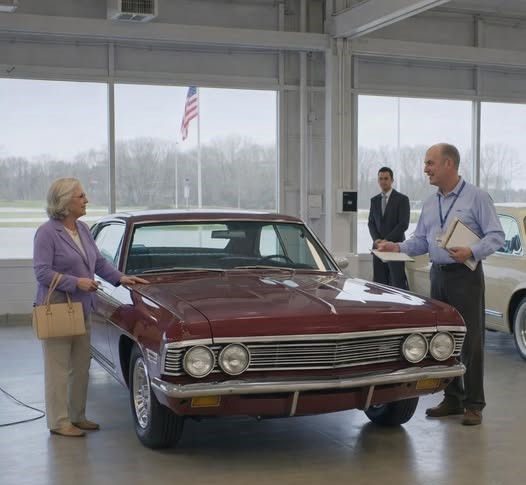
The Shelby sat under bright shop lights, gleaming like a jewel. Burgundy paint so deep it looked wet. Chrome polished to a mirror shine. Tires clean, rims perfect. The shape of it was muscle and elegance, a car that looked like it was born to roar.
My throat closed.
I walked toward it slowly, as if approaching a sleeping animal I didn’t want to startle. I placed my palm on the hood. The metal was cool, smooth, solid. Real. Here.
The smell hit me when I opened the driver’s door. Old leather. The faint sweetness of polish. The ghost of the garage at home.
I slid into the driver’s seat, and for a moment it felt like Dennis might walk in, wiping his hands on a rag, grinning as he said, Well, Carol, you ready to see what she can do?
Tom leaned against the door frame, watching me with a mixture of sadness and respect.
“Two years ago,” he said quietly, “Dennis asked me to help him install something. A hidden compartment. He told me if anything ever happened to him, I needed to make sure you knew about it.”
My pulse jumped.
“What kind of compartment?” I asked, though I already knew the answer would change everything.
Tom pointed to the dash. “Behind the radio face. He wanted it accessible but not obvious.”
He showed me the mechanism, a specific pressure point, a release I never would have found on my own. The radio face came away with a soft click, revealing a dark space behind it.
Tom stepped back.
“I’m going to give you privacy,” he said. “Take your time. I’ll be right outside.”
He walked out of the garage, leaving me alone with my husband’s car and the quiet hum of shop lights.
My hands trembled as I reached into the hidden compartment. My fingers brushed paper first. A thick manila folder. Under it, a sealed envelope with my name on it in Dennis’s handwriting. And beneath that, a small wooden box. Inside the box was a key.
For a moment, I could only stare.
Then I opened the envelope.
Dennis’s handwriting filled the page, dated two months before he died.
Carol, if you’re reading this, I’m gone.
I swallowed hard.
I’ve been investigating Vanessa for eighteen months. She’s not who she says she is. Her real name is Vanessa Courtland. She’s done this before, twice that I’ve found. In this folder is everything I’ve gathered. Photos, documents, contact info for her previous victims.
My breath caught. My hands started shaking so badly the paper rustled loudly.
She’s going to target our house, Carol. That’s her pattern. She targets men with aging parents and family assets, convinces them their parents are declining, that the house should be sold. Then she disappears with the money.
My eyes blurred. I blinked hard and forced myself to keep reading.
The key in this box is for our safe deposit box at First National. Box 447. Inside are stock certificates I bought in 1994. Check the current value. You’re taken care of financially.
Protect yourself. Protect our son. He’s a victim in this too.
I love you. I’m still protecting you.
Dennis.
I read it twice. Then a third time. Each pass made the words sink deeper until they stopped being ink and became weight.
Dennis had been investigating Vanessa. While I was grieving. While I was trying to navigate widowhood and loneliness and the quiet ache of mornings without him, he had been quietly fighting a battle I didn’t even know existed.
I opened the manila folder with shaking fingers.
Photos slid out first. Vanessa at a wedding, her smile bright, her arm linked with a man who was not my son. Another photo, another wedding, another man. Marriage certificates.
Vanessa Courtland married Stanley Wright, Phoenix, Arizona. June 2019.
Vanessa Courtland married George Murphy, Tampa, Florida. March 2021.
There were newspaper clippings. Local man reports elderly mother’s life savings stolen by daughter-in-law. Notes in Dennis’s careful handwriting. Observations about Vanessa’s questions. About how she steered conversations toward our house, toward my health, toward our assets. A list of contact information for the men in the marriage certificates.
At the back, Dennis’s final note.
Need more concrete proof before telling Brian. If you’re reading this and I’m gone, please finish what I started. Protect our son.
I pressed my hand to my mouth. A sound escaped me, halfway between a sob and a laugh, because the truth was unbearable and astonishing.
Tom returned quietly and stood in the doorway, watching me with gentle patience.
“He was protecting me even after he died,” I whispered.
Tom nodded. “That’s who Dennis was.”
“I need to call them,” I said, voice trembling now with urgency. “I need to know what happened.”
Tom motioned toward the front. “Use my office. Take as long as you need. Coffee, water, anything.”
I carried the folder like it might explode and followed him to a small office with a desk and a worn leather chair. Tom set a glass of water in front of me and stepped out, closing the door.
I stared at the first phone number.
Stanley Wright.
My fingers hovered, then pressed call.
He answered on the third ring.
“Hello?”
His voice sounded tired, wary, as if he’d learned to be cautious about every unknown number.
“Mr. Wright,” I said, trying to keep my voice steady. “My name is Carol Bennett. I’m calling because my son is married to a woman named Vanessa Courtland.”
Silence.
So long I thought the call had dropped.
Then, slowly, he exhaled.
“I wondered when this call would come,” he said.
A shiver ran through me.
Stanley was fifty-eight. He told me he’d met Vanessa in spring 2019 at a community center where his mother volunteered. His wife had died three years earlier. Loneliness had softened him, made him receptive to attention that felt like rescue.
“She was charming,” he said. “So attentive to my mom. She’d bring her flowers. Sit with her. Ask her questions about her childhood. My mother adored her. She thought Vanessa was an angel.”
They married six months later.
After the wedding, the comments began, small and persistent.
“Your mother seems to be slowing down.”
“Did you notice she forgot my name yesterday?”
“Are you sure she’s safe alone?”
Over months, Vanessa built a narrative, a story where his mother was fragile and declining and in danger. She found a memory care facility, expensive and glossy, and presented it like salvation.
“Twenty thousand a month,” Stanley said quietly, and I heard his shame in the number. “I didn’t have that kind of money. Vanessa said the only way was to sell Mom’s house.”
The house sale brought two hundred eighty thousand dollars. Vanessa insisted it go into a joint account to make payments easier.
“Two weeks after Mom moved,” Stanley said, voice cracking, “Vanessa disappeared. She cleaned out the account. Every penny. Changed her number. Closed her social media. Gone like smoke.”
“What happened to your mother?” I asked, though dread already filled me.
Stanley’s breath hitched. “She died six months later. She kept asking when she could go home. She didn’t need that place, Mrs. Bennett. She needed her home.”
My throat tightened so hard it hurt.
“Thank you,” I whispered. “Thank you for telling me.”
“Stop her,” Stanley said, voice suddenly fierce. “Please. Don’t let her do to another family what she did to mine.”
When I hung up, my hands were shaking.
I dialed the second number.
George Murphy answered immediately, and his voice carried a different kind of exhaustion, the numbness of someone who has replayed betrayal so many times the emotions have dulled into a bruise.
George was sixty-one. He met Vanessa at his father’s funeral in early 2021, when grief had made him raw.
“She was there,” he said. “I didn’t even know how. She said she was a friend of a cousin. She came up to me after the service and handed me a bottle of water like she’d known me forever.”
She helped him through the darkest weeks, cooked meals, listened to him talk about his father, touched his arm at the right moments. He married her eight months later, believing he’d been granted a second chance at companionship.
His father had owned a small auto repair shop for forty years. George inherited it but felt overwhelmed.
“Vanessa suggested selling,” he said. “She said it would free me. We’d travel. Heal together.”
They sold the shop for one hundred ninety-five thousand dollars. The money went into a joint account. Three days after the check cleared, Vanessa was gone.
“She targets men with aging parents and family assets,” George said. “Does your son have access to your house? Your finances?”
“Not yet,” I said, though my mind raced through Vanessa’s comments, Brian’s questions, the subtle pushes. “But she’s been setting the stage.”
“Then you have time,” George said. “Stop her before she gets him to sign anything.”
I thanked him and hung up.
For a moment, I just sat there in Tom’s office, staring at the desk surface. My breathing sounded loud in my ears. Dennis had been right. The pattern was real. The danger was real.
Tom knocked softly and stepped in. “How are you holding up?”
“Dennis suspected all of this,” I said, voice hollow.
Tom nodded. “He came to me six months before he died. He said he had a buddy, a private investigator. Peter Coleman. They were working together.”
Tom reached into a drawer and pulled out a business card, sliding it across the desk.
“Peter’s been waiting,” he said. “He told Dennis he’d be ready if Vanessa made a move.”
I stared at the card, then at the key in the wooden box.
“First,” I said, “I need to go to the bank.”
At First National, the air smelled like polished wood and cooled air conditioning. The bank manager, a woman with neat hair and a professional smile, led me to a private room once I explained I needed to access a safe deposit box.
Box 447.
The key turned smoothly. The box slid out with a soft scrape.
Inside was a single envelope, thick with paper.
Stock certificates.
And a letter.
Carol, I bought this stock as a favor to a patient in ’94. His son was starting a tech company. I gave him $5,000, never expecting anything. Found them last month while organizing files.
This is for you. For our future. For security. Sell these when you’re ready. Stay independent. Don’t let anyone convince you otherwise.
I held the letter with both hands, unable to stop the tremble. Dennis had been quietly building safety nets while I thought we were simply moving through ordinary life.
The bank manager returned with a laptop, having researched the certificates.
Her eyes widened.
“Mrs. Bennett,” she said, voice shifting from routine to careful respect, “these shares are currently valued at approximately three hundred forty-two thousand dollars.”
The room tipped sideways.
I gripped the chair as if it might slide out from under me.
Three hundred forty-two thousand dollars.
Dennis had left me financial security I never knew existed. Real security. Not the fragile kind where one emergency could undo everything. The kind that gives you options, the kind that makes you harder to corner.
When I stepped out of the bank into sunlight, my knees still felt weak, but my spine felt straighter.
Dennis had not just left me grief.
He had left me power.
Saturday morning, I met Peter Coleman at a coffee shop near downtown. The kind of place where the chairs are worn and the coffee smells strong enough to wake the dead. Peter was fifty-five, with the posture of a man who’d spent years watching people lie. Former detective, Tom had said. He wore plain clothes and carried folders, thick with information.
He shook my hand once, firm and brief.
“Mrs. Bennett,” he said, voice low. “Dennis was my friend. He made me promise not to contact you directly unless Vanessa acted against you.”
Peter opened his folder and slid papers across the table.
Vanessa’s digital footprint. Screenshots of caregiver forums where she used a fake name and asked questions about how to convince resistant elderly people they need assisted living. Browsing history for property listings. Costa Rica real estate. Beachfront rentals. Places you could disappear.
Then Peter slid another sheet over, and my heart dropped again.
Credit cards.
Three of them.
In Brian’s name.
Thirty-two thousand dollars in debt.
“Brian’s salary is sixty-five thousand a year,” Peter said. “Not enough to support the lifestyle she’s pushing.”
My hands curled into fists under the table.
Peter’s voice stayed calm. “Based on her previous victims, here’s the timeline. Phase one is the big trip. Paris, in this case. Something glamorous. Something that makes her feel special and makes Brian feel like he has to keep up. Phase two is concern about you. Phase three is assisted living. Phase four is convincing Brian to sell your house.”
“My house is worth three hundred twenty thousand,” I said.
“Exactly,” Peter replied. “Her total take would be over three hundred fifty thousand, plus whatever she siphons through credit.”
I swallowed hard. “Can the police stop her?”
“Not yet,” Peter said. “She hasn’t committed a crime in this state. We build the case now. When she makes her move, we’re ready.”
He leaned forward. “And Brian has to see it himself. If you tell him outright, she’ll convince him you’re paranoid. She’ll use grief. She’ll use guilt. She’ll use your age. He needs to touch the truth with his own hands.”
That night, I sat at my kitchen table and made a list of everything I’d noticed, every moment that had felt off but that I’d tried to explain away.
Two months ago, Brian asked where I keep the house deed.
Six weeks ago, Vanessa took photos of every room, calling it “memories.”
One month ago, Brian asked if I’d forgotten about lunch plans we never made.
Three weeks ago, Vanessa commented how tired I seemed.
Two weeks ago, a brochure for Sunset Hills Senior Living slipped from Vanessa’s purse.
And then the car, sold without my permission, sold so Vanessa could go to Paris.
The pattern was there, threading through everything.
They came back from Paris on Tuesday. Brian texted me a single photo of the Eiffel Tower with a caption that said, Amazing trip. Vanessa posted a dozen photos online, all of her smiling in expensive places, as if the world existed to be photographed.
I invited them for dinner. I made pot roast the way Brian liked, tender enough to fall apart under a fork, the smell filling the house with something like comfort.
Vanessa controlled the conversation from the moment she walked in. Paris was beautiful. The hotel was stunning. The connections she made were “invaluable.” Brian sat beside her, nodding, watching her like she was sunlight.
“It made me realize how much we’re missing out on,” Vanessa said, her voice warm.
Then her eyes slid toward me, and I felt the shift, the turn of the conversation like a blade rotating in the light.
“Carol,” she said gently, “this house is really too big for one person. Have you thought about downsizing?”
There it was.
I set my fork down slowly. “I’m managing fine.”
“Of course you are,” Vanessa said, smiling. “We just care about your safety. The stairs, the yard work. It’s a lot for someone your age.”
Brian nodded. “We worry about you here alone, Mom.”
The betrayal stung, even though I expected it.
After dinner, Vanessa excused herself. “Bathroom down the hall?”
She was gone ten minutes.
I found her upstairs near Dennis’s old office, standing too close to the filing cabinet where he kept important paperwork. The bathroom door down the hall was open and empty.
“Oh!” she said brightly. “I got turned around.”
“The bathroom is downstairs where it’s always been,” I replied.
She laughed lightly. “Of course. Silly me.”
Wednesday morning, I called Brian.
“I need to talk to you,” I said. “Just you. About your father. Something I found in his things.”
There was a pause.
“Vanessa and I don’t keep secrets,” he said.
“This isn’t about secrets,” I replied, fighting to keep my voice calm. “It’s about your father. Please, Brian.”
Long silence. Then, finally, “Okay. This afternoon.”
He arrived at three. Vanessa wasn’t with him, which made my stomach twist with cautious hope.
I had Dennis’s investigation file on the kitchen table. I slid the letter toward Brian first. The one Dennis wrote to me from the hidden compartment.
Brian read it quickly, his eyes moving fast, his face tightening.
“This is ridiculous,” he snapped, slamming the paper down. “Dad never liked her.”
“He didn’t dislike her,” I said quietly. “He was afraid of her.”
Brian stood up abruptly and began pacing the kitchen like a caged animal.
“You’re grieving,” he said, voice rising. “You’re lonely, Mom. You’re looking for something to blame.”
I opened the folder and laid out the photos on the table. Vanessa at different weddings. Different men. The marriage certificates.
Brian stopped pacing and stared.
“That’s not her,” he said automatically, denial snapping into place like a reflex.
“It is,” I said. “Call them.”
I slid the paper with phone numbers toward him. “Ask them about their wives.”
Brian stared at the numbers as if they were venomous. “You want me to call random strangers?”
“They’re not random,” I said, voice cracking despite myself. “They were married to your wife before you.”
Brian’s hands shook. He grabbed the paper, crumpled it.
“I’m not doing this,” he snapped.
He headed for the door.
“Brian,” I said, my voice breaking fully now. “Please.”
He turned, anger flashing. “Why are you doing this to me?”
The words cut. He made it sound like I was the attacker, like I was harming him by trying to protect him.
I swallowed hard. “Because your father died trying to protect you,” I said, forcing each word out, “and I’m not going to let his last months be for nothing.”
For a moment, Brian’s face changed. Something flickered in it, grief and doubt tangled together.
Then he opened the door and left.
The door slammed. The sound echoed through the house like a verdict.
I sat at the kitchen table for a long time, staring at Dennis’s handwriting, at photos of a woman I barely recognized as my daughter-in-law, at evidence that felt too large for my life.
At midnight, the phone rang.
Brian’s name on the screen.
My heart leapt, then sank.
“Brian?” I answered.
His voice was wrecked.
“I called them, Mom,” he said, and I heard the wet sound of tears. “I called them both.”
I closed my eyes, a sharp ache tightening my chest.
“It’s the same,” he whispered. “Exactly the same story.”
I pressed my fingers against my forehead, relief and sorrow crashing together.
“I went home after I left your house,” Brian continued. “I was so angry. I hated you for even suggesting it. Then I kept thinking about Dad. About those marriage certificates. So I tested her.”
“How?” I asked.
“I asked simple questions,” he said, voice shaking. “Where she grew up. Her maiden name. Things she’s told me before.”
“And?”
“Her answers were different,” he said. “Completely different. Different town, different college, different everything.”
My stomach tightened.
“So I asked about the credit cards,” he said, voice going flat. “The ones in my name I didn’t know about.”
I sat up straighter. “What did she say?”
Brian exhaled sharply. “Her whole face changed, Mom. Like a mask came off. She said I was weak, just like all of them.” His voice broke again. “She packed a bag and walked out.”
“Stay there,” I said. “I’m calling Peter Coleman.”
Peter answered on the second ring, voice alert like he’d been waiting for this.
“She checked into the airport Marriott an hour ago,” Peter said after I explained. “Multiple cash withdrawals. Booked a flight to Mexico City. Six a.m. departure. One way.”
“Can the police stop her?” I asked.
Peter’s tone sharpened. “Vanessa Courtland is a stolen identity. The real Vanessa Courtland died in 2018. Your daughter-in-law’s real name is Linda Marsh. She’s wanted for fraud in two other states. If we move now, we can get her at the airport.”
My hands went cold. “What do you need?”
“Brian’s cooperation,” Peter said. “His statement about the credit card fraud. That’s what locks this down.”
At three in the morning, Brian came to my house. He looked like he’d aged ten years in a single night. Eyes swollen, hair uncombed, shoulders slumped. Peter arrived minutes later, bringing folders and a calm urgency that filled my kitchen.
Peter laid it out plainly. “She’s leaving at six. Police are ready, but your statement needs to be filed. This gets public, Brian. You’ll likely testify.”
Brian stared at the table, jaw tight.
“What would Dad do?” he whispered.
I felt my throat tighten. “Your father spent his last months building a case against her,” I said. “He’d want you to stop her so she can’t do this to someone else.”
Brian closed his eyes and nodded once.
“Call the police,” he said.
We drove to the airport in Peter’s car, the streets empty and dark, streetlights casting long pale pools on the asphalt. My hands were clasped so tightly in my lap my fingers ached.
The airport was just waking up when we arrived. The air inside smelled like stale coffee and floor polish. Screens glowed above check-in counters. People moved with sleepy purpose, dragging suitcases, checking phones.
We stood behind a column near security, hidden enough to watch without being obvious. Two detectives in plain clothes stood nearby, pretending to look at their phones.
Five-thirty.
Then Vanessa appeared.
Two large suitcases. Designer coat. Sunglasses despite the early hour. Calm and confident like she was going to brunch, not fleeing a life she’d tried to steal.
She joined the security line.
The detectives moved in.
“Ma’am,” one said, stepping beside her. “We need to speak with you.”
Vanessa turned with a smile so bright it looked pasted on.
“Is there a problem, officers?” she asked smoothly.
The detective showed his badge. “We have a warrant for your arrest, Linda Marsh.”
Vanessa’s smile froze. For one breath, her face went blank.
“I don’t know who that is,” she said quickly. “My name is Vanessa Bennett.”
“Ma’am,” the detective said, “please step aside.”
Vanessa’s eyes flicked around, calculating. Then she ran.
She dropped her luggage, kicked off her heels, and sprinted in stockings across the polished floor. The movement was shocking, feral, pure survival.
Airport security caught her before she made it twenty feet.
She fought, kicking and screaming. People gasped, stepped back. Phones rose to record. Officers forced her arms behind her and snapped cuffs onto her wrists.
One detective opened her luggage.
Stacks of cash.
Forty-eight thousand dollars.
A passport with her photo and a different name. Linda Brennan. Documents, bank numbers, notes.
They lifted her to her feet. Her hair had come loose, strands sticking to her forehead. Her sunglasses were gone. Without them, her eyes looked wild.
Then she saw us.
Saw Brian standing thirty feet away.
Her body went still.
Then her face twisted into pure rage.
“You,” she spat, lunging toward him.
Police held her back. Her voice rose, sharp and venomous.
“You did this. You’re pathetic. Weak. Stupid. You really thought someone like me would want you?”
Brian flinched as if she’d slapped him.
I stepped in front of him without thinking, my body moving on instinct.
Vanessa turned her fury on me.
“And you,” she snarled. “Interfering old woman. This was mine. Three years I spent on this. You should have minded your own business and died already.”
The words were so ugly, so nakedly cruel, they made the air feel colder.
Police dragged her away, still screaming.
Then she was gone.
Brian stood frozen, shaking.
I turned to him and saw tears sliding down his face, silent and steady.
“Let’s go home,” I said softly.
Two weeks later, we sat at a police station giving formal statements. Detective Ramirez, a tired-looking man with kind eyes, explained what they’d found. Linda Marsh had started running cons at twenty. Vanessa Courtland was a stolen identity. They’d found five previous victims so far. Charges were filed in three states. The prosecutor expected twelve to fifteen years in federal prison.
Brian’s credit card debt was mostly forgiven once the fraud claims were approved. He still looked hollow, like someone who had been peeled open.
One month after the airport, Brian showed up at my door with two suitcases.
“Can I stay here,” he asked quietly, “just for a while?”
I stepped aside and opened the door wider. “Of course.”
He took his old room. He started therapy twice a week. Some days he seemed almost normal, moving through the house, making coffee, watching the news like he used to. Other days he barely spoke, staring out the window with a look that made my chest ache.
I didn’t push. I didn’t tell him to get over it. I understood grief. I understood shame. I understood what it feels like to realize you betrayed someone you love without meaning to.
Two months after the airport, I found him in the garage sitting on Dennis’s old work stool, holding the work journal. Tears ran down his face, dropping onto the page.
“I found this on the workbench,” he said when he noticed me. “Started reading.”
He opened it to a page and pointed.
Taught Brian to change the oil today. He’s twelve. So proud of him.
Brian’s voice broke. “I sold his car.”
I stepped closer.
“For fifteen thousand,” he said, choking on the words. “For a trip to impress a woman who was planning to destroy our family.”
“You didn’t know,” I said gently.
He shook his head. “I should have known. Dad tried to tell me. Last conversation we had, we argued about her. I told him to back off.” He swallowed hard. “He died a week later. I never apologized.”
I pulled out Dennis’s letter from the hidden compartment, the part where Dennis wrote that Brian was a victim too, that he didn’t want to break his heart without proof. I handed it to Brian.
Brian read it slowly, lips moving silently.
When he finished, he collapsed forward, shoulders shaking with sobs that sounded like something being ripped loose.
I put my arms around him the way I had when he was a little boy.
Two months later, on a Saturday morning, I heard an engine rumble outside.
Deep. Powerful. Familiar.
I stepped onto the porch and saw the Shelby in my driveway, gleaming in sunlight. Tom Graves was behind the wheel.
Brian came up beside me, eyes wide, mouth slightly open, as if he didn’t trust what he was seeing.
Tom got out and smiled at us, that sad warmth in his face.
“Bringing her home,” he said. “Where she belongs.”
Brian couldn’t speak. His hand rose slightly, hovering as if he wanted to touch the car but was afraid it would vanish.
Tom walked toward me and held out the keys.
“This was never mine, Mrs. Bennett,” he said. “Dennis built it for you.”
“Tom,” I said, throat tight, “you paid Brian fifteen thousand.”
Tom nodded. “I know. But this car is worth more than money. Dennis would want you to have it. Want Brian to learn from it again.”
He pressed the keys into my palm.
“Dennis told me once that the car was never really his,” Tom added. “It was always meant for his family.”
We opened the garage door together. Tom backed the Shelby into its spot, tires rolling over the concrete, stopping perfectly on the old oil stain as if it had never left.
The engine shut off. Silence settled.
Tom stayed for coffee, told a few stories about Dennis, about his generosity, about the way he always showed up for people without making a fuss. Then Tom left, and Brian and I stood in the garage, the Shelby between us like a bridge.
“I can’t believe it’s back,” Brian whispered.
“Neither can I,” I said.
Three months later, on a Sunday morning, we started where Dennis always started.
Brian brought the work journal into the garage. I brought coffee. We opened the hood, the metal cool under our fingertips.
Brian stared at the engine bay like a man looking at a map in a foreign language.
“I don’t know where to start,” he admitted.
I opened the journal and found the page Dennis had marked with a small red tab. Teaching Brian.
“Start with the oil,” I read aloud. “Check it first every time.”
We spent the morning going through the car together, checking fluids, examining filters, following Dennis’s notes step by step. Brian’s hands moved carefully at first, hesitant, then more confidently as memory returned to his muscles. I saw Dennis in his posture, in the way he leaned close to inspect something, in the way he wiped his hands on a rag and then frowned thoughtfully.
By afternoon, Brian was smiling.
Not the forced smile of someone trying to look okay. A real one that softened his whole face.
“I forgot how much I loved this,” he said quietly. “Being in the garage. Working with my hands.”
“Your father loved these days with you,” I said.
Brian swallowed hard and nodded.
Four months after Tom brought the car back, I decided it was time.
Saturday morning, sunlight streamed into the garage, turning dust motes into glitter. I stood with the keys in my hand, my pulse quickening with nerves that felt strangely young.
Brian came out and leaned against the doorframe, watching me.
“You ready?” he asked softly.
“I think so,” I said, though my hands were damp.
We got in. The leather seat held me firmly. The steering wheel felt heavy and purposeful beneath my palms.
I turned the key.
The Shelby roared to life, a deep sound that vibrated through my chest and made my eyes sting. For a moment, I could almost hear Dennis laughing with delight.
I backed out carefully, tires rolling over the driveway. I drove down Oakwood Drive with the windows down, warm air streaming in, the engine responding like it had been waiting.
Brian laughed, a sound that startled both of us with its joy.
“Dad would lose his mind right now,” he said, breathless. “In the best way.”
We drove with no destination. Past the hospital where I’d worked. Past the high school where Brian played football. Past the diner Dennis loved, the place where he always ordered pie like life was meant to include sweetness.
After an hour, I headed home. I pulled into the driveway, backed the car into the garage with slow care, and turned off the engine.
The sudden quiet felt sacred.
Brian looked at me, eyes bright.
“Dad would be so proud,” he said.
“Of us,” I corrected, and felt the truth of it settle warmly in my chest.
That evening, I made dinner. Brian helped chop vegetables, his knife tapping rhythmically against the cutting board. The house felt different now. Still touched by loss, yes, but no longer hollow. There was movement in it. Conversation. The simple sound of someone else rinsing a plate.
Later, I looked out toward the garage, seeing the Shelby in its place, Dennis’s tools on their outlines, the work journal resting on the bench.
I thought of Dennis’s letter.
I’m still protecting you.
He was.
He protected me with the hidden compartment and the evidence he gathered. He protected Brian with patience, refusing to shatter him without proof. He protected our future with stock certificates tucked away like a quiet miracle. He protected the Shelby by trusting Tom to do the right thing when our son did not.
Some lessons come like a slap. Some come like a slow, painful awakening.
Brian learned what it means to mistake love for manipulation. He learned what it costs to ignore the people who have always been steady in your life.
Vanessa, or Linda Marsh, learned that not every family is easy to dismantle. Some have men like Dennis, who plan, who protect, who love in ways that outlast death.
As we sat down to dinner, I lifted my glass of water.
“To family,” I said.
Brian lifted his own glass, voice thick. “To family.”
I nodded. “The one we’re born into and the one we choose. And to the courage it takes to know the difference.”
We clinked glasses and ate and talked and laughed in small, cautious bursts at first, then more easily, like muscles remembering how to move.
Outside, April had softened into true spring. The air carried that gentle promise of new beginnings, not the kind that erase what happened, but the kind that grow alongside it.
Some stories don’t tie themselves into neat bows. Some grief stays. Some trust takes years to rebuild. But that night, in a house that had held both joy and sorrow, two people who had been shaken and nearly broken were finally, truly home.
And it was enough.