
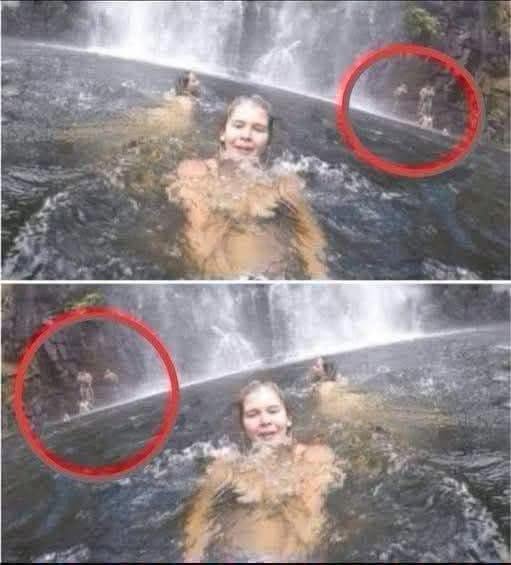
At first glance, this looks like an ordinary vacation photo. A young swimmer smiles while enjoying the refreshing water beneath a beautiful waterfall, creating a scene that feels peaceful, carefree, and completely normal. It’s the kind of snapshot many people would scroll past without giving it a second thought.
Everything changes, however, when someone points out an unusual detail in the background. A red circle highlights what appears to be a human-like figure standing near the rocky edge of the waterfall. Suddenly, the image raises all kinds of questions. Is someone quietly watching from the rocks? Is it another swimmer standing in the distance? Or is it simply an optical illusion created by the combination of shadows, flowing water, and the natural rock formations?
This is exactly the type of photograph that spreads rapidly across social media because it invites viewers to stop, zoom in, and investigate for themselves. Once your attention is drawn to the highlighted area, it’s surprisingly difficult to look away. Some people immediately see a person, while others insist it’s nothing more than an oddly shaped rock.
The explanation may lie in a psychological phenomenon known as pareidolia—our brain’s natural tendency to recognize familiar patterns, especially faces and human figures, in random objects. In this image, the rocky background, contrasting shadows, and rushing water combine to create a shape that resembles a standing person. The red circle further reinforces the illusion by directing our focus to a specific spot, making our brains even more likely to interpret the scene as a hidden figure.
Whether the mysterious shape is an actual person or simply a trick of perspective remains open to interpretation. That’s what makes photos like this so fascinating. They remind us that our eyes don’t always tell the whole story, and sometimes the most ordinary images can become the internet’s biggest mysteries simply by encouraging us to take a closer look.