
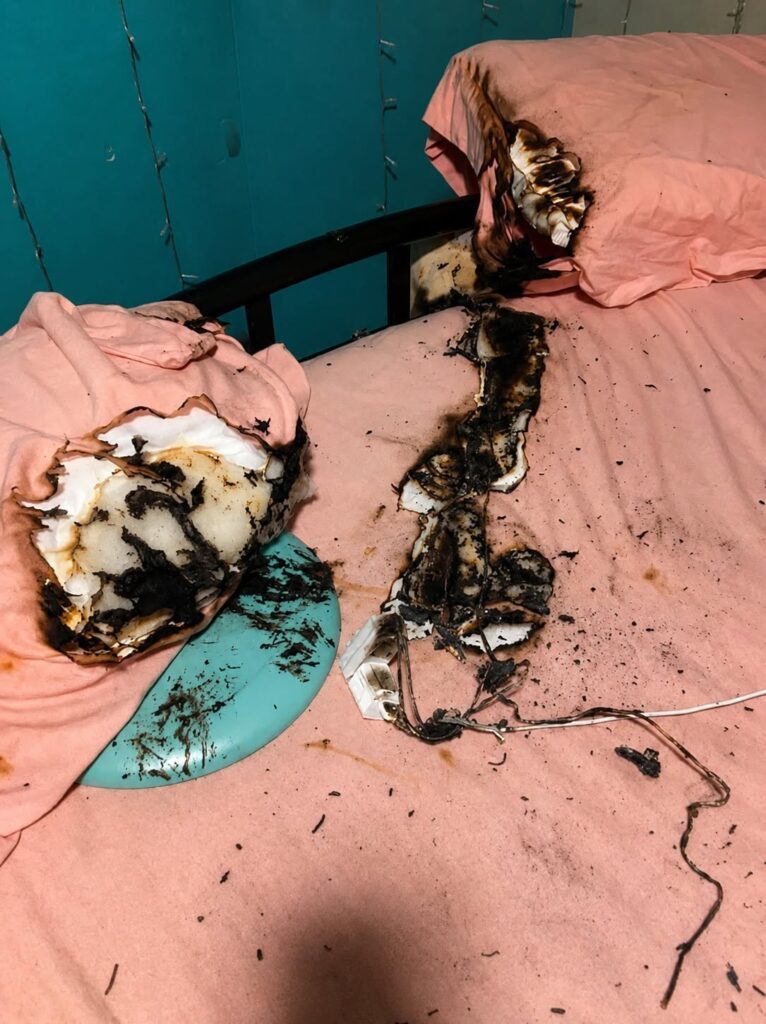
Most of us are on our cellphones constantly throughout the day. We check messages, scroll through news, watch videos, and stay connected to the people and information that matter to us.
And so, it only makes sense that we would plug them in to charge at night while we’re sleeping.
However, do you ever give much thought to where you charge your phone while you sleep?
Many of us are quite attached to our phones, and so we sleep with them beside us, on the nightstand, or even under our pillows. It feels convenient. It feels safe. It feels normal.
But firefighters across the country are issuing an urgent warning: this seemingly innocent habit can be dangerously risky.
The Newton, New Hampshire Fire Department made a Facebook post that perfectly illustrates this point—and their message has since been shared thousands of times for a very important reason.
Let’s explore why charging your phone in bed is more dangerous than you might think, what the science says, and how simple changes can protect your home and your family.
🔥 The Shocking Statistics: Why This Warning Matters
The Newton Fire Department’s post revealed a startling fact:
53% of children and teenagers charge their phones or tablets either on their beds or under their pillows.
Think about that for a moment.
More than half of young people are charging devices in ways that significantly increase fire risk—often without realizing the danger.
Why This Is So Dangerous:
| Factor | What Happens |
|---|---|
| Heat buildup | Chargers and batteries generate heat during charging; soft surfaces trap that heat |
| Poor ventilation | Pillows, blankets, and mattresses block airflow, preventing heat from dissipating |
| Flammable materials | Bedding, pajamas, and stuffed animals can ignite if temperatures rise high enough |
| Unsupervised charging | While you sleep, you can’t respond to warning signs like smoke, heat, or unusual smells |
💡 Key insight: Lithium-ion batteries (used in most phones, tablets, and laptops) are generally safe—but they can overheat, swell, or even catch fire if damaged, defective, or improperly charged.
⚡ How Phone Charging Can Start a Fire: The Science Explained
Understanding the risk starts with understanding how charging works—and what can go wrong.
The Charging Process:
- Electrical current flows from the outlet through the charger into your device
- Battery chemistry reacts to store energy (this generates heat as a byproduct)
- Heat dissipates into the surrounding air under normal conditions
- Device reaches full charge and charging slows or stops
What Goes Wrong on Soft Surfaces:
| Problem | Consequence |
|---|---|
| Trapped heat | Pillows and blankets act as insulation, preventing heat from escaping |
| Temperature rise | Without airflow, charger and battery temperatures can climb dangerously high |
| Thermal runaway | In rare cases, overheating can trigger a chain reaction causing battery failure or fire |
| Ignition risk | Bedding materials can ignite at temperatures as low as 400–500°F (204–260°C)—temperatures that faulty chargers can reach |
🔬 Research note: While phone battery fires are rare, the U.S. Consumer Product Safety Commission reports thousands of incidents annually involving overheating electronics. Most are minor, but some result in property damage or injury.
🚨 Warning Signs of a Dangerous Charger or Battery
Not all charging situations are equally risky—but certain signs should prompt immediate action.
Red Flags to Watch For:
| Sign | What It Means | Action to Take |
|---|---|---|
| Charger feels hot to the touch | Normal warmth is okay; excessive heat is not | Unplug immediately; replace if consistently hot |
| Battery swells or device warps | Sign of internal battery failure | Stop using device immediately; contact manufacturer |
| Charger or cable is frayed, cracked, or damaged | Exposed wires can spark or short-circuit | Replace immediately; never use damaged chargers |
| **Unusual smells **(burning, chemical, plastic) | Indicates overheating or electrical failure | Unplug immediately; ventilate area; inspect for damage |
| Device takes much longer to charge or won’t hold charge | Battery degradation or charger malfunction | Test with different charger; replace if problem persists |
| Charger sparks, smokes, or makes buzzing sounds | Serious electrical fault | Unplug at the wall (not just the device); do not use again |
⚠️ Emergency reminder: If you see smoke, smell burning, or suspect an electrical fire, evacuate immediately and call emergency services. Do not attempt to extinguish an electrical fire with water.
🛏️ Safe Charging Practices: How to Protect Your Home
The good news? Simple, practical changes can dramatically reduce risk.
The Golden Rules of Safe Charging:
✅ Charge on hard, non-flammable surfaces: Nightstands, desks, or countertops allow heat to dissipate safely
✅ Keep devices away from bedding: Maintain at least 12 inches of clearance from pillows, blankets, and curtains
✅ Never charge under pillows or blankets: This traps heat and creates the highest fire risk
✅ Use manufacturer-approved chargers: Third-party or counterfeit chargers may lack proper safety features
✅ Replace damaged chargers immediately: Frayed cables, loose connections, or cracked housings are fire hazards
✅ **Avoid charging while sleeping **(if possible) Charge earlier in the evening so devices are full before bedtime
✅ Don’t cover devices while charging: Cases, clothing, or other coverings can trap heat
For Families with Children and Teens:
✅ Educate early: Explain why charging on beds is dangerous—not just “because I said so”
✅ Create a family charging station: Designate a kitchen counter or hallway table where all devices charge overnight
✅ Model safe behavior: Children learn from what you do, not just what you say
✅ Check devices regularly: Look for signs of damage, overheating, or battery swelling
✅ Set boundaries: Establish house rules about where and when devices can charge
🌙 Practical tip: If you must charge overnight, use a timer plug or smart outlet to stop charging once the battery reaches 80–90%. This reduces heat exposure and extends battery life.
📱 Battery Safety Beyond Phones: Tablets, Laptops, and More
The same principles apply to all lithium-ion powered devices.
Device-Specific Guidance:
| Device | Special Considerations |
|---|---|
| Tablets | Larger batteries generate more heat; avoid charging on soft surfaces |
| Laptops | Keep vents clear; never charge on beds, couches, or laps for extended periods |
| Power banks | Store in cool, dry places; avoid leaving plugged in unattended for days |
| E-readers | Smaller batteries = lower risk, but still follow safe charging practices |
| Smartwatches | Charge on hard surfaces; avoid wrapping charging cables tightly |
🔋 Battery care tip: Lithium-ion batteries last longest when kept between 20–80% charge. Avoid regularly draining to 0% or charging to 100% if possible.
🏠 Additional Home Electrical Safety Tips
Phone charging is just one piece of home electrical safety.
Broader Precautions to Consider:
✅ Install smoke alarms on every level of your home and inside bedrooms; test monthly
✅ Use surge protectors for valuable electronics; replace them every 2–3 years
✅ Avoid overloading outlets with too many devices; use power strips with built-in circuit breakers
✅ Keep flammable materials away from heaters, lamps, and charging stations
✅ Unplug devices you’re not using, especially before leaving home or going to sleep
✅ Have your electrical system inspected by a licensed electrician every 3–5 years, especially in older homes
🚒 Fire department recommendation: Create and practice a home fire escape plan with your family. Know two ways out of every room, and designate a meeting place outside.
❓ Frequently Asked Questions
Q: Is it safe to charge my phone on my nightstand?
A: Yes—if the nightstand is hard, non-flammable, and away from bedding. Ensure the charger has room for airflow and isn’t covered by books, papers, or decorations.
Q: Can I charge my phone under my pillow if I use a “cooling” case?
A: No. Even with cooling accessories, charging under pillows traps heat and creates fire risk. Always charge on hard surfaces.
Q: How hot is “too hot” for a charger?
A: Chargers should feel warm, not hot. If it’s uncomfortable to touch for more than a few seconds, unplug it and replace it.
Q: Are wireless chargers safer than wired ones?
A: Both generate heat. Wireless chargers can actually run hotter because of energy loss during transfer. Follow the same safety rules: hard surfaces, good ventilation, no bedding nearby.
Q: What should I do if my phone battery swells?
A: Stop using the device immediately. Do not charge it. Place it in a non-flammable container (like a metal box) away from flammable materials. Contact the manufacturer or a professional for safe disposal.
Q: Can I charge my phone in bed if I’m awake and watching it?
A: Risk is lower if you’re awake and can respond to warning signs—but it’s still not recommended. Heat buildup can happen quickly, and distractions may delay your response.
Q: Are cheap, third-party chargers really that dangerous?
A: Yes. Counterfeit or uncertified chargers may lack proper safety features like overheat protection, voltage regulation, or fire-resistant materials. Always use chargers certified by recognized testing labs (UL, CE, FCC).
Q: How often should I replace my charger?
A: Replace chargers if they show any signs of damage, overheating, or wear. Even without visible issues, consider replacing them every 2–3 years as internal components degrade.
Q: What if I already charged my phone under my pillow last night?
A: Don’t panic. One incident is unlikely to cause harm—but use it as motivation to change the habit going forward. Check your charger and device for any signs of damage.
Q: Are there chargers designed for safe overnight use?
A: Some chargers feature automatic shutoff, temperature monitoring, or low-heat designs. Look for products with safety certifications and positive reviews—but remember: no charger is completely risk-free on soft surfaces.
💙 A Compassionate Closing Thought
If you’re reading this because you’ve charged your phone in bed—or because you’re worried about your child doing it—please know:
🔋 You’re not alone. Millions of people charge devices in ways that aren’t ideal. Awareness is the first step toward change.
🔋 Small changes make a big difference. Moving your charger from your pillow to your nightstand takes seconds but significantly reduces risk.
🔋 Education empowers. Sharing this information with family, friends, and especially young people can protect more than just your own home.
🔋 Safety isn’t about fear—it’s about care. Taking precautions isn’t paranoia; it’s love in action for the people and places that matter most.
Your phone is a tool for connection, learning, and convenience.
Your home is a sanctuary for rest, safety, and love.
You don’t have to choose between them.
With a few simple adjustments, you can enjoy both—safely, confidently, and peacefully.
So tonight, when you plug in your phone:
Place it on a hard surface.
Give it room to breathe.
Rest easy knowing you’ve taken one more step to protect what matters most.
🧭 The Bottom Line
Charging your phone on or under your bed creates a real, preventable fire risk.
Remember: 🔥 53% of young people charge devices on beds or under pillows—a dangerous habit
⚡ Heat from charging can’t dissipate on soft surfaces, increasing fire risk
🛏️ Always charge on hard, non-flammable surfaces with good airflow
🔋 Replace damaged chargers immediately; use certified, manufacturer-approved products
🚒 Install smoke alarms, create escape plans, and practice electrical safety year-round
💙 Small, consistent habits protect your home and the people you love
You don’t need to give up nighttime charging.
You just need to charge smarter.
Because every safe choice—no matter how small—is a promise:
This home is a sanctuary. And I will do what it takes to keep it that way.
Do you charge your phone on your nightstand or in bed? What safety habits have you adopted to protect your home? Share your tips and experiences respectfully in the comments below.