
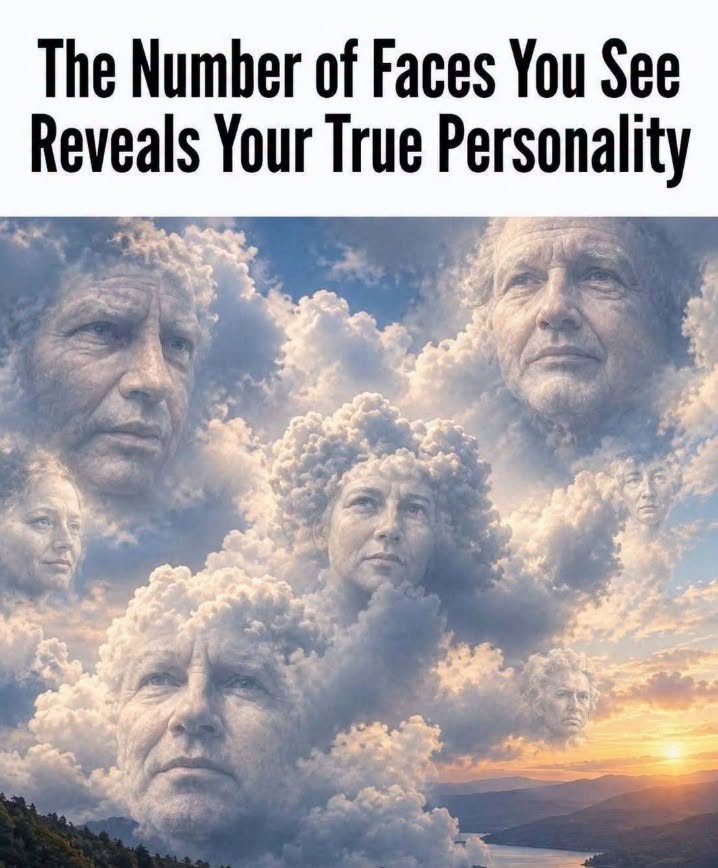
That innocent cloud could hide more faces than you ever expected. What seems like a simple visual game can become a gripping hunt, with every newly discovered outline making you question what you missed before. Count the faces you notice, then explore the playful meaning behind your total, but beware of mistaking an illusion for a genuine personality sec…
Cloudlike shapes can suddenly resolve into eyes, noses, and expressions because the brain searches for familiar patterns in ambiguous information. This tendency, called pareidolia, helps explain why an ordinary patch of shading can feel startlingly human. In this playful interpretation, finding one to six faces is linked to a practical outlook, attention to the broader scene, or flexibility between overall impressions and smaller details. It is an entertaining comparison, not an established measure of how someone thinks.
Spotting seven or more faces is framed as a sign of curiosity, visual attentiveness, and an imaginative approach to overlapping shapes. Yet a higher count does not prove greater creativity, and a lower one does not reveal a personal limitation. These puzzles are not scientifically validated personality assessments. Their real appeal is simpler: they invite us to slow down, look again, and enjoy how differently people can experience the very same scene.