
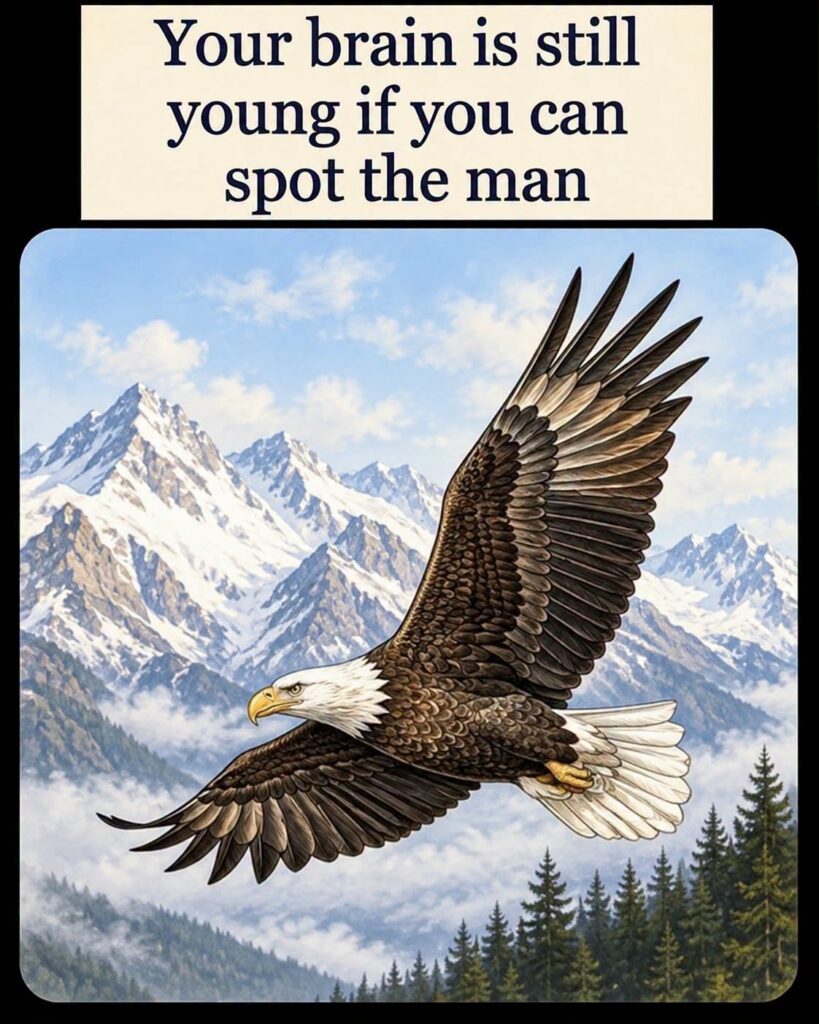
The eagle looks obvious. Too obvious. Its wings slice the sky, the mountains loom behind it, and your brain confidently decides: you’ve seen everything there is to see. But you haven’t. Somewhere in those ridges, shadows, and jagged lines, a man is hiding in plain sight. You stare harder… and somehow see less. The moment you finally spot hi…
What makes this image so unsettling is not just the hidden man, but the quiet way it exposes how easily our perception can be steered. Your brain rushes to label the eagle as the “important” object, locking the mountains into the role of background. In that instant, the man—carefully stitched into those rocky lines—becomes almost invisible, not because he isn’t there, but because your mind has already decided what the scene is supposed to be.
When you step back, soften your focus, and begin to search for fragments instead of a whole person—a curve that could be a shoulder, a shadow that might be a jawline—the illusion starts to loosen. The landscape suddenly rearranges itself, and the man’s outline emerges where there was “nothing” before. The picture never changes, yet it feels completely different, revealing how much of seeing is not about your eyes, but about what your mind is finally willing to notice.