
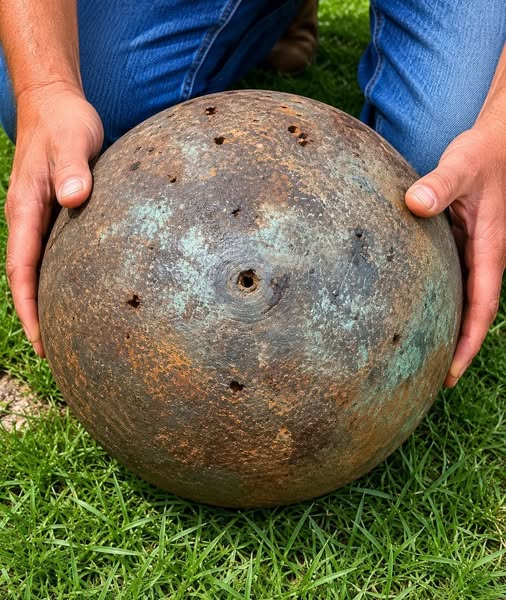
What began as an ordinary visit to a local creek quickly turned into an intriguing encounter with the past. Resting among the rocks and flowing water was a massive steel sphere, weathered by time but still impressive in both size and construction. At first glance, it appeared mysterious, prompting curiosity about its origin and purpose.
As researchers and local historians examined the object more closely, they identified it as a likely component from an industrial ball mill—a machine that played an important role in mining, manufacturing, and material processing throughout much of the industrial era.
The discovery offered more than just an interesting artifact. It provided a tangible connection to the engineering innovations that helped fuel economic development and large-scale industrial production.
A Relic From an Era of Industrial Growth
During periods of rapid industrial expansion, factories and processing facilities relied on durable machinery capable of handling enormous workloads. One of the most important pieces of equipment used in mining and material refinement was the ball mill.
These large rotating machines were designed to break down raw materials into smaller particles. By continuously tumbling heavy steel balls inside a rotating chamber, they could crush and grind substances such as ore, minerals, and other industrial materials into fine powders.
The steel sphere discovered in the creek appears to be one of these grinding components.
Although separated from its original setting, it remains a powerful reminder of the machinery that supported industries around the world.
How Ball Mills Worked
Ball mills were engineered to perform a relatively simple but highly effective task.
Inside a large rotating drum, dozens or even hundreds of steel balls moved continuously as the machine turned. Raw material was fed into the chamber, where the repeated impact of the balls gradually reduced it into smaller pieces.
This process was essential for many industries because finely ground materials were often easier to transport, process, or incorporate into manufacturing operations.
Industries that relied on this technology included:
- Mining
- Cement production
- Metal processing
- Construction materials
- Chemical manufacturing
- Industrial ceramics
Without efficient grinding systems, many large-scale industrial operations would have been far more difficult and expensive.
Built for Strength and Durability
One of the most impressive aspects of these steel spheres is their durability.
Manufactured to withstand constant collisions and heavy mechanical stress, they were designed to operate under demanding conditions for extended periods.
The production of such components required careful engineering and high-quality materials. Steel balls used in industrial mills needed to resist wear while maintaining their structural integrity despite repeated impacts.
Even after years—or sometimes decades—of use, many retained much of their original strength.
This durability helps explain why some examples continue to survive long after the facilities that used them have disappeared.
More Than Just Industrial Equipment
While the primary purpose of these spheres was practical, they also symbolize a broader chapter in technological history.
The Industrial Revolution and subsequent periods of manufacturing growth transformed economies around the world. Advances in machinery allowed industries to increase production, improve efficiency, and support expanding populations.
Simple but effective engineering solutions often played a significant role in this progress.
The steel grinding ball is one example.
Although it may appear unremarkable at first glance, it represents the countless innovations that helped industries process raw materials on a scale previously impossible.
In many ways, objects like this tell the story of how engineering helped shape the modern world.
Why Discoveries Like This Matter
Finding industrial artifacts in unexpected locations often raises interesting questions.
How did the object end up there?
Which facility did it originally belong to?
How long has it remained hidden?
Although answers are not always available, such discoveries encourage exploration of local history and industrial heritage.
Artifacts can provide valuable clues about:
- Former industrial sites
- Historical transportation routes
- Regional economic development
- Manufacturing techniques
- Engineering practices of earlier eras
Even a single object can spark conversations about a community’s past and the industries that once operated nearby.
The Role of Mining and Material Processing
Ball mills became particularly important in mining operations.
Before valuable minerals could be refined or separated, raw ore often needed to be crushed and processed into smaller particles.
Grinding equipment helped prepare these materials for additional stages of production.
This process contributed to the extraction of resources used in:
- Construction
- Transportation
- Energy production
- Manufacturing
- Infrastructure development
As cities expanded and industries grew, demand for processed materials increased dramatically.
Machines such as ball mills helped meet that demand efficiently.
Engineering That Stood the Test of Time
Modern technology has introduced new methods and more advanced machinery, but many of the principles used in historical industrial equipment remain relevant today.
The concept behind ball milling continues to be used in numerous industries.
While contemporary machines may incorporate improved materials, automation, and precision controls, the basic idea remains remarkably similar.
This continuity highlights the effectiveness of the original design.
Engineering solutions that endure across generations often do so because they solve problems in practical and reliable ways.
The steel sphere discovered in the creek serves as evidence of that lasting functionality.
A Reminder of Human Innovation
Industrial artifacts often reveal the creativity and problem-solving abilities of earlier generations.
Engineers and manufacturers faced challenges that required durable, efficient, and scalable solutions.
Their innovations helped transform raw natural resources into products that supported everyday life.
Roads.
Buildings.
Bridges.
Factories.
Transportation systems.
Many of these developments relied on materials processed through equipment like ball mills.
The steel sphere therefore represents more than a piece of machinery. It represents the ingenuity that helped support industrial progress and economic development.
Preserving Industrial Heritage
While castles, monuments, and historic homes often receive significant attention, industrial artifacts are equally important parts of history.
They document how societies produced goods, developed infrastructure, and expanded technological capabilities.
Preserving and studying these objects allows historians, engineers, and researchers to better understand the evolution of manufacturing and industrial processes.
Each artifact contributes another piece to the larger story of technological advancement.
Even when found in unexpected places, these objects can offer valuable educational opportunities.
Looking Back Through a Single Object
The discovery of a massive steel sphere in a quiet creek demonstrates how ordinary locations can sometimes reveal extraordinary connections to the past.
What initially appeared to be an unusual metal object turned out to be a link to an important period of industrial history.
Its size, durability, and purpose reflect the engineering achievements that helped fuel economic growth and manufacturing development for generations.
While the machinery that once used it may no longer exist, the sphere itself remains as a lasting reminder of human innovation and industrial craftsmanship.
By examining artifacts like this, we gain a deeper appreciation for the technologies that shaped modern society and the individuals whose ideas helped transform industry, infrastructure, and everyday life.
Sometimes a single object is enough to tell an entire chapter of history—and this steel sphere is a remarkable example of exactly that.