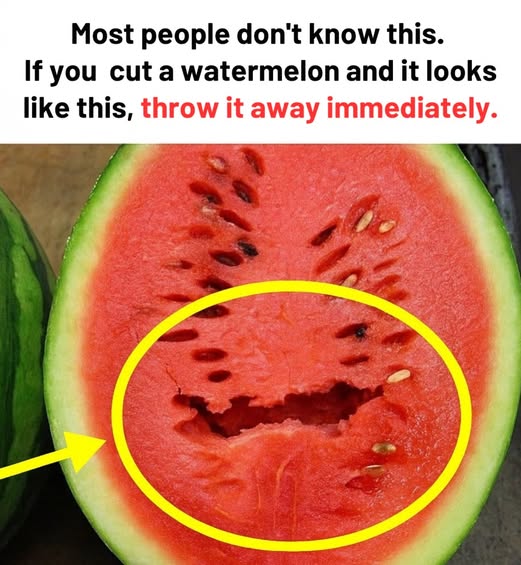
On a blazing summer day, nothing hits the spot like a cold, juicy slice of watermelon. But what if, after slicing through that perfect green rind, you’re met with a disturbing surprise—deep cracks, hollow cavities, or gaping splits running through the red flesh?
It’s not just unappetizing—it could be a serious warning sign.
What Is “Hollow Heart” in Watermelon?
That strange-looking interior is known as “hollow heart,” a condition that causes internal cracks and air pockets to form within the fruit. Despite its unsettling appearance, it’s not mold or rot—yet. But experts warn: it’s a red flag you shouldn’t ignore.
What Causes It?
Hollow heart isn’t caused by disease, but by stress during the melon’s growth. Factors include:
- 🌡️ Sudden temperature changes – heatwaves or cold snaps during ripening
- 💧 Inconsistent watering – droughts followed by heavy rain or irrigation
- 🌱 Too much nitrogen – rapid external growth that the interior can’t keep up with
- 🧬 Certain hybrid varieties – more prone to this flaw due to selective breeding
As the melon matures unevenly, the inner flesh can tear apart, leaving behind deep fissures—often invisible until you slice it open.
Is It Still Safe to Eat?
Technically, a watermelon with hollow heart might not be harmful. But the risks make it a gamble—especially during warm weather.
🚨 Here’s Why Experts Advise Caution:
- Hidden Bacteria: Cracks create moist pockets perfect for bacteria like Salmonella, Listeria, or E. coli—especially if the fruit was exposed during harvesting or shipping.
- Hard to Spot Spoilage: Internal contamination may not smell bad or show mold. You could eat harmful bacteria without realizing it.
- Weakened Defense: A stressed melon has reduced natural barriers, increasing the chances of contamination even when the rind looks fine.
USDA’s Rule of Thumb: When in Doubt, Throw It Out
If your watermelon looks odd inside—deep splits, sponge-like gaps, or strange textures—don’t risk it. Food safety experts agree: it’s better to toss it than take a chance, particularly for children, seniors, pregnant women, or anyone with a weakened immune system.
How to Pick a Safe, Sweet Watermelon
While you can’t detect every flaw before cutting, these tips help you choose a healthier, higher-quality melon:
✅ Look for a creamy yellow spot – a sign it ripened in the field
✅ Check for symmetry – avoid misshapen or lumpy melons
✅ Inspect the rind – firm, smooth, and blemish-free is best
✅ Tap it – a deep, hollow sound can signal ripeness
✅ Once cut, examine the flesh – it should be vibrant, firm, and free of cracks
Final Word: Trust What You See
Hollow heart might look like a minor imperfection, but it can indicate deeper vulnerabilities. And in hot summer months—when bacteria thrive—it’s simply not worth the risk.
So if you slice open your melon and see:
🚫 Deep fissures
🚫 Hollow or gaping holes
🚫 Separated, stringy, or mushy flesh
Put down the fork. Don’t taste it. Just toss it.
Your health is worth more than a questionable bite of fruit.