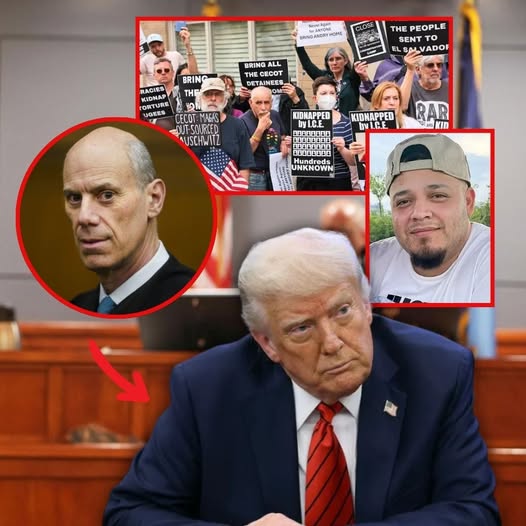
BALTIMORE — In a dramatic turn in federal court Tuesday, a judge signaled that the Trump administration could face contempt proceedings after failing to comply with an order to return a deported Venezuelan migrant to U.S. soil.
U.S. District Judge Stephanie Gallagher expressed frustration over the government’s inaction in the case of “Cristian,” a 20-year-old migrant who was removed from the U.S. and sent to El Salvador in March—ultimately landing in the country’s notorious CECOT maximum-security prison. His deportation occurred amid a wave of removals tied to the Trump administration’s use of the Alien Enemies Act.
During Tuesday’s hearing, Gallagher acknowledged that Cristian’s attorneys may now have legal grounds to pursue sanctions or even a contempt motion against the administration.
“I don’t disagree that you have proffered a basis under which you could potentially seek some sort of sanctions or contempt,” Gallagher said, while clarifying that she was not yet weighing in on whether such an effort would succeed.
The hearing capped days of escalating tension as court filings and government responses failed to fully clarify Cristian’s whereabouts or status. Gallagher’s remarks now raise the stakes in a case that has drawn scrutiny over the administration’s aggressive deportation tactics.
Related: Federal Judge Extends Arguments in Abrego Garcia Case, Slams ICE Witness Who ‘Knew Nothing’

BALTIMORE — A federal judge in Baltimore warned Tuesday that the Trump administration could face contempt proceedings after it failed to comply with a court order requiring the return of a deported Venezuelan migrant to U.S. soil — a deportation that now appears to have been part of a secretive prisoner swap.
U.S. District Judge Stephanie Gallagher, who was appointed by Donald Trump, made the statement during a tense hearing focused on “Cristian,” a 20-year-old Venezuelan asylum seeker identified in court filings as Daniel Lozano-Camargo. Cristian was deported to El Salvador in March under the Alien Enemies Act — a wartime law rarely used in modern U.S. history — and later transferred to El Salvador’s notorious CECOT supermax prison.
But just days before Tuesday’s hearing, the U.S. government confirmed Cristian had been quietly deported again — this time from CECOT to Venezuela, the very country from which he sought asylum.
That deportation directly defied Gallagher’s earlier ruling. In April, she had determined Cristian’s removal violated a 2024 Department of Homeland Security settlement, which barred the deportation of certain young asylum seekers until their claims were fully processed in court. Gallagher ordered the Trump administration to facilitate Cristian’s return. Instead, he was swept into a diplomatic deal.
According to the Justice Department, Cristian was among 252 Venezuelan nationals deported from CECOT to Venezuela last Friday as part of a prisoner exchange to secure the release of 10 Americans detained in that country. U.S. Secretary of State Marco Rubio confirmed the swap that same night on social media.
Cristian’s lawyers said they were given no advance notice of the move — learning of it only after their client was already on Venezuelan soil. Attorney Kevin DeJong lambasted the Trump administration for what he described as “a blatant disregard” for the court’s authority and called the deportation “an egregious violation” of Gallagher’s order.
“I do not say this lightly, and it’s a weighty issue to consider,” DeJong told the court. “But given the history of violations here, criminal contempt should be on the table.”
Judge Gallagher didn’t dismiss the suggestion.
“You have proffered a basis under which you could potentially seek some sort of sanctions or contempt,” she said, while emphasizing she was not yet ruling on the matter. “We’re in a different position now.”
Indeed, the facts on the ground have shifted significantly. Cristian’s deportation to Venezuela—his home country and the subject of his asylum claim—raises legal and humanitarian questions, especially given reports that the deportation may have been orchestrated weeks in advance.
Gallagher noted the court still does not know whether the Trump administration even attempted to comply with the order by requesting Cristian’s return from El Salvador. “We do not know if that happened or not,” she told DOJ attorney Ruth Ann Mueller, rejecting arguments that the case is now moot. “No, that doesn’t comply with my order. That doesn’t answer the question.”
The judge ordered the Trump administration to begin filing weekly status reports on Cristian’s situation in Venezuela, beginning Friday. She also said the court may authorize discovery to determine whether administration officials acted in deliberate defiance of her ruling.
Despite shifting procedural ground, Gallagher made it clear the court is not “abandoning ship” in its efforts to bring Cristian back to the U.S.
In a particularly striking exchange, Justice Department lawyers argued the court lacked authority to further investigate Cristian’s situation abroad. Gallagher cut them off, stating flatly that motions for sanctions and contempt would, in fact, permit the court to examine the administration’s broader conduct.
Cristian’s legal team has 10 days to file sanctions-related motions, which could include a push for criminal contempt charges — a rare and serious rebuke aimed squarely at a former presidential administration.

The case of Cristian closely mirrors that of Kilmar Abrego Garcia, another migrant wrongfully deported to El Salvador in March. In both cases, federal judges ordered the Trump administration to return the migrants to U.S. soil and to provide regular status updates to ensure compliance. But while Abrego Garcia was ultimately brought back, Cristian was not.
Instead, Tuesday’s hearing and a flurry of new court filings revealed a far more troubling picture — one in which Cristian may have been intentionally excluded from repatriation efforts, despite a standing court order.
“Cristian was a pawn in this plan,” said his attorney, Kevin DeJong, accusing the Trump administration of taking “active, purposeful steps to deport him” in direct defiance of Judge Gallagher’s ruling. “They could have included him on the flight back to the U.S. with Abrego Garcia,” DeJong argued. “The only reasonable inference we see is that the government attorneys willfully disregarded this court.”
Judge Gallagher appeared to share some of that concern.
Back in May, she denied a request by the Trump administration to lift the order requiring Cristian’s return, firmly stating that her ruling wasn’t about the merits of his asylum claim. She acknowledged that Cristian had two minor drug offenses and a conviction earlier this year, but emphasized that the issue at hand was not guilt or innocence — it was due process.
“He is entitled to be here and have his hearing,” Gallagher said at the time, referencing the 2024 DHS settlement that barred deportations for certain asylum seekers until their cases were fully heard. “This is not a decision about whether Lozano-Camargo will be granted asylum. It’s about the process he is legally guaranteed.”