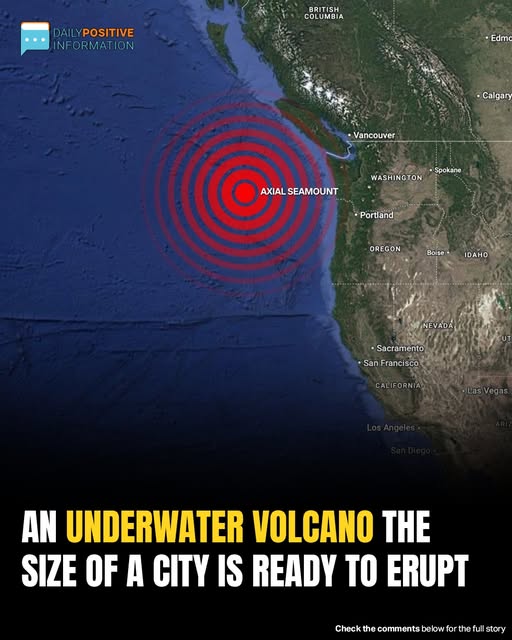
Geologists are closely monitoring a massive undersea volcano off the coast of Oregon that’s showing signs of an imminent eruption.
Nearly a mile (1.4 km) beneath the ocean’s surface, Axial Seamount is awakening. This volatile giant sits on a unique geological crossroads—both a hotspot where molten rock surges from Earth’s mantle, and part of the Juan de Fuca Ridge, a seafloor rift where two tectonic plates, the Pacific and Juan de Fuca, are steadily pulling apart. The result: a pressure cooker of magma building beneath the seabed.
Scientists at the National Science Foundation’s Ocean Observatories Initiative Regional Cabled Array, operated by the University of Washington, have recorded a sharp uptick in seismic activity. Hundreds of small earthquakes are now shaking the volcano each day—an ominous sign that magma is rising and the seamount is inflating.
“Right now, we’re seeing a few hundred quakes per day,” said William Wilcock, a marine geophysicist at the University of Washington. “That’s still less than what we observed before the last eruption, but it’s a clear warning sign.”
Wilcock believes the volcano is on track to erupt later this year or in early 2026—but cautions that nature doesn’t follow a script.
“It could be tomorrow,” he said. “This system is completely unpredictable.”
What Happens When the Deep Sea Erupts? Axial Seamount’s Fiery Secrets Revealed
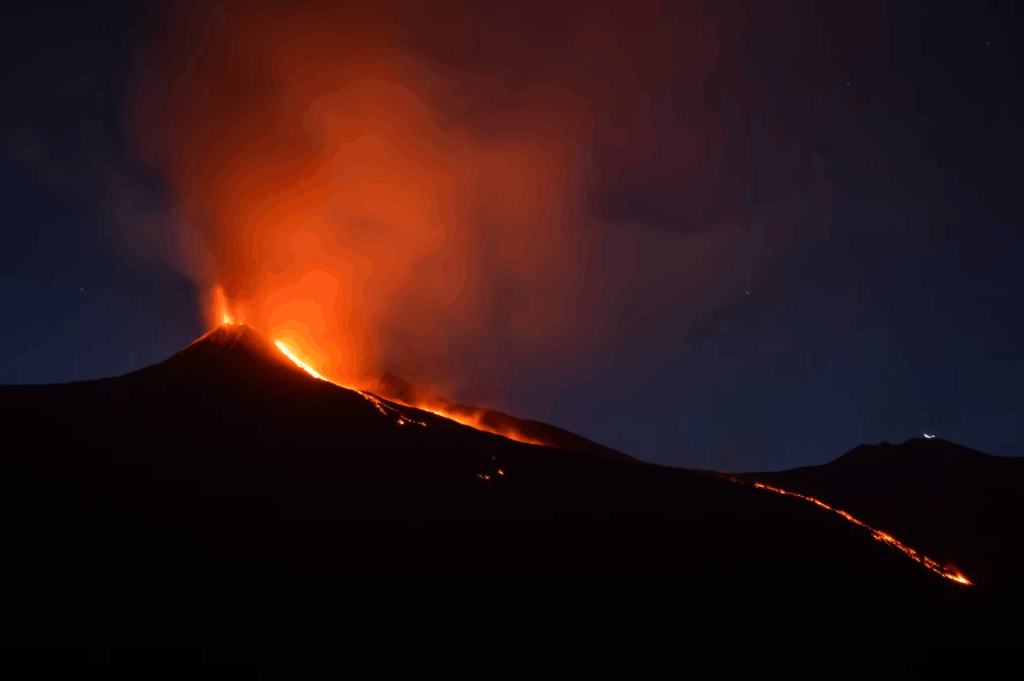
If the underwater volcano Axial Seamount erupts again—as scientists believe it soon will—expect a dramatic show hidden beneath nearly a mile of Pacific Ocean.
During its last eruption in April 2015, more than 10,000 micro-earthquakes rocked the seafloor in a single 24-hour period. Magma surged from deep within the Earth, spilling across 25 miles (40 km) of seabed for over a month, creating new volcanic terrain in silence and darkness.
Despite its remoteness, Axial Seamount is closely watched. Researchers from the University of Washington’s Regional Cabled Array have placed cameras, sensors, and fiber optic cables along the seafloor, capturing real-time data from this dynamic environment.
“It’s not a violent explosion like you’d see on land,” said Debbie Kelley, director of the array. “It’s more like putting a mile of ocean on top of Hawaii’s Kilauea volcano—you’d get some fountaining, but no dramatic ash plumes.”
Life in the Fire Zone
What lies in Axial’s caldera—its massive collapsed crater—is anything but dead. In fact, it’s teeming with strange life that thrives in its extreme heat and pressure.
Hydrothermal vents, like underwater geysers, shoot out mineral-rich fluids loaded with bacteria and microbes. These vents form ghostly white plumes called “snowblowers,” which spew clusters of debris and living organisms into the water.
During past eruptions, lava flows incinerated the small ecosystems living near these vents. But astonishingly, life rebounded.
“Within three months, the hydrothermal communities were flourishing again,” Kelley said. “It’s one of the most incredible discoveries we’ve made—life thriving where you’d expect nothing.”
Kelley believes underwater volcanoes like Axial may even hold clues to the origins of life on Earth’s early oceans.
Marine Creatures Feel the Tremors—But Stay Safe
Despite the earthquakes and lava, marine life nearby—including whales, octopuses, and deep-sea fish—seem mostly unaffected by the eruptions.
“They may sense the tremors and heat, but we don’t expect any real harm,” Kelley told CNN. “And people on land? You probably won’t notice a thing.”
A Volcano That You Can Watch From Home
Thanks to its relatively gentle nature and proximity to scientific monitoring equipment, Axial Seamount may soon be the first underwater volcano to erupt live on camera.
“The observatory plans to livestream the eruption when it happens,” Kelley confirmed. “It’s never been done before.”
That level of observation is rare. The first time scientists ever saw an underwater eruption up close happened by accident—during a routine dive on the East Pacific Rise in 2006, when researchers stumbled across an active lava flow and what they dubbed a “tubeworm barbecue.”
“We’re witnessing the way the planet builds itself,” said Dan Fornari of Woods Hole Oceanographic Institution. “It’s hard to reach and harder to study—but absolutely essential.”
Moon Tides and Volcanic Timing
In an intriguing twist, scientists have noticed that Axial Seamount’s past three eruptions—in 1998, 2011, and 2015—all occurred between January and April, when Earth moves farthest from the sun.
“It’s likely no coincidence,” said marine geophysicist William Wilcock. “We suspect lunar gravity might play a role.”
As the moon’s pull shifts ocean tides, it alters pressure on the seafloor. When the magma chamber swells to its limit, these subtle tidal forces may be enough to tip the scales and trigger an eruption.
“It’s like watching a pressure cooker that we can’t predict exactly,” Kelley added. “But we know it’s close.”