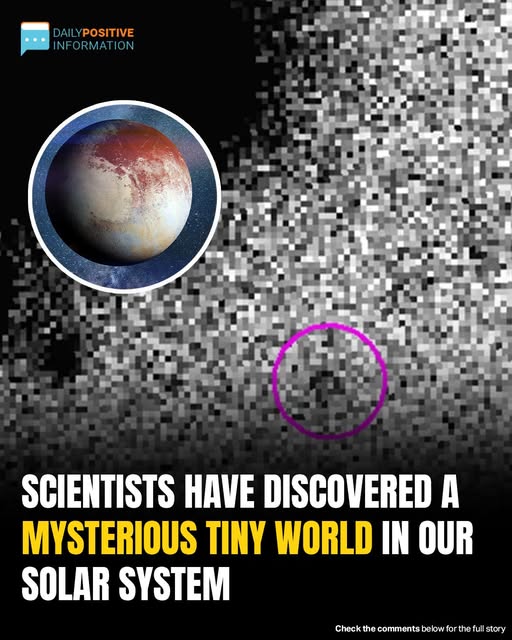
Scientists have unveiled a captivating new discovery: a mysterious small world nicknamed ‘Ammonite’, spotted by the Subaru Telescope at Hawaii’s Mauna Kea Observatory. Measuring about 380 kilometers across, this enigmatic object is being hailed as a cosmic “fossil” — preserving secrets from the earliest days of our solar system.
Ammonite joins an exclusive group known as the sednoids — small celestial bodies with unusual, distant orbits far beyond Neptune’s reach. It becomes only the fourth member of this rare family, which first gained attention in 2003 with the discovery of Sedna, a dwarf planet roughly eight billion miles from Earth and the farthest known object in our solar system at that time.
Research from 2021 suggests Sedna formed during the solar system’s infancy, its orbit reshaped by dynamic gravitational forces within a densely packed star cluster where our sun was born. Now, with Ammonite’s discovery, scientists are gaining fresh clues about the mysterious early environment that shaped our cosmic neighborhood.
Other theories suggest Sedna might have originated from a low-mass star, or that its orbit was dramatically altered by a close stellar encounter — like when Scholz’s star passed near our solar system about 70,000 years ago, at a distance of roughly 52,000 astronomical units from the Sun.
Regardless of its origins, the discovery of Ammonite is providing space scientists with both answers and fresh mysteries to explore.
“In recent years, spacecraft have visited various small bodies in our Solar System for close-up study and sample collection. However, these missions have only explored a small fraction of the vast cosmic neighborhood,” explained Dr. Fumi Yoshida of the University of Occupational and Environmental Health and the Chiba Institute of Technology, who leads the Formation of the Outer Solar System: An Icy Legacy (FOSSIL) project.
“Most of the Solar System remains uncharted territory. Thanks to the wide-field power of the Subaru Telescope, we are steadily pushing the boundaries of what we know,” Dr. Yoshida added.
Between March and August 2023, the Subaru Telescope detected a possible distant object lurking on the solar system’s fringes. Follow-up observations in July last year confirmed the object’s existence and helped pin down its orbit and estimated size — between 220 and 380 kilometers wide.
Digging into archival data, astronomers discovered that this object had been glimpsed before, at the Kitt Peak National Observatory in 2005 — over 20 years ago — and again in 2014 and 2021. These long-term observations, spanning 19 years, have greatly improved scientists’ understanding of Ammonite’s path through space.
What makes Ammonite especially intriguing is that it follows an orbit unlike any of the other sednoids, suggesting that the outer solar system is far more complex and diverse than previously thought. This unexpected orbit also challenges popular theories, including the existence of the hypothetical “Planet Nine.”
Dr. Yukun Huang of the Center for Computational Astrophysics at NAOJ, who modeled Ammonite’s orbit, noted, “Ammonite’s orbit doesn’t line up with the other three sednoids, which reduces the likelihood that Planet Nine is still out there. It’s possible that a massive planet once influenced these objects but was later ejected, leaving behind the strange orbits we observe today.”
Dr. Yoshida added, “Ammonite resides so far from Neptune’s reach that the planet’s gravity has little effect on it. The presence of objects with elongated orbits and large perihelion distances in this region points to extraordinary events in the ancient solar system when Ammonite was formed.”
“Studying the orbital evolution and physical properties of these distant, unique objects is vital to unlocking the full story of our solar system’s formation and evolution.”
“At present, the Subaru Telescope is one of the few instruments on Earth capable of making such groundbreaking discoveries. I look forward to many more findings from the FOSSIL team that will help us paint a complete picture of our cosmic origins.”