
For more than a decade, the name Jeffrey Epstein has existed less as a subject of objective inquiry and legal reckoning than as a political instrument.
A tool wielded to achieve influence, shape narratives, and score partisan points. Across multiple election cycles, leading Democratic figures.
Political commentators, and aligned media outlets frequently invoked Epstein’s associations as a means to discredit Donald Trump, framing the billionaire financier and convicted sex offender as a mirror to alleged moral failings in his personal and professional life.
The rhetoric often suggested that anyone remotely connected to Epstein represented a threat to public integrity.
Political operatives, operating on the assumption that selective exposure could shift voter perceptions, turned Epstein into a symbol, a shorthand for corruption, privilege, and misconduct.
Yet this framing, while politically effective in certain contexts, was inherently selective. For years, the public conversation focused almost exclusively on Trump’s interactions with Epstein, while broader networks of influence—comprising wealthy donors, media executives, celebrities, and political figures across party lines—were largely sidelined.
Epstein’s web was vast, intersecting finance, philanthropy, academia, and politics, spanning both the left and the right.
This asymmetry in scrutiny served political objectives, but it also planted the seeds of future complications: by treating a complex, morally fraught network as a weapon instead of a societal concern, leaders effectively limited their own capacity for principled investigation.
In recent months, however, the narrative has begun to shift. As a wave of new documents, correspondence, and financial records has entered the public domain, attention has expanded.
Epstein’s activities, once examined primarily through the lens of partisan advantage, are now prompting broader questions about the scope of his influence, the nature of access granted to him by elite individuals, and the ethical compromises made by those who interacted with him.
The emerging scrutiny highlights a crucial point: scandals, once instrumentalized for political gain, do not remain neatly confined.
They have a tendency to push outward, illuminating connections that cross conventional boundaries and raising uncomfortable questions for all who may have been involved.
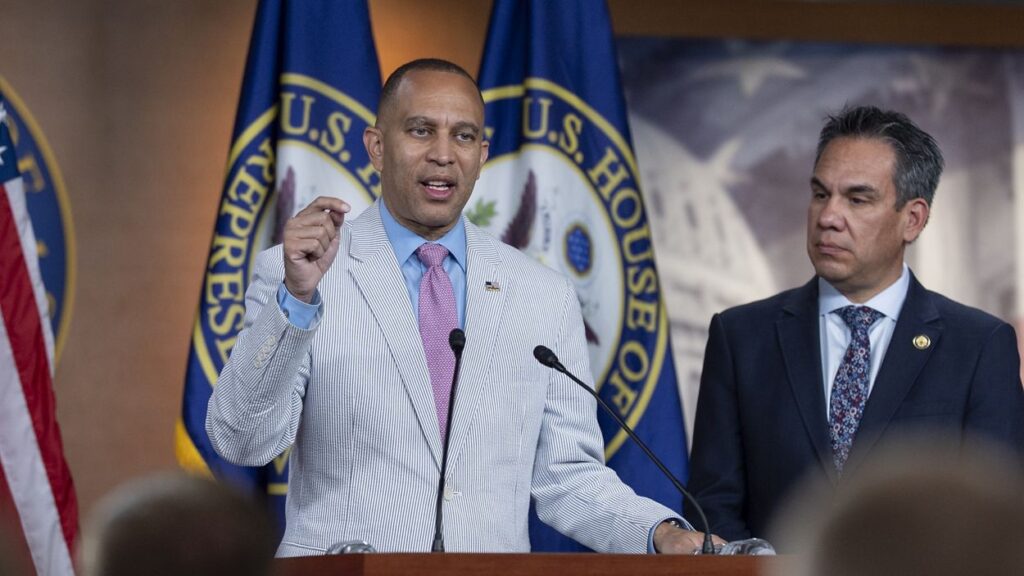
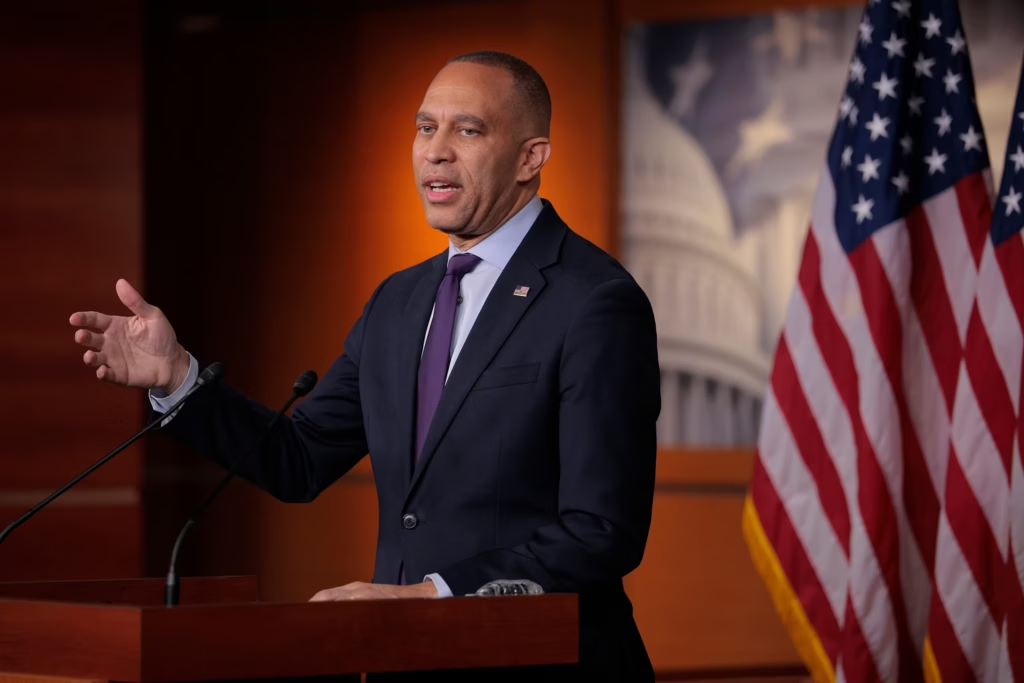
At the center of this renewed attention is Hakeem Jeffries, the House Democratic Leader widely regarded as a potential future Speaker.
Allegations circulating in investigative reporting suggest that channels of communication and potential influence with Epstein may have persisted well beyond the financier’s initial legal troubles.
While these reports do not establish criminal conduct, they underscore a tension in political accountability. For years, Democratic leaders presented a standard of moral clarity, arguing that any association with Epstein, regardless of timing or context, reflected a failure in judgment.
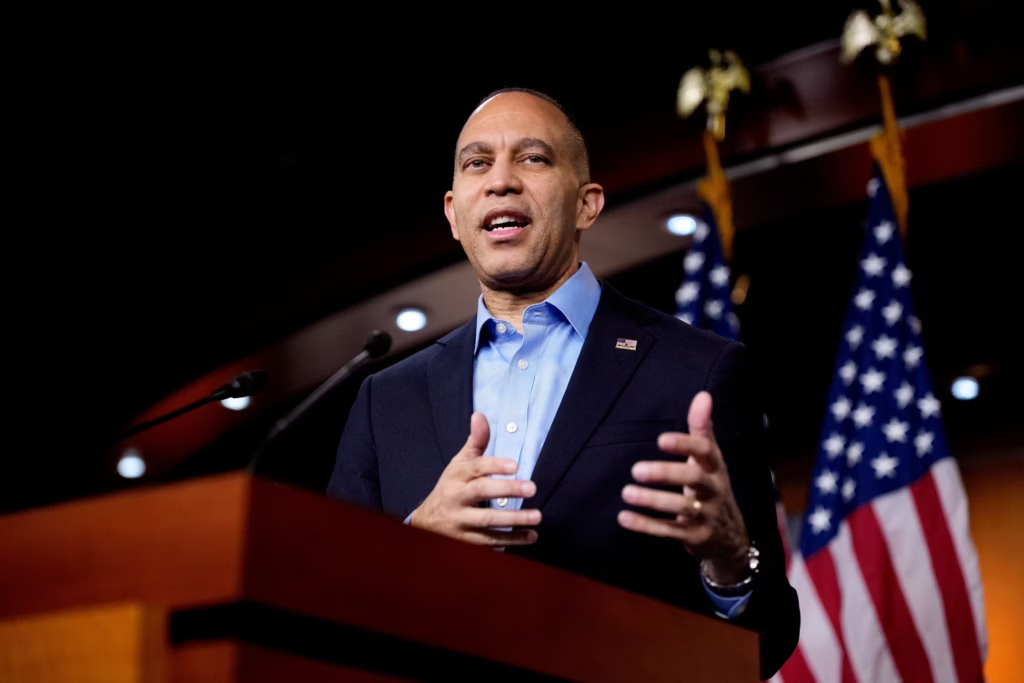
That standard, once asserted with confidence and rhetorical force, is now facing an acid test: can it be applied impartially, even when scrutiny touches allies rather than opponents?
It is important to emphasize that as of this writing, no criminal findings have been announced against Jeffries, and he has publicly denied any wrongdoing. Yet in the realm of political credibility, legality is only one measure.
Public perception is informed as much by consistency, transparency, and the perceived integrity of messaging as it is by convictions or indictments.
When a figure or institution selectively enforces a standard—pressing it against political opponents while shielding allies—it invites skepticism and undermines the very moral authority that rhetoric seeks to establish.
This dynamic is not unique to any one party. Across the political spectrum, observers have noted a tendency for moral issues to become instruments of strategic advantage, applied when convenient and ignored when inconvenient.
Yet Epstein’s case is particularly corrosive precisely because it intertwines wealth, power, social networks, and allegations of sexual exploitation. The stakes are higher than typical partisan squabbles: the scandal touches on fundamental questions of ethics, governance, and societal trust.
A response framed as principled, therefore, cannot afford the luxury of selective scrutiny without risking systemic credibility.
The implications extend beyond the individual figure of Jeffries. As additional records surface—financial ledgers, private communications, and undisclosed travel logs—it becomes increasingly difficult to separate partisan narratives from institutional realities.
The political calculus that once treated Epstein as a cudgel against Trump now faces the challenge of reconciling prior statements and actions with emerging evidence.
Calls for “full disclosure” that once seemed rhetorically potent now risk exposing inconsistencies within the very leadership that championed them. In other words, the tool may have turned back on the wielder.
Historical context deepens the complexity. During the years immediately following Epstein’s 2008 conviction, media and political figures debated the ethical implications of his connections with high-profile individuals.
Epstein’s capacity to cultivate influence rested on a combination of financial leverage, charisma, and access to elite circles. His associations spanned cultural, political, and philanthropic spheres, often placing individuals in morally ambiguous situations.
For those attempting to navigate these environments, the challenge was not simply legal compliance but ethical discernment—a terrain notoriously difficult to chart when social capital and ambition intersect.
Political leaders who framed Epstein primarily as a partisan instrument now face a dual challenge: first, to reconcile their previous messaging with a broader set of facts; second, to maintain institutional credibility in a landscape increasingly defined by transparency expectations.
Public skepticism of political institutions is already high, and selective enforcement of ethical standards exacerbates that mistrust.
When scrutiny moves inward—toward figures within one’s own party—the optics matter as much as the substance. Even absent wrongdoing, the appearance of inconsistency can erode confidence in leadership.
This is not merely a hypothetical concern. Epstein’s notoriety has ensured that every connection, every interaction, and every unexplained absence of accountability is subject to intense examination.
For Democratic leadership, the calculus is now markedly different than it was when Epstein was primarily used as a rhetorical weapon. The discourse has shifted from adversarial critique to systemic evaluation.
How broadly did influence spread? Which leaders maintained contact with Epstein despite public warnings or prior convictions? How consistently were ethical standards applied across the political spectrum?
These are questions that cannot be answered through selective disclosure alone—they demand a thorough and impartial assessment.
What is emerging, therefore, is a moment of institutional reckoning. The scandal is no longer a convenient cudgel to score points against opponents; it is a test of whether moral postures can withstand scrutiny when applied evenly. The challenge is structural, not merely personal.
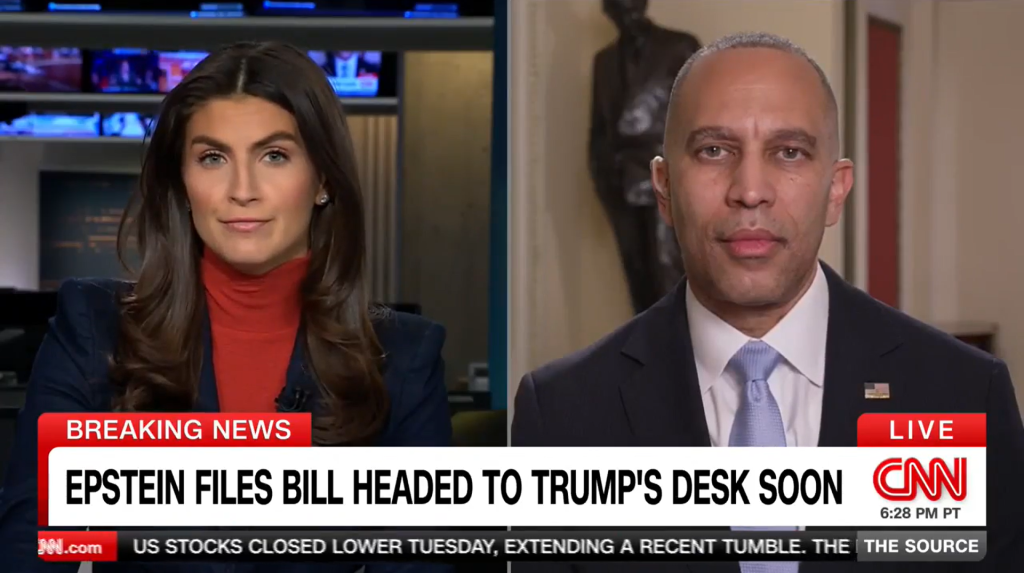
Leaders must confront the possibility that prior strategies, reliant on selective exposure, may have undermined their capacity for impartial oversight.
The risk is clear: if credibility is contingent on partisan advantage rather than principle, every new revelation carries disproportionate consequences.
As the Epstein case continues to unfold, the focus has shifted from individual culpability to institutional accountability. What was once framed as a series of discrete interactions—an opportunistic critique of a single political figure—now reads as an examination of systemic vulnerability.
The emerging question is no longer merely, “Who knew what and when?” but rather, “How effectively do political institutions enforce ethical standards across all members, regardless of party affiliation?”
This distinction is critical. When scandals are treated as partisan weapons, they obscure patterns of influence and conceal broader ethical considerations.
The Epstein case demonstrates how selective enforcement can erode trust: when a political party emphasizes one individual’s association with Epstein while downplaying or ignoring another’s, the message of moral clarity becomes unstable.
Constituents quickly perceive the discrepancy, undermining the authority of leadership and creating an environment where skepticism of intent often outweighs attention to facts.