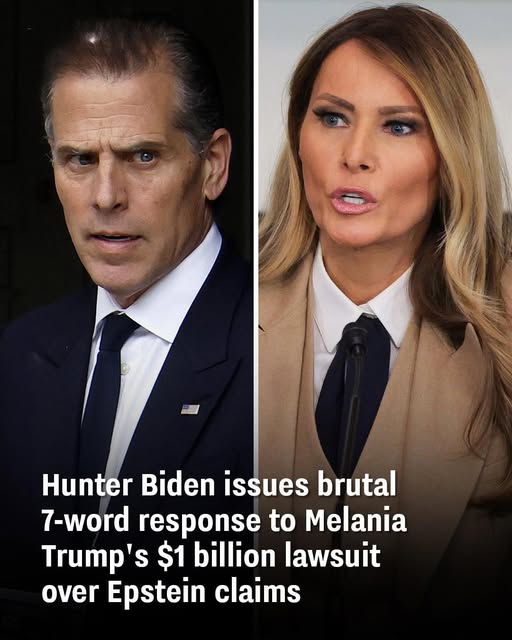
A billion-dollar legal threat has erupted into a public spectacle, exposing the stark political divides that continue to roil America. What started as a provocative interview comment has escalated into a potential courtroom battle involving some of Washington’s most prominent figures, with reputations, fortunes, and political legacies hanging in the balance.
The conflict centers on allegations that have sent shockwaves through both legal and political circles—claims that brush up against the shadowy networks of elite society. As attorneys mobilize and public statements grow increasingly defiant, this could become one of the most consequential defamation cases of modern times.
The stakes could not be higher. On one side stands the First Lady, backed by high-powered lawyers demanding unprecedented damages. On the other, a figure already familiar with legal controversies who shows no sign of backing down despite the threat of financial ruin. The outcome may set key precedents in defamation law, political speech, and the limits of public discourse in a deeply polarized nation.
The Allegations That Sparked the Fire
Hunter Biden, son of former President Joe Biden, ignited the storm during a Channel 5 interview with filmmaker Andrew Callaghan. He claimed that Melania Trump’s introduction to Donald Trump was facilitated by the late Jeffrey Epstein, the convicted financier whose connections to the powerful have long fueled controversy.
“Epstein introduced Melania to Trump – the connections are so wide and deep,” Biden said, adding that alleged Epstein-related files could even “implicate” Donald Trump. These statements, made in the context of elite networks and political connections, have now become the focus of a defamation threat that could rank among the largest in recent American history.
The timing only intensified the impact. Emerging amidst lingering Epstein-related conspiracy theories and during a politically charged period, Biden’s claims hit a flashpoint in public discourse, creating a perfect storm of controversy.
Melania Trump’s Billion-Dollar Legal Response
Melania Trump’s legal team acted immediately and aggressively. Attorney Alejandro Brito issued a letter labeling Biden’s statements “false, disparaging, defamatory and inflammatory,” demanding a full public apology and threatening damages of at least $1 billion.
This figure places the potential lawsuit among the largest defamation claims ever filed in the U.S., dwarfing typical high-profile defamation cases that usually seek damages in the millions. The letter also accused Biden of publishing the claims for personal publicity rather than factual accuracy, asserting the statements caused “overwhelming financial and reputational harm” to the First Lady.
The Journalistic Angle
The controversy deepened when it emerged that Biden’s claims were partially based on reporting by journalist Michael Wolff, whose work has previously examined the Trump administration. The Daily Beast, which initially published Wolff’s claims, later retracted the article and issued a public apology after facing legal pressure—a move highlighting the intensity and credibility of Melania Trump’s legal response.
The retraction underscores the high stakes and raises questions about the original reporting, revealing the complex interplay between media narratives and the legal risks of controversial claims.
Hunter Biden’s Defiant Retort
Far from backing down, Hunter Biden delivered a seven-word, profanity-laced response when asked if he would apologize: “Fk that, that’s not going to happen.”**
Biden framed the legal threat as a strategic distraction, asserting that the claims do not meet the legal standard for defamation, which requires proving “actual malice” for public figures. He further positioned himself as David against Goliath, calling the billion-dollar threat a bullying tactic designed to intimidate him.
This confrontation now sets the stage for a high-stakes legal drama, where political legacy, public perception, and the limits of free expression collide in one of the most provocative disputes of the moment.
The Epstein Connection and Historical Context
To understand the full weight of this legal dispute, it’s crucial to examine the broader context surrounding Jeffrey Epstein and his ties to powerful elites. Epstein, who died in federal custody in August 2019 while awaiting trial on sex trafficking charges, had long cultivated relationships across politics, business, and entertainment. His death—officially ruled a suicide but widely questioned—has only fueled ongoing conspiracy theories and public fascination with his network.
Epstein’s private jet, famously dubbed the “Lolita Express,” and his private island have been scrutinized for evidence of who may have crossed paths with the financier. President Trump’s interactions with Epstein are well-documented through photographs, social events, and public statements, though Trump has consistently denied involvement in Epstein’s illegal activities and distanced himself following Epstein’s legal troubles.
The circumstances of Donald and Melania Trump’s first meeting remain murky. Officially, they met at a 1998 Fashion Week party in New York City, where Melania worked as a model and Donald was already a high-profile businessman. Yet over the years, alternative accounts have surfaced, including social events hosted by modeling agent Paolo Zampolli and other elite gatherings in New York during the late 1990s—fueling speculation that has now become entangled in this legal battle.
Legal Precedents and Defamation Law
The potential lawsuit raises critical questions about defamation law, especially concerning public figures. In the U.S., plaintiffs who are public figures face a higher bar for defamation claims, thanks to the landmark Supreme Court ruling New York Times Co. v. Sullivan (1964). This established the “actual malice” standard, requiring plaintiffs to prove that false statements were made knowingly or with reckless disregard for the truth—a protection designed to safeguard robust political debate.
Applying this standard can be tricky when allegations involve specific facts rather than opinions. Hunter Biden’s statements about Melania’s introduction to Donald Trump could be considered factual claims, making them more susceptible to legal challenge if proven false. Meanwhile, Melania’s billion-dollar damages claim would require substantial evidence to demonstrate measurable harm to her reputation, income, or other tangible interests—a remarkably high threshold in defamation law.
Political and Media Implications
Beyond the courtroom, this dispute highlights the evolving intersection of politics and media. Biden’s original statements appeared on Channel 5, an independent outlet known for unconventional journalism, whose editorial standards differ from traditional news organizations. The involvement of journalist Michael Wolff, known for controversial bestsellers on the Trump administration, further complicates questions of sourcing and verification.
The case underscores the challenges media organizations face when reporting on unverified allegations, especially in an era where conspiracy theories and politically charged narratives dominate discourse.
The Broader Biden Legal Landscape
This potential lawsuit adds another layer to Hunter Biden’s ongoing legal challenges, which include tax and federal gun investigations. While a billion-dollar defamation claim is unprecedented, Biden’s defiant response suggests he views the legal threat as political theater rather than a serious litigation risk. Historically, billion-dollar defamation awards are rare, and collecting them can be even more difficult, making the public spectacle perhaps more strategic than substantive.
What Happens Next
Several outcomes are possible:
- Formal Lawsuit: Melania Trump’s team could file a lawsuit, triggering a lengthy process of discovery, depositions, and potentially a trial.
- Negotiated Settlement: A resolution might include partial retractions or clarifications, though Biden’s public defiance suggests this is unlikely.
- Media and Political Entanglement: As more outlets and public figures weigh in, the dispute could expand, affecting broader media and political dynamics.
A Test of Legal and Political Boundaries
This confrontation is more than a defamation dispute—it’s a test of the limits of political speech, journalistic responsibility, and public discourse. The outcome could redefine how public figures respond to controversial claims, how media organizations handle unverified allegations, and how courts balance free speech with the right to protect one’s reputation.
For now, Hunter Biden shows no intention of backing down, setting the stage for a high-profile legal battle that could dominate headlines. The stakes are immense: Melania Trump risks heightened attention to the allegations, while Biden risks legal consequences—but also earns a public image of defiance. In either scenario, the nation will be watching every move.