Every morning, I’d step into the garden only to find it ravaged. Carrots chewed down to stubs. Lettuce uprooted. A bean vine severed in half. I installed a motion-sensor light, even set up a trail cam, determined to catch the culprit in the act. I was ready for raccoons, foxes, or even a hungry deer. What I wasn’t prepared for—what I never imagined—was that the truth would break my heart and rebuild it in a single breath.
It all began with Runa not showing up for breakfast.
Now, Runa isn’t your typical dog. She’s got a shepherd’s spirit—strong-willed, independent, and just a touch wild. When she was a pup, she’d curl up under the porch and refuse to come inside, even when the rain poured down in sheets. After her last litter didn’t make it, she changed. She stopped chasing shadows across the field. She stopped playing fetch. Mostly, she just slept. She’d spend whole nights in the barn, lying in silence, as if the world outside had nothing left to offer her.
That morning, I figured she was just sleeping through it, through me calling her name from the porch. But something felt wrong. Maybe it was guilt—lately, I had been more focused on fixing fences and fighting off invisible foxes than paying attention to her. So, I grabbed a biscuit, pulled on my boots, and headed to the barn.
Inside, it was quiet. Dust danced in the early sunlight that filtered through the cracks in the boards. The familiar smells—hay, old tools, a hint of oil—wrapped around me. But there was something else. A sound. Soft. Too soft. I stepped lightly around the crates and leaned down near the pile we hadn’t touched in months.
And then I heard it again.
A whimper.
Low. Heartbreaking.
I crouched, my heart thudding in my chest, and peered behind the crates. There she was—Runa, curled around something small and fragile, her body coiled tight like a spring. I whispered her name, afraid she’d bolt or snap. But she didn’t. She just looked up at me with those amber eyes—full of something. Fear? Grief? Maybe both.
And then I saw them.
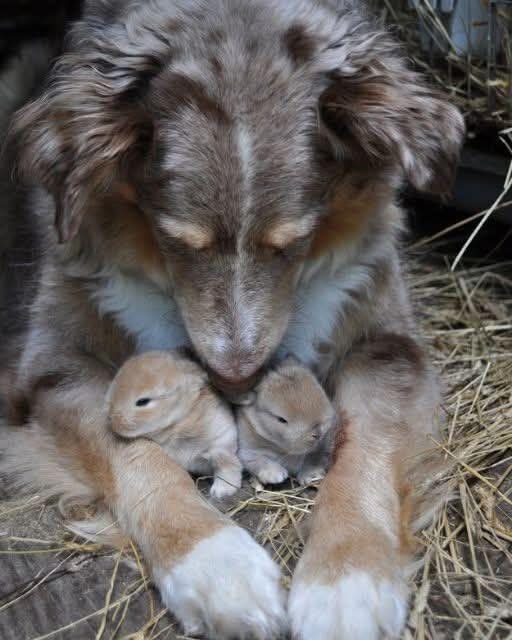
Two tiny creatures, barely breathing, nestled between her paws. At first, I thought they were puppies. Maybe someone had abandoned them, and she had found them. But no. They were baby rabbits. Tiny. Their eyes still shut, their bodies so fragile I could barely breathe for them.
And Runa was nursing them.
I didn’t move. Didn’t say a word. I just sat there, staring, trying to process what I was seeing. My dog—the same one who used to bark relentlessly at squirrels—was caring for these tiny creatures like they were her own flesh and blood.
It didn’t make sense. Not until I saw it. The flash of red fur behind the crates.
At first, I thought it was a fox. I reached forward, my heart racing, and carefully moved the crate aside. What I found was worse.
A dead rabbit.
There was no blood—just stillness. A leg twisted unnaturally, the fur matted. From the look of it, she had dragged herself there, trying to hide, trying to reach her babies.
And she hadn’t made it.
I sat back, stunned. The mother rabbit must have been stealing from my garden—feeding herself, feeding her kits. And now she was gone. Left her babies behind, barely alive. And somehow, Runa had found them. No. Runa had rescued them.
And the garden? The vegetables I had blamed on a hungry predator? They weren’t the work of a thief. They were the desperate actions of a mother, doing whatever she could to feed her young. And I had been setting traps all along.
I looked at Runa again. She lay still, her head tucked between her paws, shielding her babies. She didn’t fully trust me yet, but she hadn’t run either. That meant something.
I stayed there with her, the sun creeping lower behind the barn. Finally, I reached into my pocket, broke a biscuit in half, and offered her a piece. She took it, cautiously. When I reached to touch the babies, she tensed, then slowly, she let me.
They were warm. Alive. Breathing.
Over the next few days, I set up a box and a blanket in the corner of the barn. I brought her food and water. I researched how to care for wild rabbits—what they needed, what not to do. Runa stayed with them almost constantly. Each time I checked on them, they were stronger. By the second week, their eyes opened. They began hopping, clumsy and curious, with Runa following close behind, like a proud mother watching her little ones take their first steps.
When I told the neighbors, they thought I was crazy. “A dog raising rabbits? That’s not normal,” one said. But it was normal—it just wasn’t the kind of normal we’re used to. It was grief meeting purpose. It was instinct wrapped in second chances.
Eventually, when the rabbits were strong enough, they stopped coming back. One morning, I found the box empty. Runa sat in the grass all day, watching the trees, her ears up, her nose twitching at every breeze.
But she didn’t cry. She didn’t follow them.
She had done her part.
Months passed. The garden flourished—though I still lose a few carrots here and there. Runa sleeps indoors now, curled up at the foot of my bed. She’s still independent, still carries that wild edge. But now it’s softer. More patient.
It’s like she knows something we forget too easily—that love doesn’t always come in the package we expect. That family isn’t just the ones we’re born to. It’s the ones we choose to protect when it matters most.
So now, every time I see a flash of red in the woods, or hear rustling near the beans, I smile. I don’t curse. I don’t set traps.
I just watch. And wonder.
Because sometimes, what we think is a nuisance… turns out to be a miracle in disguise.
If this story moved you, even just a little, share it. You never know whose heart might need a reminder that hope can still grow in the unlikeliest places. ❤️