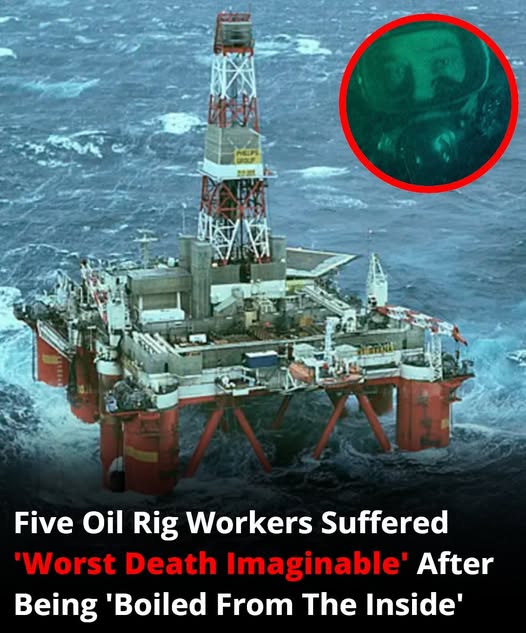
In 1983, what should have been a routine maintenance job turned into one of the most horrifying accidents in deep-sea history. Five professional saturation divers aboard the Byford Dolphin oil rig lost their lives in a catastrophic pressure-related incident — a moment so violent and grotesque it continues to haunt the industry to this day.
On November 5th, the crew was carrying out standard operations near the North Sea platform when a sudden and devastating failure occurred. In an instant, five lives were lost in a way so brutal it defied belief.
To understand the scale of this tragedy, we need to grasp what “saturation diving” entails — a highly specialized technique that allows divers to work at extreme depths for prolonged periods. These professionals live in pressurized chambers and breathe a carefully calibrated mix of oxygen and helium, enabling them to function hundreds of meters below the ocean’s surface.
But with such extreme conditions comes extreme risk — and in this case, the smallest mistake unleashed a force of unimaginable destruction.

Technical divers working on oil rigs perform critical underwater maintenance and construction, often in some of the harshest environments on Earth. (Getty Images)
To survive nearly 1,000 feet beneath the ocean’s surface, these divers breathe a carefully balanced gas mixture kept under intense pressure — a life-saving adaptation to withstand the crushing forces of the deep sea.
To manage this extreme environment, divers don’t just dive and resurface repeatedly. Instead, they live for days inside pressurized chambers that mimic the conditions of the ocean floor. This system allows them to avoid the dangerous and time-consuming process of repeatedly decompressing and repressurizing their bodies.
By living in these pressurized spaces, they can carry out prolonged underwater repairs safely — or so it’s supposed to be.
Tragically, for the five men inside the Byford Dolphin’s chamber, this safety system became a deadly trap.
These divers had been living inside a complex pressurized habitat that included both their living quarters and a “diving bell” — a small, isolated chamber designed as a safe space where divers could decompress gradually after their deep-sea work.
This bell was sealed off from the rest of the system to protect them during the delicate decompression process.
But on that fateful day, something went horribly wrong.
Somehow, the diving bell was released prematurely — before the doors were fully sealed.
The result was catastrophic.
The pressure in the living area plummeted from nine atmospheres — the equivalent of the deep ocean’s weight — down to normal surface pressure in just seconds.
To put this in perspective: divers usually spend days carefully adjusting to surface pressure after working at such depths.
Imagine the violent, lethal shock their bodies suffered when the pressure dropped so suddenly and dramatically.

Among the five men trapped in the diving bell, William Crammond, working as a tender, was killed instantly when the diving bell violently struck him.
The other four divers — Roy Lucas, Bjørn Bergersen, Edwin Coward, and Truls Hellevik — faced fates that were both brutal and heartbreaking beyond comprehension.
The rapid depressurization caused nitrogen dissolved in their blood to expand explosively, forming lethal bubbles that tore through their bodies with unimaginable force.
Yet, one diver endured a horror beyond the rest.
His body was described as “fragmented” — an understatement that barely hints at the true savagery of the event.
The sudden loss of pressure literally forced parts of his body through a 60-centimeter-wide opening in the chamber.
The force was so extreme that his internal organs were violently expelled from his chest cavity, scattering across the pod — some fragments found as far as 10 meters away from the chamber.
Martin Saunders, another tender on duty, was the sole survivor of this nightmare. Though he lived, he was left critically injured and forever haunted by the gruesome scenes he witnessed firsthand.
The catastrophic, instantaneous depressurization turned the divers’ blood into a lethal sea of bursting bubbles — but for one man, the horror was unimaginably worse.