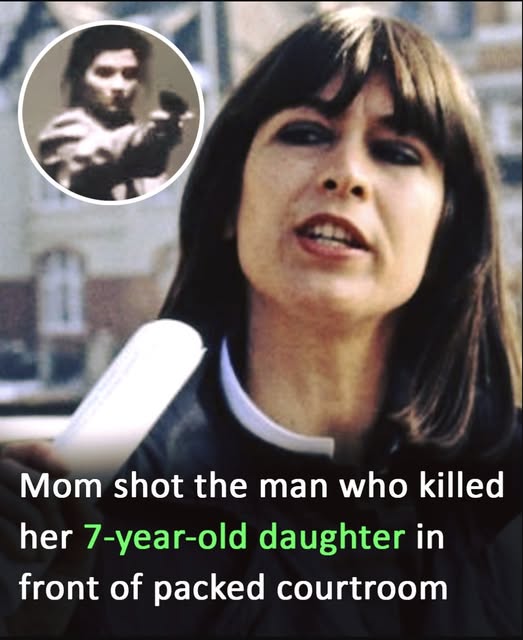
On March 6, 1981, in the quiet city of Lübeck, a courtroom fell into stunned silence—then chaos. Marianne Bachmeier, a grieving mother, stood up, reached into her handbag, and pulled out a pistol. Her target was Klaus Grabowski—the man accused of kidnapping, abusing, and killing her seven-year-old daughter, Anna Bachmeier.
In a matter of seconds, seven shots rang out. Grabowski collapsed onto the courtroom floor, dead.
Marianne didn’t run. She didn’t apologize.
In that moment, she did what many only imagine in their darkest grief—she took justice into her own hands.
A Life Marked by Pain
Long before that day, Marianne’s life had been shaped by hardship. Growing up in postwar Germany, she endured trauma and instability, including abuse during her childhood. As a teenager, she became pregnant twice and gave both children up for adoption.
But everything changed in 1973 when Anna was born.
This time, Marianne chose differently. She raised Anna on her own, building a life around her daughter. Despite financial struggles—running a small pub and living with her mother—Anna became the center of her world.
Bright, curious, and full of life, Anna was everything Marianne held onto.
The Crime That Broke Everything
On May 5, 1980, after a minor argument at home, Anna left—and never returned.
She was lured and kidnapped by Grabowski, a neighbor with a disturbing past. Previously convicted of sexually abusing children, he had undergone chemical castration—only to later reverse its effects through hormone treatment. Despite this history, he lived freely in the community.
Anna was held captive for hours. She was abused, then strangled.
Her body was later found in a cardboard box near a canal.
Grabowski might have escaped detection—if not for his own fiancée, who alerted police. He was arrested that same day.
But for Marianne, the arrest brought no relief.
A Trial That Turned Into Something Else
During the trial, Grabowski made shocking claims—attempting to shift blame onto Anna, even suggesting the child had somehow manipulated him.
For Marianne, already drowning in grief, it was unbearable.
On the third day of the trial, she made her decision.
She entered the courtroom with a loaded gun hidden in her purse. As proceedings began, she stood, aimed, and fired—seven times.
Witnesses later recalled her calling him a “pig.”
Her statement was chilling in its simplicity:
“He killed my daughter… I wanted him dead.”
Justice or Revenge?
Marianne was arrested immediately and charged with murder. But the case quickly became more than a crime—it became a national debate.
Was she a criminal?
Or a mother pushed beyond the limits of human endurance?
During her trial, Marianne claimed she acted in a trance-like state, haunted by visions of Anna. But evidence suggested planning—precision, familiarity with the weapon, and a note she wrote: “I did it for you, Anna,” accompanied by seven hearts.
Public opinion split sharply.
Many saw her as a tragic hero—a symbol of raw, maternal justice. Others warned that if individuals take justice into their own hands, the rule of law begins to collapse.
In the end, she was convicted of manslaughter and illegal possession of a firearm. She received a six-year sentence but served only three.
Life After the Shots
After her release, Marianne left Germany, seeking distance from the spotlight. She lived in Nigeria for a time, later moving to Sicily, before eventually returning to Lübeck in the 1990s after being diagnosed with pancreatic cancer.
Even years later, she remained conflicted—but resolute.
In interviews, she admitted the act was intentional. She didn’t deny it. She believed Grabowski had forfeited his right to live.
On September 17, 1996, Marianne died in her hometown. She was buried beside Anna—a quiet ending to a story that had once shaken an entire nation.
A Question That Still Divides the World
Decades later, the story of Marianne Bachmeier continues to provoke debate.
Was she a grieving mother driven beyond reason?
Or a symbol of a justice system that failed to protect the innocent?
There are no easy answers.
What remains undeniable is the depth of her loss—and the unsettling truth her story reveals: that in the face of unimaginable grief, the line between justice and revenge can become dangerously thin.