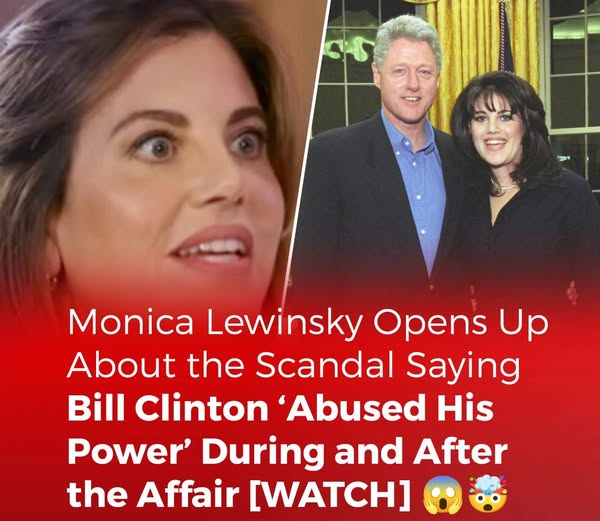
More than 25 years after her name became synonymous with scandal, Monica Lewinsky is reclaiming her narrative — and redefining how the world views one of the most talked-about affairs in modern political history.
In a candid conversation on the How to Fail podcast with host Elizabeth Day, Lewinsky opened up about the complex, often painful emotions she carried as a 22-year-old intern entangled in a relationship with the most powerful man in the world — then-President Bill Clinton.
“It was a 22- to 24-year-old young woman’s love,” she recalled. “The way we see love evolves with every relationship we have.” Looking back, she acknowledged what she couldn’t see then: “I think it was also an abuse of power.”
Though Lewinsky has spoken publicly about the affair before, her latest reflections cut deeper — revisiting the emotional fallout, the public shaming, and how age and perspective have helped her understand the stark imbalance that defined her relationship with Clinton.
“What I felt then was real to me — limerence, infatuation, intensity,” she explained. “But now, I understand how power shaped everything.”
The affair, which exploded into public view in 1998, nearly upended a presidency. But while Clinton weathered the political storm, it was Lewinsky who became the national scapegoat — mocked, ridiculed, and humiliated in the media.
Branded a seductress and reduced to a punchline, she bore the full weight of a scandal she says was never just about sex — but about power, silence, and survival.

“I think that was a narrative that was crafted and put out by the White House,” she said. “That mantle was picked up by a lot of women, too.”
The derogatory language — with slurs like “dumb bimbo” dominating headlines and comedy routines — wasn’t just the work of tabloids or late-night television. According to Lewinsky, it was part of a calculated effort by the Clinton administration to discredit her and shield the president from accountability.
The strategy worked — at least politically. President Bill Clinton was impeached by the House of Representatives in 1998 for perjury and obstruction of justice but was acquitted by the Senate and completed his term in office.
Lewinsky, on the other hand, was left to carry the full weight of the scandal. Her name became synonymous with disgrace, reduced to a punchline and a symbol of political downfall.
In a 2021 CNN interview, she further exposed the harsh truth behind the public spectacle, emphasizing the deeply unequal power dynamic at play.
“It was wholly inappropriate,” she said. “I was 22, literally just out of college. The power differentials there are something that I couldn’t ever fathom — consequences at 22 that I understand, obviously, so differently at 48.”
Lewinsky didn’t mince words when describing Bill Clinton’s behavior during their relationship, calling his actions “wholly inappropriate” and pointing to the deep imbalance at its core.
“I was 22, literally just out of college,” she recalled. “The power differentials there are something that I couldn’t ever fathom — consequences at 22 that I understand, obviously, so differently at 48.”
Now in her late forties, Lewinsky has transformed from a public punchline into a leading advocate against cyberbullying, public shaming, and abuse of power. Through TED Talks, published essays, and high-profile interviews, she has reclaimed her voice — and used it to challenge the systems that once crushed her.
Her recent reflections highlight a larger cultural shift in how we understand consent, accountability, and institutional power. What was once framed as a “consensual affair” is now being reexamined with far greater nuance — prompting the public to ask: can there truly be consent when one person holds all the power?
By continuing to speak out, Lewinsky isn’t just rewriting her own history. She’s pushing society to confront uncomfortable truths about gender, authority, and the way we treat those caught in the crosshairs of scandal.
In revisiting the most painful chapter of her life, Monica Lewinsky is doing more than reflecting — she’s leading a cultural reckoning, one conversation at a time.