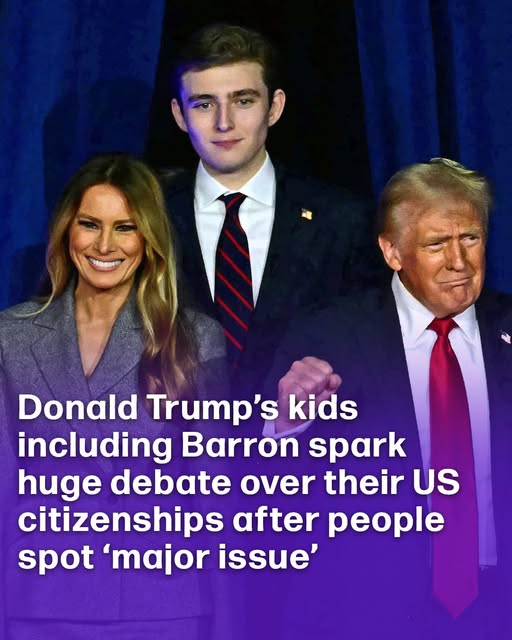
BIRTHRIGHT CITIZENSHIP UNDER FIRE: TRUMP’S EXECUTIVE ORDER BACKLASH SPARKS DEBATE OVER HIS OWN CHILDREN’S LEGAL STATUS
America is facing one of its most explosive constitutional showdowns in modern history. Former President Donald Trump’s bold effort to dismantle birthright citizenship through executive order has ignited a fierce legal, political, and cultural storm—one that now touches his own family.
What began as a sweeping policy push to deny automatic citizenship to children of undocumented immigrants has veered into deeply personal territory. Critics are zeroing in on a provocative question: Would Trump’s own children—including Barron—qualify for citizenship under the very rules he’s trying to rewrite?
THE ROOT OF THE STORM: BIRTHRIGHT CITIZENSHIP EXPLAINED
At the heart of the controversy lies the 14th Amendment, ratified in 1868 to guarantee citizenship to formerly enslaved people and anyone born on U.S. soil. Its powerful promise—“All persons born or naturalized in the United States, and subject to the jurisdiction thereof, are citizens”—has long stood as a pillar of American identity.
Unlike many nations that define citizenship through bloodlines, the United States embraced a more inclusive vision rooted in place of birth. For more than 150 years, that promise has anchored immigrant families, giving rise to generations of Americans regardless of their parents’ immigration status.
But Trump’s second-term executive order aims to redraw those boundaries. It targets children born to undocumented immigrants and foreign nationals on temporary visas, arguing they are not truly “subject to the jurisdiction” of the U.S.—a legal reinterpretation that defies decades of precedent.
TRUMP’S FAMILY IN THE CROSSHAIRS
In a stunning twist, Trump’s crusade against birthright citizenship has turned a spotlight on his own children’s eligibility. With several of his children born to non-citizen mothers and under varying residency circumstances, critics say the executive order could, in theory, cast doubt on their citizenship under its own logic.
The irony has not gone unnoticed. Legal scholars and political commentators argue that Trump’s push raises uncomfortable questions about consistency, fairness—and hypocrisy.
A SUPREME SHIFT THAT CHANGED THE GAME
On June 27, the U.S. Supreme Court issued a landmark decision that limits the ability of lower courts to block federal policies nationwide. This ruling gives unprecedented momentum to Trump’s order. Under the new legal landscape, states that haven’t mounted successful challenges could begin enforcing the policy—potentially denying citizenship to newborns—by the end of July.
This fragmented legal environment could mean some children are deemed citizens in one state but denied in another. And if the Supreme Court later deems the policy unconstitutional, there could be legal chaos: What happens to the citizenship status of children born during this murky legal window?
WHAT’S AT STAKE
Civil rights groups, constitutional experts, and immigrant advocates warn that this executive order could unravel a bedrock American principle. Allowing selective enforcement threatens to erode the Equal Protection Clause and open the door to unchecked executive overreach.
And with Trump’s own family now caught in the rhetorical crossfire, the debate is no longer just about policy. It’s about what it means to be American—and who gets to decide.
THE TRUMP FAMILY CITIZENSHIP CONUNDRUM: CRITICS TURN SPOTLIGHT ON BIRTHRIGHT DEBATE AT HOME
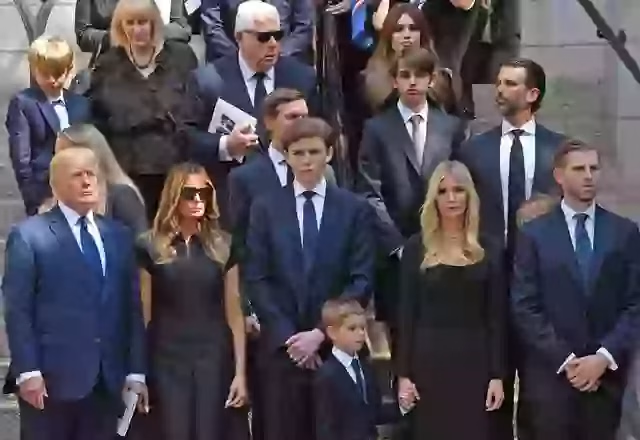
As Donald Trump wages a high-profile battle to end birthright citizenship, a new wave of scrutiny has emerged—not from the courts or Congress, but from the American public. In a twist laced with irony and political drama, critics are now turning their attention to the citizenship status of Trump’s own children, suggesting his policy push could backfire on his family.
The controversy stems from a key detail: neither Ivana Trump nor Melania Trump was a U.S. citizen when their children were born. That fact has fueled claims across social media that Trump’s proposed changes to the Fourteenth Amendment might—if applied retroactively—disqualify his children from being considered U.S. citizens.
Trump’s first wife, Ivana, born in Czechoslovakia, didn’t become a U.S. citizen until 1988—years after the births of Donald Jr. (1977), Ivanka (1981), and Eric (1984). Melania, a native of Slovenia, obtained her citizenship in 2006—the same year Barron was born.
The internet pounced.
“As Trump moves to end birthright citizenship, maybe we should talk about the fact that neither of his wives were citizens when his children were born,” one user posted.
Another wrote, “Donald Trump wants to rewrite the rules—should we start with Barron?”
Some critics went even further, suggesting that Trump should apply his new rules to his own family first. The posts quickly went viral, feeding a media narrative of hypocrisy and contradiction at the heart of his immigration agenda.
THE LEGAL REALITY: TRUMP’S KIDS ARE SAFE—AND WHY
While the public outcry has stirred headlines, legal scholars argue that the accusations don’t hold up under scrutiny.
Despite the personal irony, Trump’s children would retain their U.S. citizenship under both current law and his proposed changes. Here’s why:
First, under the Constitution and longstanding federal law, a child born in the U.S. to at least one American citizen automatically acquires U.S. citizenship. Trump—born in New York and a lifelong citizen—passes citizenship to his children by blood (jus sanguinis), regardless of their mothers’ status.
Second, all of Trump’s children were born on American soil (jus soli), further cementing their status.
Even under Trump’s proposed executive order, which seeks to deny citizenship to children born to unauthorized immigrants, his family wouldn’t be affected. Both Ivana and Melania were in the U.S. legally when their children were born. Melania, for example, held a green card before giving birth to Barron and later naturalized as a U.S. citizen.
Legal experts emphasize that the order targets children born to parents in the U.S. without legal status—not to lawful residents or spouses of American citizens.
“Donald Trump is a U.S. citizen. That alone grants his children citizenship,” one user clarified in response to the speculation.
Another added, “His wives were here legally, and he was a citizen—so yes, his kids are citizens. Facts matter.”
THE EMOTION VS. THE LAW
The backlash underscores a larger issue: how emotionally charged political debates often blur the line between law and perception. While Trump’s proposal is legally narrow, it carries heavy symbolic weight—and that symbolism has now come full circle.
What started as a controversial immigration policy has now hit home, putting Trump’s own family under the magnifying glass and turning a national legal debate into a deeply personal drama.
THE TRUMP BIRTHRIGHT CITIZENSHIP GAMBLE: WHAT’S REALLY AT STAKE FOR AMERICA
A Policy That Won’t Touch Trump’s Kids—But Could Reshape Millions of Lives
While former President Donald Trump’s push to end birthright citizenship wouldn’t affect his own children, the impact on millions of other American families could be catastrophic. At the heart of his controversial executive order is a proposal to strip automatic citizenship from children born on U.S. soil to undocumented immigrants and temporary visa holders—a sweeping move that could fundamentally alter what it means to be American.
Each year, approximately 400,000 children are born in the United States to unauthorized immigrant mothers. Under current law, these children are granted full U.S. citizenship at birth. Trump’s proposed change would deny them that right, creating a new class of stateless children—born in America, but without a country to claim them.
Also targeted are children born to foreign nationals on student, tourist, or temporary work visas. Legal experts warn that, under the executive order, even these families—often lawfully present in the U.S.—could lose their children’s path to citizenship.
“We’re talking about creating a permanent underclass,” warns immigration attorney Maria Rodriguez. “These children would be Americans in every way—except on paper.”
The policy risks tearing families apart. Parents could face deportation while their U.S.-born children remain behind. Others might be forced to uproot their entire lives to protect children who would otherwise grow up without legal protection in the only country they’ve ever known.
Hospitals, schools, and public agencies would also face chaos, tasked with verifying parental immigration status at birth—a function they’ve never handled and are ill-equipped to manage.
THE LEGAL FRONT: CAN A PRESIDENT CHANGE THE CONSTITUTION?
The executive order has sparked one of the most consequential constitutional battles of the modern era. Democratic-led states and civil rights groups argue that Trump’s move violates the Fourteenth Amendment—particularly the clause that grants citizenship to “all persons born or naturalized in the United States, and subject to the jurisdiction thereof.”
That language, unchanged since 1868, was specifically designed to guarantee citizenship for freed slaves and their children following the Civil War. In 1898, the Supreme Court ruled in United States v. Wong Kim Ark that this guarantee extended to children of non-citizens, establishing a precedent that has stood unchallenged for over 125 years.
Trump’s legal team claims that today’s unauthorized immigration represents a different legal landscape—and that the clause should be reinterpreted to exclude children born to undocumented or temporary residents.
But legal scholars across the political spectrum have largely dismissed that argument.
“The framers of the Fourteenth Amendment intentionally used broad, inclusive language,” explains Dr. Jennifer Martinez, a constitutional law professor at Stanford. “They considered—and rejected—proposals to limit citizenship based on parental status.”
If upheld, Trump’s order could empower future presidents to unilaterally reinterpret other foundational constitutional rights—a precedent many fear could outlast the citizenship debate.
THE POLITICAL FAULT LINE: A DEFINING ISSUE OF THE TRUMP ERA
Trump’s executive order has energized his base and outraged his opponents, making birthright citizenship a flashpoint in the 2024 and 2028 election cycles.
Supporters argue that the policy will close a loophole exploited by so-called “anchor babies”—a term widely criticized as misleading and offensive.
“American citizenship should mean something,” says Sen. Tom Cotton. “We shouldn’t reward illegal behavior with automatic benefits.”
But Democrats and civil rights advocates see the move as a direct attack on American values.
“This is about who we are,” says Senate Minority Leader Chuck Schumer. “We’ve always recognized children born here as Americans—no exceptions, no second-class citizens.”
Even moderate Republicans have expressed concern—not necessarily about the policy’s goals, but about the precedent of bypassing Congress and rewriting constitutional norms via executive order.
LOOKING ABROAD: HOW AMERICA COMPARES TO THE WORLD
Globally, the U.S. has been a standout among developed nations for its broad, place-of-birth-based citizenship policy. Most other countries—Germany, France, Japan, and Australia among them—tie citizenship to ancestry or parental legal status, not just location of birth.
Canada is one of the few developed countries still offering full birthright citizenship, though proposals to restrict it have emerged there as well.
“The U.S. policy has always reflected its identity as a nation of immigrants,” says Dr. Patricia Williams, a comparative law professor at Oxford. “Eliminating it would align the U.S. with other developed nations—but at the cost of its founding ideals.”
International watchdogs warn the change could lead to increased childhood statelessness, violating global human rights standards and creating diplomatic friction—especially for tourists, workers, and students who give birth while temporarily in the U.S.
A BUREAUCRATIC NIGHTMARE IN THE MAKING
Should the executive order survive legal scrutiny, implementation would be a logistical and bureaucratic minefield.
Birth certificates would no longer be enough to prove citizenship. Hospitals would need to determine parents’ immigration status at delivery. Vital records offices would require new verification systems. Federal agencies like the State Department and Social Security Administration would face huge backlogs as they retool procedures to reflect the new rules.
“We’re talking about fundamentally restructuring how we determine citizenship at birth,” says Sarah Johnson, a former director of the Immigration and Naturalization Service. “It would overwhelm every agency involved.”
And if the order is later struck down, a legal quagmire could follow. What happens to the children denied citizenship during the interim? How would their rights be restored?
THE HUMAN COST: FEAR, IDENTITY, AND UNCERTAINTY
Beyond law and policy, the human stakes are staggering.
Families fear separation. Children risk growing up in limbo—raised as Americans, but with no passport, no Social Security number, and no protection from deportation.
“My daughter was born in L.A.,” says Maria Santos, an undocumented mother from El Salvador. “She speaks English. She goes to school here. This is her home. How can they say she’s not American?”
Child psychologists warn of long-term trauma. Legal ambiguity around identity and belonging can lead to anxiety, depression, and stunted emotional development.
Community organizations are already seeing a rise in panic. Some families are considering leaving the country—voluntarily—rather than raise children in a legal gray zone.
THE FUTURE OF AMERICAN CITIZENSHIP
The outcome of this battle could shape U.S. identity for generations. If the courts uphold Trump’s order, America may adopt a narrower, more exclusionary vision of citizenship—one that reflects global norms but breaks with centuries of inclusive tradition.
If the courts reject it, birthright citizenship could emerge more firmly entrenched, a reaffirmed pillar of American democracy.
At the heart of it all is a single, existential question: Who gets to be American?
“This isn’t just about immigration,” says Dr. Michael Rodriguez, a political scientist at Georgetown University. “It’s about power, identity, and the very soul of the Constitution. What happens next will echo for decades.”