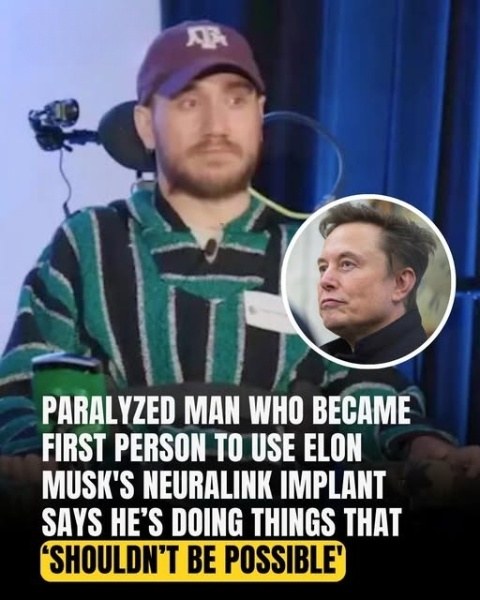
“The First Paralyzed Patient to Receive Elon Musk’s Neuralink Opens Up About Its Transformative Impact”
Noland Arbaugh, 30, who became a quadriplegic after a tragic diving accident in 2016, is the first person to experience the groundbreaking Neuralink chip. In January 2024, he became the first patient to have the device implanted, and now, he’s sharing how it has completely reshaped his life.
Neuralink, founded by Elon Musk in 2016, aims to revolutionize brain-computer interfaces, with the potential to restore lost functions for those with disabilities. For Noland, this cutting-edge technology represents not just a glimpse of hope, but a life-changing transformation.
As the world’s first recipient of Elon Musk’s Neuralink brain-computer interface (BCI), Noland Arbaugh is redefining what’s possible for people with paralysis.
The Neuralink chip interprets electrical impulses in the brain that occur when a person imagines movement. By translating these signals into digital commands, Noland can now operate a computer—using only his thoughts.
After receiving the implant in January 2024, Noland woke up able to control a cursor on screen simply by thinking about moving his hand.
“Honestly, I didn’t know what to expect—it sounds so sci-fi,” he told the BBC.
Paralyzed from the shoulders down after a diving accident in 2016, Noland never imagined he’d be able to enjoy simple pleasures like playing video games or chess again. “I grew up playing games,” he said. “Now I’m beating my friends at them—which really shouldn’t be possible, but it is.”
Beyond entertainment, the experience has opened up new frontiers in neuroscience. “We know so little about the brain,” Noland said, “and this is allowing us to learn so much more.”
Although the technology is still in its early stages, he’s optimistic. Noland hopes the chip will eventually let him control his wheelchair.
There have been setbacks. At one point, the chip malfunctioned and disconnected from his brain, abruptly halting his progress. “That was really upsetting, to say the least,” he recalled. “I didn’t know if I would be able to use Neuralink ever again.”
Fortunately, engineers were able to restore the connection—and even improve it.
Noland’s journey is more than a tech milestone; it’s a glimpse into a future where mind and machine work together to restore freedom.
Elon Musk shared his long-term vision on X, stating:
“It is possible to shunt the signals from the brain’s motor cortex past the damaged part of the spine, enabling people to walk again and use their arms normally.”
This ambitious goal lies at the heart of Neuralink’s mission: to help paralyzed individuals regain mobility and independence.
For now, the company is focused on perfecting the basics.
“Our current work is centered on pushing cursor control performance to the same level as that of able-bodied individuals,” Neuralink said, “and on expanding functionality to include text entry.”
Looking ahead, the team aims to bring thought-powered control into the physical world.
“In the future, we intend to extend the Link’s functionality to control robotic arms, wheelchairs, and other technologies that may enhance independence for people living with quadriplegia.”
The promise of Neuralink is no longer science fiction—it’s becoming a life-changing reality.