Astronomers Discover Rare New World Lurking Beyond Pluto
A mysterious new world has been spotted at the outermost edge of our solar system.
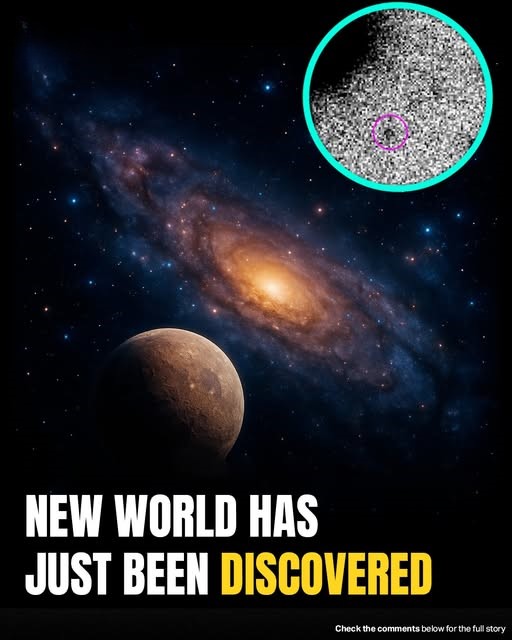
Astronomers using the powerful Subaru Telescope in Hawaii have discovered a tiny, distant object now named Ammonite, officially designated 2023 KQ14. This icy body lies far beyond Pluto, in a region few celestial objects have ever been found.
What makes Ammonite remarkable is its classification: it’s a “sednoid”—a rare type of frozen, distant world that shares traits with dwarf planets like Pluto and the icy remnants of the Kuiper Belt. So far, only four sednoids have ever been identified.
In 2023, Ammonite was orbiting at a staggering 71 times the distance between Earth and the Sun. Even more astonishing, scientists believe it has followed this stable and highly elongated orbit for 4.5 billion years, quietly circling in the frozen darkness since the birth of the solar system.
This discovery not only adds to our growing list of distant solar system objects—it could also hold clues to the mysterious forces shaping the edge of our cosmic neighborhood.
Newfound ‘Fossil’ World Ammonite Challenges the Hunt for Mysterious Planet Nine
A tiny, icy world drifting far beyond Pluto is challenging everything astronomers thought they knew about the outer solar system.
Recently discovered by a Japanese team using the Subaru Telescope in Hawaii, the distant object—officially known as 2023 KQ14, but nicknamed Ammonite—belongs to an ultra-rare group of celestial bodies called sednoids. These frozen relics orbit in a distant, shadowy region of space, far beyond Neptune’s gravitational influence.
But Ammonite isn’t just rare—it’s also puzzling.
For billions of years, its orbit mirrored that of the few other known sednoids. Yet scientists have now found that Ammonite’s path has shifted in strange ways, suggesting a more complex and dynamic outer solar system than previously imagined.
“This hints at dramatic events in our solar system’s ancient past,” said Dr. Yukun Huang of the National Astronomical Observatory of Japan. “It’s even possible a planet once existed out there—one that was ejected, causing the odd orbits we observe today.”
A Cosmic Fossil from the Dawn of Time
Ammonite was spotted as part of the FOSSIL project—short for Formation of the Outer Solar System: An Icy Legacy—a survey aimed at uncovering frozen relics from the solar system’s infancy.
“These objects are like time capsules,” explained planetary scientist Fumi Yoshida. “They preserve clues from the early days of our solar system—what we call cosmic fossils.”
Ammonite’s unusually elongated orbit places it far beyond the reach of Neptune’s gravity. According to Yoshida, “The presence of objects with such wide orbits implies that something extraordinary occurred billions of years ago, during the time Ammonite formed.”
A Blow to the Planet Nine Theory?
The discovery of Ammonite also raises new doubts about the long-theorized Planet Nine—a giant, hidden world believed to lurk far beyond Pluto.
Astronomers once thought that the strange orbits of distant objects like sednoids pointed to the gravitational influence of an unseen ninth planet, sometimes dubbed Planet X. However, Ammonite’s orbit doesn’t align with predictions for Planet Nine’s location.
“This weakens the case for Planet Nine,” said the research team. “Instead, we may be looking at the aftermath of a massive planet that was once ejected entirely from the solar system.”
Still, the mystery of Planet Nine isn’t dead. A recent NASA-backed analysis narrowed the list of possible candidates to a single object, potentially orbiting the sun at a jaw-dropping 46.5 to 65.1 billion miles away—more than 20 times farther than Pluto.
If it exists, such a planet could help explain why our solar system is missing a common planetary type found around other stars: the super-Earth—a world larger than Earth but smaller than Neptune.
“Finding Planet Nine could actually make our solar system feel more normal,” NASA has said.
But for now, it’s Ammonite that’s capturing astronomers’ imaginations—a frozen fossil drifting silently in the dark, whispering secrets from the solar system’s distant past.
Could Planet Nine Be Warping the Outer Solar System?
One of the enduring mysteries of our solar system lies in the unusual behavior of objects beyond Neptune. The Kuiper Belt—a vast, icy region filled with comets, dwarf planets, and frozen debris—appears to be mysteriously tilted.
Unlike the relatively flat orbital plane followed by the inner planets, the Kuiper Belt’s objects orbit at a tilt of about 20 degrees. This strange misalignment has led astronomers to a fascinating theory: the existence of a massive, hidden planet lurking at the edge of our solar system—Planet Nine.
According to this hypothesis, Planet Nine’s long-term gravitational pull could be skewing the orbits of these icy bodies, slowly twisting the entire Kuiper Belt over time. This would explain not only the belt’s tilt, but also why many distant objects—like Pluto and other dwarf planets—seem to cluster together and move in the same direction, rather than drifting off randomly.
Such an organized pattern among otherwise scattered objects suggests the presence of a powerful gravitational force—potentially from a yet-undiscovered giant planet hovering near the solar system’s outer rim.
Whether Planet Nine is real or not remains an open question. But its potential influence continues to be one of the most intriguing explanations for the strange dynamics shaping the frozen frontier of our cosmic neighborhood.