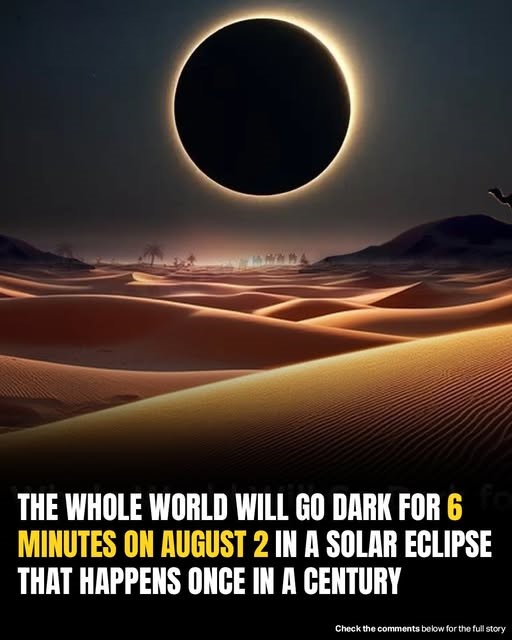
Mark your calendars for August 2, 2027 — a rare celestial spectacle is headed our way, and it’s one you won’t want to miss. This total solar eclipse will plunge parts of Earth into daytime darkness for an extraordinary six minutes and twenty-three seconds, the longest total eclipse since 1991.
A total solar eclipse occurs when the moon completely covers the sun, casting an eerie shadow over the land and turning day into night for those lucky enough to be in the path of totality — the darkest part of the shadow.
This breathtaking event won’t grace our skies again until 2114, almost a century later. So if you want to experience this rare dance of the cosmos, start planning your journey now to be in the perfect spot to witness several unforgettable minutes of darkness during the day.
In other words, this is likely your only chance to witness an eclipse of this magnitude in your lifetime.
Dubbed the “Great North African Eclipse,” this spectacular event is set to take place soon — and if you’re wondering where to catch the best view, the answer is clear: Luxor, Egypt. This ancient city will enjoy the longest duration of totality, making it the ultimate viewing spot on Earth.
Can’t make it to Luxor? Don’t worry — the eclipse will also be visible, though not quite as spectacularly, from many parts of North Africa and even some regions of Southern Europe, including Gibraltar.
Tens of millions of people live within the eclipse’s narrow path of totality, with many fortunate enough to have clear skies to witness this breathtaking cosmic dance.
While a partial solar eclipse will darken the skies over much of the globe, nothing compares to the full experience of totality during the Great North African Eclipse.
Interestingly, the best places to see a total eclipse usually lie at sea — since most of our planet is covered by water — but this eclipse breaks the mold. It’s the longest total eclipse visible over land in nearly 100 years, and one of the longest total eclipses ever recorded.
Meteorologist Jean Meeus’ research reveals that the absolute longest total eclipse could last up to 7 minutes and 31 seconds, so the 6 minutes and 23 seconds of this event is incredibly rare and close to that maximum.
Other total solar eclipses are slated for 2026 and 2028, but neither will last nearly as long — and after that, we won’t see another eclipse of this length until well into the next century.
This truly is a once-in-a-lifetime celestial event.