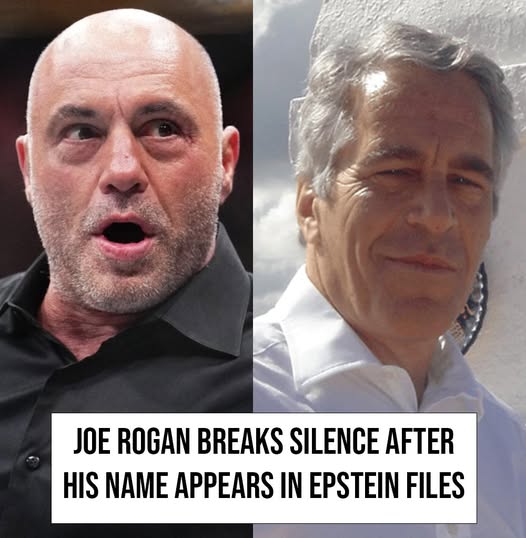
In the high-stakes, multi-year fallout of the Jeffrey Epstein investigation, the release of millions of pages of evidence under the newly minted Epstein Files Transparency Act has become a digital dragnet, pulling names from every corner of the global elite into the public eye. The latest high-profile figure to find his name etched into the archives of the Department of Justice is Joe Rogan—the world-renowned podcaster, comedian, and outspoken supporter of President Donald Trump’s 2024 campaign.
However, unlike many who have retreated behind layers of legal counsel, Rogan opted for his signature brand of radical transparency. During Tuesday’s episode of The Joe Rogan Experience, the comedian addressed the revelation head-on, clarifying the nature of his proximity to the disgraced financier and launching a scathing critique of the federal narrative surrounding the case.
The Paper Trail: A 2017 Invitation Denied
The link between Rogan and Epstein was unearthed in a series of email exchanges from September 2017 involving Lawrence Krauss, a prominent Canadian theoretical physicist and frequent guest in elite circles. According to the unsealed records, Epstein had taken an interest in Rogan’s exploding media influence, writing to Krauss: “I saw you did the Joe Rogan show, can you introduce me? I think he is funny.”
Krauss, who had appeared on Rogan’s podcast earlier that year, initially obliged the request, replying: “I will reach out to Rogan.”
However, the follow-up correspondence suggests a swift and decisive rebuff from the Austin-based host. Krauss eventually apologized to Epstein for failing to secure the introduction, noting that Rogan appeared uninterested. “He seems more timid than I would have thought,” Krauss wrote, misinterpreting Rogan’s lack of interest for a lack of nerve.
“Are You High?”: Rogan Recounts the Rejection
Speaking with guest Cheryl Hines—actress and wife of Health and Human Services Secretary Robert F. Kennedy Jr.—Rogan reflected on the absurdity of the request. While he avoided naming Krauss directly during the segment, he recalled his visceral reaction to the pitch.
“I am in the files for not going because Jeffrey Epstein was trying to meet with me,” Rogan told Hines. “It was not even a possibility that I would have ever went. I was like, are you high? What are you talking about?”
When Hines asked if he felt a sense of relief for never engaging with the financier, Rogan responded with a blunt “yes,” framing the lure of Epstein’s circle as a trap for those obsessed with proximity to power.
“Some people get intoxicated by being in a circle of rich and powerful people. They just want to be around them,” Rogan observed, suggesting that only those interested in “sucking up to the rich and powerful” would have been drawn into Epstein’s orbit.
The FBI’s Conclusion: “The Gaslightiest Gaslighting”
The podcast discussion eventually shifted to a recent ABC News report detailing the FBI’s internal findings. According to a review of Department of Justice records, the Bureau concluded that while there was substantial evidence of Epstein exploiting young women and girls, there was insufficient evidence to prove he was operating a coordinated sex trafficking ring for the benefit of other powerful men.
Rogan’s reaction to the headline—“FBI Concluded Jeffrey Epstein Was Not Running a Sex Trafficking Ring For Powerful Men, Files Show”—was one of incredulous fury.
“That is the gaslightiest gaslighting s*** I’ve ever heard in my life,” Rogan erupted. “What do they think was going on? Just men having cocktails and talking about science?”
The Disconnect in the Evidence
The prosecutor’s memo from 2025 further complicates the public’s understanding of the case. It notes that while thousands of photos were seized from Epstein’s residences in Manhattan, Palm Beach, and the U.S. Virgin Islands, the images did not explicitly implicate other high-profile associates in physical crimes. Furthermore, a 2019 internal memo stated that a review of Epstein’s financial records—including payments to figures in academia, finance, and global diplomacy—found no direct links between those specific transactions and criminal activity.
Despite these findings, the sheer volume of the release—millions of pages made public between 2025 and 2026—continues to fuel public skepticism. The political tension surrounding the files reached a fever pitch earlier this week when select members of Congress were granted access to unredacted versions of the documents. Their mandate is to verify that no incriminating evidence was improperly withheld or suppressed during the initial investigation.
As the “Epstein Files” continue to dominate the news cycle, Rogan’s inclusion serves as a rare instance where a person of interest appears in the records not as an associate, but as a refusenik—a detail that Rogan himself seems more than happy to publicize.