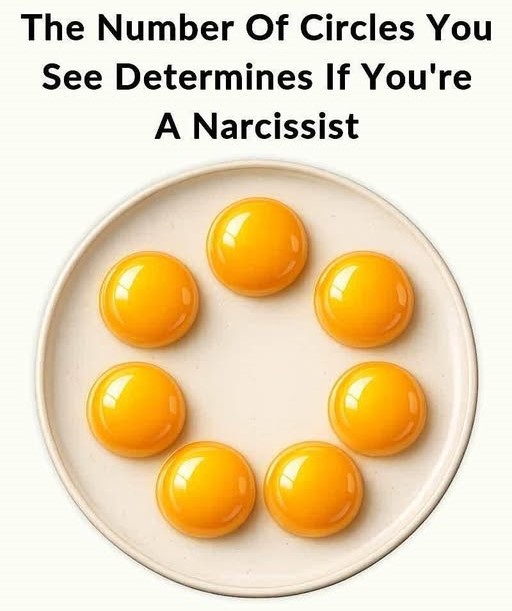
\At first glance, the image seems simple: a plate with several bright yellow circles arranged neatly inside it. But the longer people stare, the more debates start. Some see only the obvious circles, while others begin counting hidden shapes formed by spacing, shadows, or the plate itself. That uncertainty is exactly what makes images like this go viral—they trigger curiosity and make people question their own perception.
Despite the dramatic claim attached to it, this image doesn’t actually diagnose narcissism or any personality trait. There’s no scientific method where counting circles can reveal who someone truly is. What it does reveal is how differently people process visual information. Some focus only on the most prominent shapes, while others instinctively look for patterns, boundaries, or negative space.
Psychologists have long noted that perception is influenced by attention, experience, and context. When someone is told an image “means something,” the brain starts searching harder, sometimes seeing more than what’s objectively there. That doesn’t make one person better or worse—it simply shows how suggestion can guide interpretation without us realizing it.
Images like this succeed because they feel personal. People enjoy comparing answers, defending what they see, and wondering what it might say about them. The real appeal isn’t self-diagnosis; it’s the moment of pause where the mind engages, explores, and reacts. That small spark of curiosity is enough to keep the image circulating.
In the end, the number of circles you see doesn’t label your personality. It highlights how easily the human brain plays along with suggestion and ambiguity. The image isn’t a test—it’s a reminder that perception is flexible, subjective, and often shaped by the story we’re told before we even start looking.