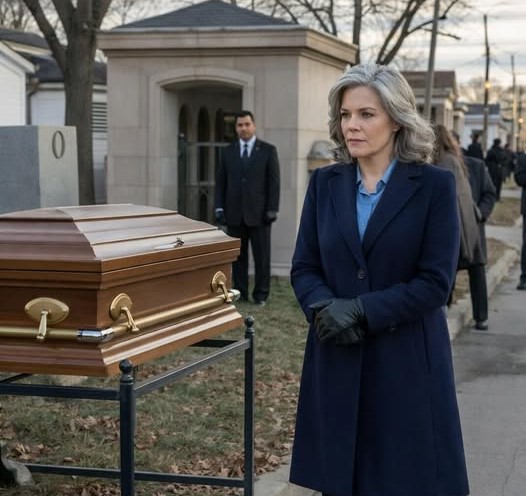
The chapel doors were heavier than I remembered, as if the building itself had decided grief should require effort.
I paused with my hand on the brass handle, listening to the faint hum of the heater and the soft shuffle of someone moving inside. Outside, November air had that metallic bite it always carried, a cold that made your nostrils sting and turned every breath into a thin ribbon of mist. The sky was the color of wet cement, flat and undecided, as if even the weather couldn’t commit to what kind of day it wanted to be.
I stepped in.
Warmth hit me first, but it didn’t feel comforting. It felt stale, like heat that had been trapped too long. The chapel smelled of furniture polish and lilies, a sweetness so thick it made the back of my throat tighten. White lilies were everywhere, their petals bright against the dark wood, their perfume insistently cheerful in the way grief people always seemed to be. As if sweetness could blunt the fact of death.
It couldn’t.
Near the front, the funeral director adjusted a ribbon, then leaned to straighten a spray of flowers around George’s mahogany casket. The wood was glossy, rich, and dignified. George would have approved of that. He would have run his fingertips along the smooth surface and nodded once, satisfied that even in the end, nothing had been done cheaply or carelessly.
I stood in the doorway longer than necessary, my black dress feeling too tight around my ribs, as if it had shrunk overnight. The fabric was familiar, the one George liked because he said it made my eyes look like storm clouds right before rain. He used to say it with that half-smile he reserved for flirting, even after decades of marriage. Even after life had dulled the edges of romance into something quieter and sturdier.
The empty chairs behind me pulled at my attention, like a hand tugging my sleeve.
Twenty-four seats. Polished oak. Deep burgundy cushions. Neatly arranged, waiting.
Not a single body filled them.
I had expected, foolishly, that the absence might be temporary. That maybe traffic had slowed them, or a child had spilled something in the car, or someone had taken a wrong turn. I had expected the sound of footsteps, hurried and apologetic, the rustle of coats being shrugged off, the murmur of relatives greeting each other softly.
But the room was silent except for the heater and the funeral director’s careful movements.
Just me. Alone.
The funeral director glanced up and approached with the soft step of a man trained to move quietly around sorrow. He was middle-aged, gray at the temples, with eyes that looked kind even when his mouth stayed neutral.
“Mrs. Holloway?” he asked gently. “We can wait a few more minutes if you’d like. Sometimes people run a bit late.”
I looked down the rows again. Empty. Every one of them.
My throat tightened, but my voice came out steadier than I felt.
“No,” I said. “Start the service. George hated tardiness.”
The funeral director nodded once, a flicker of relief crossing his face. He had expected tears or a collapse, I could tell. He had expected me to ask for more time, to cling to the possibility that my children might still come.
I wouldn’t give him the satisfaction of seeing me beg for what should have been automatic.
George would have hated that too.
In the final weeks, when cancer had hollowed him until his cheeks looked carved and his hands seemed too large for his arms, he still insisted on routine. He’d lined his pill bottles in a row like soldiers, each one facing forward. He’d insisted the news come on at six, even if he was too tired to follow the stories. He’d asked me to place his slippers side by side by the bed each night, as if order could hold back chaos.
He believed in showing up. In doing what you said you would do. In being the kind of person other people could count on.
I had loved him for that.
Our children had learned something else entirely.
The pastor stepped up to the lectern. A young man with neatly combed hair and an earnest face. I didn’t recognize him. That wasn’t unusual. We had attended church off and on, never regularly enough to be known intimately, and George had never wanted a fuss anyway. The funeral home offered a list of clergy, and I had chosen one who sounded kind on the phone. Kindness, I’d learned, mattered more than familiarity in moments like this.
But as he began speaking, his words felt like they had been taken from a binder of acceptable phrases. He spoke about eternal rest and loving memories and a life well lived, but everything he said was broad enough to apply to any man, any family.
I sat in the front row, hands folded in my lap, and tried not to flinch at how wrong it felt to have George reduced to generic comfort.
George Holloway was not generic.
George Holloway had built three houses with his own hands. Not “helped renovate,” not “supervised contractors,” but built, hammer in hand, sweat running down his spine, measuring twice and cutting once because that was how he did everything. He could identify birds by their call, and he could tell you whether a storm was coming by the way the air smelled. He cried during old war movies, usually when the music swelled and men made sacrifices they didn’t talk about, but he never cried at funerals because he believed grief was private and should be honored by steadiness, not spectacle.
He had made me laugh when I didn’t want to. Especially when I didn’t want to.
He had held my hand through illnesses and disappointments and the small humiliations of aging. He had kissed my forehead every night for decades, a ritual so steady it became part of my body’s understanding of safety.
He had been my home.
The pastor continued. I listened, not to his words, but to the silence around them. The silence that should have been filled with my son’s clearing throat, my daughter’s sniffle, the quiet shifting of grandchildren who didn’t understand but felt the heaviness anyway.
Instead, the chapel held only my breathing.
And beneath that, a different sound in my mind, the small click of something breaking.
The morning had started with Peter’s text.
Not a call. Not even a voicemail.
Sorry, Mom. Something came up. Can’t make it.
Seven words that landed like a slap.
I had stared at my phone for a full minute after reading them, waiting for more. Waiting for an explanation, for a second text, for some sign that my son understood what he was doing. The phone stayed silent.
I tried calling him anyway. It went straight to voicemail. I left a message I can barely remember now because I was holding my dignity with both hands, gripping it tight so it wouldn’t slip away. I didn’t beg. I didn’t plead. I said only, “It’s time, Peter. Your father is here. We are here. Call me.”
Then I checked Celia’s social media. Because that’s what mothers do now when their children won’t answer the phone. We track them through filtered photographs and captions that pretend life is always bright.
Celia’s Instagram story showed champagne flutes raised with three girlfriends, their faces flushed with the particular glow of brunch and irresponsibility. The caption read: Sunday brunch with my girls. Living our best lives!
The funeral was at ten.
She had chosen eggs Benedict over goodbye.
Peter’s feed showed a golf course. Him mid-swing. Expensive clubs flashing in the pale sun. Perfect weather for closing deals, he wrote, as if life was a series of opportunities he could not afford to miss.
I had raised these people.
George and I had fed them, clothed them, stayed up through nightmares and breakups and college rejections. George had taught Peter to fish and had spent hours untangling lines and pretending not to mind when Peter lost interest. He had walked Celia down the aisle, his arm stiff with pride, tears shining when she whispered, “Thank you, Daddy.”
He had shown up for everything.
And now, they couldn’t show up for him.
The service ended. Recorded hymns played through tinny speakers, their notes thin and distant. The pallbearers were strangers hired by the funeral home. They lifted George’s casket with careful professionalism, but they didn’t know him. They didn’t know the weight of the man inside. They didn’t know how he used to whistle while cooking Sunday breakfast or how he built Ethan a treehouse and patched the elbow of his favorite sweater afterward because he tore it on a nail and refused to throw it away.
I followed behind them alone, my heels clicking too loudly on the marble floor. The sound was sharp, like breaking bones.
Outside, the cemetery stretched gray and patient under a sky that threatened rain but refused to deliver. Bare trees stood like witnesses. Dead leaves skittered across the ground, their movement restless and small.
At the graveside, the lowering apparatus whirred and groaned. The sound felt obscene, mechanical in a moment that should have been sacred. I watched the casket descend, the polished mahogany catching one last faint glimmer of light before disappearing into earth.
The pastor said words about dust and ashes.
I heard nothing but the thud of my own heart.
When he finished, he glanced at me as if expecting me to signal I was ready to leave. The groundskeeper waited at a respectful distance, his cap pulled low, hands in his pockets.
People think grief looks like collapse. Like keening. Like dramatic sorrow.
Sometimes grief looks like standing very still because if you move, you might fall apart into pieces so small you’ll never gather them again.
When everyone else had gone, I stayed.
My heels sank slightly into soft soil. The new mound of dirt looked too raw, too fresh. I stared at it as if staring could summon George back, could make this a mistake someone corrected.
“Goodbye, George,” I whispered, my voice thin in the open air. “I’m sorry they didn’t come. I’m sorry I couldn’t make them be better.”
The wind picked up, cold and sharp, lifting dead leaves and scattering them across the grave. For a moment, I could almost hear George’s voice the way I’d heard it for decades, steady and firm.
Don’t apologize for other people’s choices, May. You taught them how. They chose not to learn.
I didn’t know if it was my imagination or memory or something else, but it settled inside me like a hand on my shoulder.
When I finally walked back to my car, the world felt both distant and painfully clear. The cemetery gates closed behind me with a slow metallic groan that sounded like finality.
Back home, the house was too quiet.
George’s recliner sat by the window, leather worn smooth where his head had rested. His reading glasses perched on the side table beside a half-finished crossword puzzle. I could still see his handwriting in the squares.
LOYALTY.
HONOR.
FAMILY.
I stood there and stared, the irony so sharp it almost made me laugh, but no sound came out. The words sat on the page like a verdict.
In the kitchen, I opened the wine cabinet and pulled out a bottle we’d been saving for our fifty-fifth anniversary. George had died three months shy of it. The bottle looked untouched, patient.
I poured myself a glass and sat at the kitchen table where we had eaten tens of thousands of meals. The chair across from me was empty, and for a second my body expected him to walk in, rubbing his hands together, asking what smelled good.
He didn’t.
I opened my laptop.
If my children lived fully anywhere, it was online. Their real lives seemed to happen in posts and stories and captions, carefully curated, polished and bright. I clicked through Facebook, Instagram, and the other platforms I barely understood but had learned to use because that was where my children placed their attention.
Peter had posted another selfie, this time with clients. Everyone was grinning. Ties loosened. Glasses raised. Another successful week in the books. #Blessed #WorkHardPlayHard.
Blessed, he wrote. On the day his father was lowered into the ground.
Celia’s feed was worse. Brunch. Shopping. Cocktails in a bar with exposed brick and warm lighting. In the newest photo, she wore a necklace I’d never seen before. Her smile was wide and unburdened.
Treated myself today. Self-care isn’t selfish!
My fingers trembled on the trackpad. I closed the laptop slowly, as if closing it would close off the nausea rising in my throat.
I walked down the hallway to George’s study. The room smelled like old paper and his cologne, the scent still lingering faintly in the curtains and the leather chair. Everything was neat. George’s neatness had been a language. Pencils aligned. Papers stacked. A small tray for keys and coins, emptied now because he was gone.
I opened the bottom drawer and pulled out the folder labeled Estate Documents in his precise handwriting.
Inside was our will, drafted two years ago with Thomas Fields, our longtime attorney. I spread the papers across George’s desk and read them, not as a formality, but as if I were seeing our lives written in ink for the first time.
Everything was divided between Peter and Celia. The investment account, almost three hundred thousand dollars saved over decades of careful choices. The house George renovated himself. The lake cabin we bought when the kids were small. The car. The antiques. The clock George’s grandfather brought from Ireland.
All earmarked for children who had not been able to show up for their father.
I pulled out another folder, one I kept separate. It held copies of checks I had written over the years. I had always been meticulous with finances, not out of suspicion, but because that was how I survived widowhood scares and medical bills and the unpredictability of life. You track what matters because life can take it away quickly.
I flipped through the stack.
Fifteen thousand dollars for Celia’s wedding that was supposed to be small and became three hundred people.
Seven thousand for Peter’s startup that died within six months.
Twenty-two thousand when Celia’s husband lost his job and they were desperate.
Five thousand for Ethan’s robotics camp.
Twelve thousand for private school tuition.
The list went on. A paper trail of love mistaken for obligation.
I opened my phone’s calculator and began adding the numbers.
Two hundred and forty thousand dollars.
I stared at the total until the digits blurred.
Two hundred and forty thousand given freely. Never repaid. Rarely acknowledged beyond a brief thank-you delivered with the same tone you use when someone hands you a glass of water. Gratitude that lasted only until the next need emerged.
I sat back in George’s chair and stared at the photo on his desk. The two of us on our fortieth anniversary, standing in front of the rose garden he planted. We were smiling, older but still bright with the kind of happiness built on shared effort. We looked like a couple who believed family meant something solid.
Maybe we had believed too much.
Or maybe we had taught our children that we would always catch them, so they never learned to fear the fall.
The clock on the wall ticked softly. The sound was steady and infuriating, as if time had no respect for grief.
I picked up the phone and called Thomas Fields. It was late, close to midnight. I left a message, my voice calm because I could not afford to sound uncertain.
“Thomas, it’s May Holloway. I need to revise my will. Call me first thing tomorrow. It’s urgent.”
That night, sleep refused to settle. I lay in bed on my side, never the middle. George always took the middle, sprawled slightly, stealing blanket without apology. Even in the last months, even when he was too weak to shift much, my body still avoided the center as if his presence might return.
The house made its usual noises. The refrigerator hum. The heat clicking on and off. The faint creak of settling wood. Outside, a dog barked once and then fell silent.
Grief is love with nowhere to go. George used to say that. I understood it that night with cruel clarity.
I had forty-seven years of love for a man who was gone, and decades of love for children who had become strangers.
It sat in me like water with no drain.
At eight-thirty the next morning, Thomas Fields called.
“May,” he said, voice warm with concern, “I got your message. Are you sure about this? Changing a will in the immediate aftermath of loss can sometimes lead to regrets. People act from shock, from—”
“I’m sure,” I interrupted. My voice surprised me with its firmness. “Can you see me today?”
“Of course,” he said, and I heard the shift in him. He recognized that tone. It wasn’t hysteria. It was decision. “Come by at ten.”
His office was in a quiet building downtown, the kind with carpet that muffled footsteps and walls lined with framed degrees. It smelled like leather and lemon polish. The air was cool and controlled. Thomas had aged well, hair gone silver, eyes still sharp behind wire-rimmed glasses. He’d handled George’s business license, our mortgage, property transfers. He had known us since before our children were grown. Since before Peter became impatient and Celia learned to weaponize charm.
I sat across from his desk and placed my hands flat on my knees, anchoring myself.
“I want Peter and Celia removed from the will entirely,” I said. “Everything goes to Ethan.”
Thomas set his pen down carefully, as if the movement required ceremony. “Your grandson,” he said.
“Yes.”
He watched my face, measuring. “May, I need to ask. Is this because they missed the funeral?”
“It’s because they missed his life,” I said. The words felt sharp in my mouth, but they were true. “It’s because I spent three weeks watching my husband die, and he kept asking where the kids were. Why they hadn’t visited. And I lied. I made excuses until I ran out of ways to lie.”
Thomas’s expression softened, and the softness made my throat tighten.
“On his last day,” I continued, voice steady but thin, “when he was barely conscious, he whispered, ‘Tell them I love them.’ They couldn’t even come to hear it.”
Thomas was quiet for a moment, then he nodded once, slow and solemn. He picked up his legal pad and began writing.
We spent two hours restructuring everything. House, investment accounts, cabin, car, antiques, the clock. Thomas suggested an irrevocable trust for Ethan, something that would protect the inheritance from pressure, manipulation, and the predictable hunger that comes when money is at stake.
“He’s nineteen,” Thomas said. “That’s young. Even a good kid can be worn down by guilt. We can structure it so he can’t access everything until thirty, with allowances for education, medical expenses, reasonable support. This will keep it safe.”
“Do it,” I said without hesitation. “Protect him. Protect what George built.”
Thomas nodded, making notes. “This will also reduce probate complications and keep your estate plan clear. It’s the best approach if you expect conflict.”
“I do,” I said quietly. “They’re very good at conflict when they want something.”
When the documents were ready, Thomas read each section aloud. It felt formal, but I appreciated the care. My signature would change the course of my family. That deserved seriousness.
My hand did not shake when I signed.
As I finished, Thomas asked gently, “Do you want to tell them yourself? Or let them find out naturally?”
I thought of Peter’s text. Celia’s brunch photo. Their absence in that chapel. Their father’s casket lowering with no family hands on it.
“Naturally,” I said. “Let them wonder why the well has run dry.”
Walking out of Thomas’s office into daylight, I expected to feel guilt. Expected to feel the familiar ache of being the mother who fixes things, the mother who smooths over hard edges.
Instead, I felt lighter.
Not vindictive. Not cruel. Just relieved, like I’d set down a weight I hadn’t realized I’d been carrying for decades.
That afternoon, my neighbor Lorraine knocked on my door with a plate of lemon bars and the kind of expression that said she knew more than people assumed.
Lorraine had lived across the street for twelve years. She had watched our children grow up and then drift away. She had watched me chase after them with casseroles and checks and patience. She had watched George age into illness with his quiet dignity.
She stepped into my kitchen without waiting for an invitation, because that’s what people do when they’ve known you long enough to skip politeness.
“I saw the funeral home car yesterday,” she said, settling into a chair. “Only one car for a man as good as George. That tells me everything I need to know.”
I poured tea, hands steady. The kettle hissed softly, the sound oddly comforting in its normalcy.
“I changed the will,” I said.
Lorraine lifted her eyebrows. “Oh?”
“They’re out,” I said. “Ethan’s in.”
Lorraine nodded like I’d told her the forecast. “About damn time.”
I let out a breath I didn’t know I’d been holding. “You think I’m being cruel?”
“I think you’re being honest,” she said. “I’ve watched you chase their approval for twenty years, May. Babysitting when you had your own doctor appointments. Writing checks while they took vacations. You keep giving, they keep taking, and somewhere in there love got confused with convenience.”
She bit into a lemon bar, chewed thoughtfully, then added, “My niece tried to get me to sell my house last year. Said it was too much for me. What she meant was it was too much asset sitting unused when she could turn it into money for her own life. I told her I’d rather die in my own kitchen than live in a place that smells like industrial cleaner and somebody else’s decisions.”
A laugh surprised me, small but real. It felt strange in my throat, like a muscle that hadn’t been used in too long.
Lorraine’s gaze softened. “You did what you had to do. George would have wanted you protected. And Ethan, that boy, he’s got a backbone. He’ll honor what you’re doing.”
“I hope so,” I whispered.
Lorraine patted my hand once, firm. “Hope is fine, but documents are better. Estate planning doesn’t run on hope.”
After Lorraine left, her words stayed in the kitchen like a warm mug in cold hands.
Three days passed before Celia called.
I watched the phone ring the first time until it stopped. Let it ring the second time too. On the third, I answered, not because I was ready to forgive, but because I was ready to hear what she wanted.
“Mom,” Celia said. Her voice was tight, controlled in the way she had perfected over years. She could sound calm even when she was furious. She could sound fragile even when she was manipulating. “We need to talk.”
“About what?” I asked.
A pause. “Ethan told me you changed the will.”
Of course he had. Ethan was honest to a fault. It was one of his best qualities, though in that moment I wished he’d waited.
“Yes,” I said. “I did.”
“Is it true?” Celia’s voice caught. “Peter and I are out?”
“Yes.”
Silence stretched. I could hear her breathing, measured, the way her therapist probably taught her.
“Because we missed the funeral?” she asked, and there it was, the attempt to reduce everything to a single moment, a single mistake, something fixable with apologies.
“Because you missed your father’s life,” I said. “The funeral was just the final confirmation.”
Celia’s breath hitched. “Mom, you’re making it sound worse than it was.”
“How would you like me to describe it?” I asked. My voice stayed even, but my hands curled into fists on the table. “Your father’s casket. Twenty-four empty chairs. Me alone. Lowered into the ground with no family. What words make that sound better?”
She tried. She really did.
“I couldn’t handle it,” she said, voice rising slightly. “I couldn’t see him like that. I needed a distraction. I needed to be around people who were alive and happy and…”
“Not dying,” I finished for her. “Not reminding you that death exists.”
“You don’t understand,” she insisted. “I’m not strong like you. I needed time to process.”
“Process what, Celia?” I asked softly. “He was dying for six months. You had time. You just chose to spend it elsewhere.”
She shifted tactics.
“Mom, I had a nail appointment,” she said, and even saying it aloud sounded absurd. “You know how anxious I get when I have to reschedule. My therapist says routines are important for my mental health.”
“And brunch,” I said. “And shopping. And cocktails. I saw the photos, Celia.”
“You were stalking my social media?”
“I was trying to understand where my daughter was while I buried her father alone.”
The silence that followed was thick. I could hear faint muffled sounds in the background, a television perhaps, or someone else in the room. For a moment I wondered if she had her husband or a friend nearby coaching her through the conversation.
That thought made me tired.
“You can’t just cut us out,” she whispered finally. “We’re your children. Blood doesn’t stop mattering because we made a mistake.”
“And I was your father’s wife,” I replied. “He deserved more than absence. If you couldn’t show up for him, why do you expect to benefit from his life’s work?”
“This is cruel,” she said, anger sharpening her voice.
“No,” I said softly. “Cruelty is what you did. This is consequences.”
She hung up.
I set the phone down and returned to folding laundry, the simple rhythm of matching socks strangely soothing. It was ordinary, and ordinary felt like safety.
Peter arrived the next morning, as if Celia had handed him the baton. His BMW pulled into the driveway, and for a moment I watched through the window the way I used to watch when the kids were teenagers, waiting to see if they were sneaking in late or coming home responsibly.
He came in with his wife, Meredith, both dressed like they were heading to a meeting. Peter wore a coat that looked expensive, his hair neatly styled, his jaw set. Meredith looked quiet, her eyes more observant than anxious.
“Mom,” Peter began immediately, not even sitting down. “This is crazy. You can’t disinherit your own children because we made one mistake.”
“It wasn’t one mistake,” I said calmly.
Peter scoffed. “What, you’re punishing us because we didn’t show up one time? Are you hearing yourself?”
I looked at him and saw George’s eyes in his face, but none of George’s warmth. All the structure, none of the substance.
“It’s a pattern,” I said. “A lifetime of taking without giving. Showing up only when you want something.”
Meredith stood slightly behind him, silent, watching.
Peter pushed on. “We helped you plenty. I fixed your computer. Celia brought you groceries.”
“After I paid for them,” I said.
Peter’s mouth opened, then closed. His nostrils flared.
“Let me show you something,” I said, and I surprised myself by how calm I felt.
I walked to George’s study, retrieved the folder, and brought it to the living room. I laid it on the coffee table and opened it.
Checks. Transfers. Notes. Dates. Amounts.
Peter’s eyes flicked across the pages, his face shifting from annoyance to confusion to something like discomfort.
“Two hundred and forty thousand dollars,” I said. “That’s what I gave you and Celia over twenty years. Gifts. Not loans. Because you’re my children. Because I believed helping you was part of love.”
Peter’s throat bobbed as he swallowed.
“But love is not an endless bank account,” I continued. “Help is a two-way street. And when your father needed you most, that street was closed.”
Peter’s jaw tightened. “Mom, you’re being dramatic.”
“Am I?” I asked quietly. “I buried him alone.”
Meredith moved then, stepping forward slightly. I expected her to defend Peter, to add her own arguments. Instead, she looked at me with an expression I couldn’t quite place at first.
Relief.
Respect.
“Thank you,” she said quietly.
Peter turned sharply toward her. “What?”
Meredith didn’t flinch. “Thank you,” she repeated to me, voice steady. “For not enabling him anymore. For not letting him think he can coast through life on other people’s effort.”
Peter stared at her like she’d spoken a different language.
Meredith’s gaze stayed on mine. “I’m sorry about George,” she added softly. “He deserved better.”
Then she walked out.
Peter scrambled after her, his protests echoing in the hallway. The front door closed behind them, and the house fell silent again.
But the silence felt different now.
Cleaner.
I made myself lunch that day. Real food, not leftovers shoved into a bowl. I ate slowly at the kitchen table, the place where George used to read the paper and argue gently about headlines. I picked up a novel I’d started years ago and never finished, and for the first time since George died, I read without checking my phone every few minutes, waiting for another demand.
That evening, Ethan knocked on the door.
I opened it and saw him standing on the porch, tall and still growing into his frame, his eyes red. He had driven two hours from college without being asked.
“Grandma,” he said, and then he hugged me so tightly I felt something crack inside me, not breaking, but opening.
“I heard,” he whispered into my hair. “I’m so sorry. Mom didn’t tell me until three days ago.”
“I know, sweetheart,” I said, and my voice shook for the first time all day.
We stayed like that for a moment, holding on, neither of us quite ready to let go. I could feel his shoulders trembling slightly.
“I should have been there,” he whispered. “I kept thinking I had time. That I’d come home for Thanksgiving. That there’d always be another weekend.”
“Don’t,” I said gently, pulling back to look at him. “Don’t carry that.”
His eyes were wet, and the sight of his grief made my own throat tighten.
“Your grandfather knew you loved him,” I continued. “He told me. A week before he died he said, ‘That boy’s going to be something special. He’s got a good heart.’”
Ethan wiped his eyes with the back of his hand, the same gesture George always used, a little embarrassed by emotion.
“And the will,” Ethan said quietly. He looked uncertain now, almost guilty. “Is it true? Mom said… she said you cut them out.”
“Yes,” I said.
“But why me?” he asked. “I don’t understand. They’re your kids. Your actual children.”
I led him inside, and we sat in the living room where George’s recliner faced the window. The crossword still sat on the table, the words LOYALTY and FAMILY staring up at us like a lesson.
“Do you remember last summer?” I asked.
Ethan blinked. “When I mowed your lawn?”
“You didn’t call first,” I said. “You didn’t ask if I needed help. You just showed up and did it because you saw something that needed doing.”
He shrugged awkwardly. “It was hot. You shouldn’t have been out there.”
“That’s exactly it,” I said, reaching for his hand. “You showed up. You see me as a person, not as an obligation. Love isn’t grand gestures, Ethan. It’s showing up. It’s calling just to talk. It’s remembering someone exists even when you don’t need anything from them.”
Ethan’s eyes filled again. “I loved Grandpa.”
“I know,” I whispered. “And he knew too. That matters more than money or houses or any estate plan. But what George and I built should go to someone who understands what it represents.”
We talked for hours. I told him stories about George he hadn’t heard. About our early years when we had nothing but each other and somehow it was enough. About George’s first job, about the way he proposed, about the way he used to dance with me in the kitchen when a song came on the radio and he couldn’t resist. I showed Ethan photo albums and letters George wrote me decades ago, the paper soft and fragile with time.
“I want to make you proud,” Ethan said finally, voice quiet.
“Then just be yourself,” I told him. “That’s all your grandfather ever wanted. Decency. Honesty. Showing up.”
When Ethan left that night, the house didn’t feel emptier. It felt fuller, as if something alive had moved through it again and left warmth behind.
After he drove away, I walked through the rooms slowly.
The living room where George and I had danced on Saturday nights, me stepping on his toes and him pretending it was part of the choreography. The kitchen where we argued about politics and agreed about what mattered. The hallway where the kids used to run, laughing, before they learned how to be too busy.
I opened George’s closet and found his favorite sweater, the blue one with the patched elbow from the day he tore it building Ethan’s treehouse. I pulled it on even though it swallowed me, sleeves hanging past my fingertips.
It still smelled faintly of him. Old Spice, sawdust, something that was just George.
I sat in his recliner by the window, the leather cracked and familiar, molded to his shape. Outside, twilight settled. Streetlights flickered on. Across the street, someone grilled dinner, smoke rising and smelling faintly sweet.
The rose garden George planted was dormant, bare stems and mulch and the promise of spring.
“They’ll bloom again,” he used to say every fall. “You just have to trust the roots are still working underground.”
Wrapped in his sweater, sitting in his chair, I understood the truth of that in a new way.
Not everything dead stays dead. Some things rest. Some things heal.
I whispered into the quiet, “I did it.”
The house didn’t answer, but it didn’t need to. Some conversations with the dead are really conversations with yourself, finally saying aloud what you’ve known for years.
I chose peace.
I chose to stop pretending that giving pieces of myself away would somehow make my children love me more.
I chose to stop apologizing for expecting reciprocity.
That night, I fell asleep in George’s chair, the sweater heavy and comforting, and I dreamed of roses blooming in November, impossible and beautiful.
In the morning, frost traced delicate patterns on the window. The coffee maker clicked on, brewing automatically, a habit from decades of shared mornings. The smell filled the kitchen, warm and grounding.
I stood at the sink with my mug and looked out at the sunrise. Light spilled across the neighborhood in soft gold, turning ordinary houses into something tender.
Behind me, the house George renovated stood solid. Every nail he drove. Every board he sanded. Every small repair he insisted on doing himself because he believed homes were promises you kept.
For now, it was mine.
And I would fill it however I chose.
The empty chairs at George’s funeral had been an answer, brutal and undeniable. When the moment mattered most, who showed up?
Now I knew.
And I had acted accordingly, not out of revenge, but out of clarity. Out of elder law practicality. Out of estate planning necessity. Out of the simple truth that inheritance is not an entitlement, and a will is not a reward for shared DNA. A legacy is meant to honor love, loyalty, and presence.
By sunrise, I had stopped waiting for my children to become the people I raised them to be.
I had chosen the one who already was.