The courthouse smelled like old wood and stale air conditioning, the kind of smell that settles into your clothes and follows you home. By the time we walked out into the daylight, my knees felt like they’d been hollowed out with a spoon, and my mouth tasted metallic, as if my body had been holding its breath for hours.
Maya kept one hand pressed to her lips as we stepped onto the sidewalk, her eyes red but bright in a way I hadn’t seen since she was a teenager. Xavier walked beside us with the thick file tucked under his arm, his face steady and unreadable the way lawyers learn to keep it.
“Seven business days,” Maya whispered, like she needed to say it out loud to make it real. “He has to bring her back.”
I nodded, but my throat wouldn’t let words through. I could only manage a sound, a low hum of agreement that felt too small for what we’d just won.
Malik clung to Maya’s coat, his fingers curled tight in the fabric. The courthouse steps had been loud, echoing, full of strangers. He’d spent most of the hearing with his hands over his ears, rocking slightly. Now he stared at the street and the passing cars as if his mind was trying to reassemble itself.
Xavier stopped near the curb. “You did well,” he told Maya. “Both of you. But listen carefully. A provisional order is powerful, but it’s also fragile. Marcus will try to twist it. Beatrice will try to provoke you. The next seven days matter.”
Maya swallowed. “What if they don’t bring her?”
“Then we file an enforcement motion immediately,” Xavier said. “We document everything. We do not go banging on doors. We do not argue in lobbies. We make the court do its job.”
I watched my daughter’s shoulders rise with a deep breath and fall again. It wasn’t peace she was feeling, not yet. It was the first stretch of air after nearly drowning.
On the bus ride home, she sat by the window with Malik’s head in her lap. She stroked his hair in slow, repetitive motions, the way you calm an animal that has been chased too long. Her eyes stayed on the passing strip malls, the faded billboards, the gray stretches of road.
“I keep thinking they’ll take her farther away,” she said suddenly, voice barely audible over the rumble of the bus.
“They won’t,” I replied, though I couldn’t promise it with certainty. What I could offer was presence. “Not without consequences. Not anymore.”
At home, our smaller rental felt tighter than ever. Boxes still lined one wall from the move we’d done to afford court costs. The ceiling fan clicked faintly. The kitchen light buzzed when it was switched on. But it was clean. It was ours. And nobody had the power to change the locks without us hearing the scrape of a key.
Xavier left us with a stack of copies and a short list written in block letters.
- Keep therapy appointments
- Save all messages and missed calls
- No direct contact with Marcus unless through counsel
- Prepare for delivery day
Then he paused at the door, looking at me with a tired seriousness. “Mr. Stovall, if they show up angry, don’t let pride bait you into a fight. They want you to look unstable.”
“I understand,” I said.
He gave a small nod and left.
That first night after court, I didn’t sleep much.
The house was quiet in the late hours, but quiet doesn’t always mean calm. Quiet can mean waiting. It can mean listening for danger that never announces itself politely.
I lay on my back staring at the ceiling, hearing the soft rustle of Maya shifting in bed beside the children. Aaliyah’s bassinet sat empty in the corner, a shadow of what should have been. Malik’s breathing hitched sometimes, a small sound of anxiety even in sleep.
I kept seeing Beatrice in the courtroom, her mouth twisted as she spoke about shame, about neighbors, about how a “special” grandson would stain their name. I kept hearing Marcus’s lawyer talk about Maya as if she were a liability, a disorder, a file.
And under all of it, I kept hearing the simplest sound that had started this whole nightmare.
A door. Closing.
The door of a condo I helped pay for, shutting on my daughter while her baby remained inside.
On the third day, Marcus’s lawyer sent a message through Xavier. It was short and cold, written like a business memo.
Delivery will occur on the seventh business day at 3:00 p.m. Location: Elijah Stovall residence. Parties must remain calm. No recording devices.
“No recording devices?” I repeated when Xavier read it over the phone.
“Which means they plan to say something they don’t want saved,” Xavier replied. “Record anyway. Quietly. Your phone in your shirt pocket if you have to. But don’t advertise it.”
I looked at Maya. She was sitting at the table breaking crackers into small pieces for Malik, her hands steady but her eyes distant.
“They’re coming,” I told her.
Her fingers froze for half a second. Then she nodded, once, firm.
“Okay,” she said. “Okay.”
The day they brought Aaliyah back, the afternoon light was dull and heavy, like the sky couldn’t decide whether to rain. I had been watching the alley from the window since noon, my nerves stretched thin.
Maya paced the living room, her arms empty, her body moving like it couldn’t settle. Malik sat on the rug with his stuffed doll, glancing at the door every few minutes as if he sensed something important was coming. He didn’t speak much, but he understood change. He felt it in vibrations, in tone, in the way adults moved differently when fear was nearby.
At 2:58 p.m., a vehicle slowed at the mouth of the alley.
Maya stopped pacing.
I stepped onto the porch.
A taxi pulled in first, tires crunching gravel. A moment later, a moped sputtered behind it.
Marcus climbed off the moped, holding a small bundle wrapped in a pale blanket. His hair was gelled like always, but the confidence in his posture had thinned. His shoulders were tense. His gaze flicked around the yard, taking in the smaller house, the worn porch steps, the patchy grass. He looked like a man who wanted to believe we were beneath him, even while he obeyed a judge’s order.
Beatrice stepped out of the taxi with her purse clutched tight. Her chin lifted the moment she saw me, as if she could straighten herself into superiority.
Marcus approached first. He held the bundle out at arm’s length, like it wasn’t flesh and blood, like it was paperwork he wanted signed and returned.
“Here,” he said, voice flat. “According to the court order.”
Maya stepped onto the porch beside me so quickly I felt the air move.
Her hands shook as she reached for Aaliyah. The moment the baby’s weight shifted into her arms, Maya’s whole body changed. Her shoulders softened. Her face crumpled. A sound escaped her that wasn’t a sob exactly, more like a breath she’d been holding for weeks finally breaking free.
Aaliyah stirred, blinked, then let out a small cry.
“Forgive me,” Maya whispered, pressing her lips to the baby’s forehead. Tears dropped onto the blanket. “Mama’s here. Mama’s here.”
Malik stood from the rug and shuffled toward the porch slowly, uncertain. Loud moments scared him, but curiosity pulled him forward.
He peered at the baby, his eyes wide. His mouth moved, searching for words. Then, softly, he murmured, “Baby… s’sister.”
Maya turned slightly so Malik could see her. “Yes,” she whispered. “Your sister.”
Malik reached out one hesitant hand and touched the edge of the blanket with one finger, as if testing whether the baby was real. Then he pulled his hand back quickly, overwhelmed by his own courage, and pressed his forehead to Maya’s hip.
Beatrice cleared her throat loudly.
“We complied,” she said sharply. “Don’t mistake this for agreement.”
Xavier wasn’t there in person, but his instructions lived in my spine. I didn’t argue. I didn’t raise my voice. I simply held the moment steady.
“We only require compliance,” I said. “The rest is for court.”
Marcus’s eyes narrowed. “Are you sure you want to raise her here?” he asked Maya, voice dripping with false concern. “This place isn’t exactly… stable.”
Maya didn’t look at him. She was rocking Aaliyah gently, the baby’s cries already softening against her chest.
“This place is safe,” Maya said quietly. “That’s what matters.”
Marcus scoffed. “You could live well with me.”
“With you,” I said, stepping forward half a pace, “not with the children.”
His jaw clenched.
Beatrice stared at Aaliyah for a long moment, then turned her eyes on Maya.
“If you can’t handle it,” she said, “don’t be proud. That girl deserves the best.”
Maya lifted her head. Her eyes were swollen, but her voice was steady.
“That’s why she can’t be in your house,” she said. “I’m poor, but I don’t throw children away.”
For a second, Beatrice looked like she might spit something back, but Marcus’s hand tightened on her arm.
“Let’s go,” he muttered.
They turned and walked away, Beatrice climbing into the taxi as if she were boarding a carriage, Marcus swinging onto the moped with a stiff, angry motion. The vehicles disappeared out of the alley.
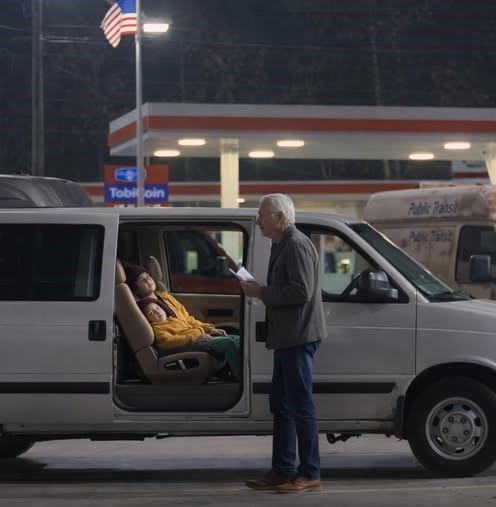
The quiet that followed felt different from the quiet at the gas station.
This quiet had something living inside it.
Maya stood on the porch holding Aaliyah, trembling, tears still falling silently. Malik leaned against her legs. I placed my hand on my grandson’s head and felt the warmth of his hair under my palm.
Inside the house, Maya sat on the couch with Aaliyah tucked close, her body still rocking even when she wasn’t moving. Malik sat beside her with his stuffed doll, staring at the baby’s tiny hands.
I watched them for a long time, unable to sit. My heart felt too full, too tight.
“Pops,” Maya whispered finally, her voice hoarse. “I can’t believe she’s here.”
“She’s here,” I said. “And she stays.”
The months that followed were not easy, but they were real.
Morning routines became our anchor. Rice and eggs. Toast when the bread was on sale. Coffee for me, tea for Maya. Aaliyah’s cries at dawn. Malik’s careful quiet, his sensitivity to sound, his need for slow gentleness.
Twice a week, I took Malik to therapy. The clinic smelled like disinfectant and crayons, an odd combination that somehow made sense. Malik didn’t talk much, but the therapist taught him ways to communicate without panic. He started to look people in the eye more often. He started to point and make small sounds that meant more than they seemed.
Maya continued counseling too. At first it was for court records, then it became something else, something she chose for herself.
“Postpartum depression doesn’t mean you’re unfit,” the counselor told her. “It means you needed support and you didn’t get it.”
Every time Maya heard that, her shoulders loosened a little more.
The condo case moved forward in paperwork and hearings. Compensation came in pieces, not all at once. When it finally arrived, we used it carefully. Paying debts. Fixing the leaky roof. Buying a better mattress. Setting aside money in accounts for the children so nobody could claim it was theirs to control.
We weren’t rich.
But we weren’t sleeping in a van anymore.
One late afternoon, Maya and I sat on the porch while the kids played on a mat with a secondhand toy train. The sun dipped low, turning the street orange. A neighbor’s radio played faintly somewhere nearby.
“Pops,” Maya said quietly, “if you hadn’t passed that gas station that night…”
I looked at her.
“If I hadn’t said what I said years ago,” I replied, “maybe you wouldn’t have felt like you had to survive without me.”
She swallowed. “I believed you meant it.”
“I did,” I admitted. “And it was wrong.”
She leaned her head back against the porch post, eyes closing for a moment.
“I promised myself I’d never be a grumpy parent like you,” she said.
“And?” I asked.
A small smile tugged at her mouth. “Now I’m glad you’re grumpy,” she said. “If you’d stayed quiet, I might not have made it.”
I let out a low laugh that surprised me with how close it was to a sob.
We heard things about Marcus and Beatrice through others. The condo sold. Legal obligations and debts followed. Marcus took odd jobs. Beatrice withdrew from people who once nodded at her in hallways. Their world got smaller the way ours once had.
One day, by accident, we passed through their area.
I saw Marcus sitting outside a small rental, smoking, staring at the street like he was waiting for something that wouldn’t come. Beatrice sat beside him in a plastic chair, rigid, eyes fixed forward.
Marcus glanced up and our eyes met for a brief moment.
In me, something old and hot flared.
I could have told him what I’d wanted to say since the gas station. I could have let him taste shame.
Instead, I tapped the driver’s shoulder.
“Keep going,” I said.
Maya looked at me, then down at Malik and Aaliyah. She understood.
Revenge would have made us smaller. It would have pulled us into their kind of ugliness.
Our work was here, in this cramped house where no one was ashamed of Malik and no one could steal Aaliyah.
That night, after the children fell asleep, I sat on the edge of the mattress in the dim room and watched Maya sleeping between Malik and Aaliyah. Their breathing was soft and steady, the rhythm of safety.
I thought of the gas station, the cold van, Maya’s hollow cheeks, Malik curled up like he wanted to disappear.
I had been late. Too late for so many things.
But not too late for this.
I reached out and gently smoothed Maya’s hair back from her forehead, careful not to wake her.
“I almost lost you,” I whispered into the quiet. “I won’t make that mistake again.”
Outside, the city hummed faintly, indifferent.
Inside, my family slept.
And for the first time in a long time, my chest wasn’t filled with rage.
It was filled with something steadier.
A home reclaimed. A father redeemed. A promise kept.
The first night Aaliyah slept under our roof, Maya didn’t really sleep at all.
She lay on the couch with the baby tucked into the crook of her arm, her eyes open in the dim light like she was afraid the moment would dissolve if she blinked. Every tiny sound made her tighten. The soft click of the heater. A car passing outside. Malik shifting on his mattress in the corner.
I sat in the kitchen with a cup of coffee that had gone cold, listening to the house breathe. Aaliyah’s faint newborn noises drifted in and out, little sighs and hiccupy whimpers that sounded like life insisting on itself.
Around two in the morning, Maya whispered, “Pops?”
I stood in the doorway of the living room. “I’m here.”
She didn’t look at me at first. Her eyes stayed on the baby’s face, as if she needed to memorize every eyelash.
“I keep thinking they’re going to come back,” she said.
I stepped closer and lowered my voice. “They won’t. Not tonight.”
“But they’ve taken things before,” she whispered, and the fear under her words wasn’t just about Marcus. It was about everything she’d learned the hard way: that doors can close, that people can smile while they’re sharpening knives.
I pulled a chair over and sat beside her, careful not to jostle Aaliyah.
“You’re not by yourself anymore,” I said. “If anyone comes, they’re meeting me first.”
Maya finally looked up. Her eyes were swollen, her lashes stuck together from dried tears, but there was something steadier in her expression than I’d seen at the gas station.
“What if I mess up?” she asked. “What if I get tired and cry and they use it again?”
“You can cry,” I told her. “You can be tired. You can be human. None of that makes you unfit.”
Her mouth trembled.
In the silence that followed, Malik made a small noise from his mattress, a soft distressed hum. He was half asleep, arms wrapped around his stuffed doll, his face tense even in dreaming.
Maya flinched automatically, guilt flickering across her face. The guilt always came first for her, even before breath.
“I should go check him,” she whispered.
“I’ll do it,” I said, standing.
Malik’s eyes opened when I knelt beside him. He stared at me, unfocused for a second, then relaxed slightly when he recognized my face. I didn’t speak loudly. I knew better now. I simply smoothed his hair and adjusted the blanket over his shoulders.
“Safe,” I murmured, a word he understood more by tone than meaning. “Safe.”
He blinked slowly and closed his eyes again.
When I stood up, I saw Maya watching me from the couch, Aaliyah pressed to her chest. She looked like someone trying to rebuild a world out of broken pieces.
In the morning, the house woke the way it always had since Maya came back. Slowly, carefully.
The sunrise made a thin stripe of pale gold across the floor. Malik sat cross-legged on the rug, lining up plastic blocks in a straight line, his way of making order. Maya sat on the couch nursing Aaliyah, her face drawn but calm, her body finally doing what it had been made to do without someone judging her for it.
I cooked rice and eggs and set a plate down in front of Maya.
“You need to eat,” I told her.
She shook her head at first, instinctively, the way people do when they’re used to hunger. Then she took a small bite. Her eyes closed briefly as if the taste reminded her she was reminding her body how to live.
When Xavier called that afternoon, his voice was brisk but satisfied.
“Delivery confirmed,” he said. “Good. Now we stay clean. No contact unless through me. They’ll try to bait you into mistakes.”
“What happens next?” Maya asked, leaning forward. Aaliyah slept against her shoulder, tiny fist curled.
“The next hearing will formalize visitation,” Xavier said. “Marcus is going to push for unsupervised access, and Beatrice will push for influence. We’re going to push back with evidence and consistency.”
Maya’s fingers tightened on the phone.
“I don’t want them alone with her,” she said quietly.
“Then we build the strongest case possible,” Xavier replied. “And Maya, keep going to counseling. Keep attending every appointment. Not because you need to prove you’re sane, but because the court needs to see stability and support.”
After Maya hung up, she sat staring at the wall for a long moment, not moving.
“You all right?” I asked.
She swallowed. “I hate that I have to prove I’m a good mother when they’re the ones who stole my baby.”
I felt my jaw tighten. “That’s why we don’t miss a single step,” I said. “We don’t give them even an inch.”
The first supervised visitation was arranged two weeks later at a family services office that smelled like disinfectant and crayons. The waiting room had faded posters about healthy communication and coping skills.
Marcus arrived in a clean shirt and pressed pants, looking like a man walking into an interview. Beatrice came with him, of course, wearing a stiff smile and carrying a diaper bag as if she expected to take over the moment she sat down.
Maya held Aaliyah against her chest, her arms protective but her face composed. Malik sat close to her, hands over his ears because the fluorescent lights buzzed and the room echoed.
When Marcus saw Malik, his eyes flicked away too quickly.
Beatrice’s gaze lingered longer, sharp and assessing, as if Malik were a problem she had to endure.
A caseworker named Denise greeted us. She was middle-aged, calm, and tired in the way people get when they’ve seen too many families try to hurt each other.
“Ground rules,” Denise said. “No raised voices. No accusations. The focus is the children.”
Marcus nodded like he’d been rehearsing humility.
Beatrice smiled thinly.
Maya said nothing. She simply shifted Aaliyah slightly so the baby’s head rested more comfortably.
Denise led us into a room with two chairs, a small couch, and a bin of toys.
Marcus sat on the edge of one chair and held his hands together, trying to look restrained and sorrowful. “Maya,” he began, voice gentle, “I just want to see my daughter.”
Maya didn’t flinch. “Then look,” she said quietly.
Denise nodded at Maya, and Maya slowly unwrapped Aaliyah from her blanket just enough for Marcus to see her face.
Marcus leaned forward. His expression flickered into something that might have been tenderness, but it didn’t last. His eyes kept darting to Denise, to the clipboard, to what was being recorded.
Beatrice reached out immediately.
“Let me hold her,” she said, her voice too bright. “Grandma’s been worried sick.”
Maya tightened her grip. “No.”
Beatrice’s smile faltered. “Excuse me?”
Maya’s voice stayed calm. “You don’t get to act like this is normal. You don’t get to take her from me and then reach for her like you didn’t.”
Denise cleared her throat. “Mrs. Thorne, you may hold the baby when Maya is comfortable, and when it is appropriate under the agreement.”
Beatrice’s mouth tightened, but she nodded stiffly. “Of course.”
Marcus tried again. “Maya, we can fix this without all the bitterness. You’re making things harder than they need to be.”
My chest burned, but I stayed silent. This wasn’t my conversation to dominate.
Maya lifted her eyes to Marcus. “Harder,” she repeated quietly. “You changed the locks and kept my newborn. Don’t talk to me about hard.”
Marcus’s face hardened for a split second before he smoothed it again. “You weren’t well.”
Denise’s pen moved.
Maya didn’t raise her voice. “I was tired,” she said. “I was postpartum. I needed support. You wanted control.”
Marcus leaned back, jaw tight.
Beatrice spoke sharply. “We protected that baby.”
Denise looked up. “From what, exactly?”
The silence that followed was thick.
Beatrice glanced at Marcus, then looked away. “From instability,” she said finally, vague and careful.
Denise wrote something down and said, “Visitation will remain supervised for now.”
Beatrice’s eyes flashed.
Maya’s shoulders loosened just a fraction.
On the ride home, Maya stared out the bus window, holding Aaliyah close.
“He didn’t even look at Malik,” she whispered.
I nodded. “Malik doesn’t fit the story they want to tell about themselves.”
Maya’s mouth tightened. “And that’s exactly why I can’t let them shape Aaliyah’s life.”
The weeks kept moving, each one filled with small routines that saved us.
Therapy for Malik twice a week. Maya’s counseling sessions every Tuesday. Grocery runs timed around Aaliyah’s naps. Paperwork appointments with Xavier. Calls with Denise. Forms that needed signatures. Receipts that needed saving. Names and dates written down like they were precious.
Some days felt almost normal.
Other days felt like war disguised as schedules.
The condo case dragged on in the background, a slow grind of numbers and documents. Xavier explained it to me in plain language in my kitchen, sitting at the table where my bills used to pile up.
“The judge will determine proportional interest,” he said, tapping the folder. “Your transfer is evidence. The letter from your late wife helps establish intent. Marcus will keep saying it was a gift, but the court is already leaning toward shared equity because of the circumstances and the custody findings.”
Maya listened with her hands wrapped around a mug of tea, eyes tired but focused.
“Does that mean we get the condo back?” she asked.
“Not necessarily the property itself,” Xavier replied. “More likely compensation. Marcus may be forced to refinance, sell, or pay out your interest.”
Maya swallowed. “I don’t want that condo,” she said. “I want my children safe.”
“And money buys stability,” Xavier said gently. “Not happiness, but stability. The kind you didn’t have when they threw you out.”
One afternoon, a letter arrived addressed to Maya from Marcus’s lawyer. The envelope looked official enough to make her hands shake.
She sat at the table staring at it for a long time before opening it. When she finally did, her face drained.
“They want to reassess Malik,” she whispered. “They’re claiming he’s being neglected because he has tantrums.”
I felt my stomach drop.
“They’re trying again,” I said.
Xavier read the letter and nodded grimly. “It’s a strategy,” he said. “They want to paint you as overwhelmed and unfit, then argue Malik should be with them too, even though they’ve never cared for him. We counter with therapy records, school evaluations, and testimony from professionals.”
Maya’s voice cracked. “They don’t even like him.”
“That doesn’t matter to them,” I said quietly. “What matters is winning.”
The next hearing came a month later, smaller than the first but still heavy. Marcus arrived with his lawyer and Beatrice at his side, her expression practiced. Maya walked in holding Aaliyah, with Malik clutching her sleeve. I sat behind them, my hands clasped so tightly my fingers hurt.
The judge reviewed the visitation reports. Denise testified calmly that Maya was cooperative, consistent, and attentive, and that Marcus’s focus appeared “more procedural than relational.”
Beatrice’s lawyer objected loudly, but the judge didn’t flinch.
When Xavier presented Malik’s therapy progress notes, the judge’s face softened slightly as he read.
“Child shows improvement in regulated environment,” the judge said, looking toward Marcus. “Where has the father been in these appointments?”
Marcus’s lawyer spoke quickly about work schedules and logistics.
The judge’s gaze sharpened. “Convenient,” he said.
Beatrice shifted in her seat, her lips tight.
Maya sat perfectly still, holding Aaliyah close, Malik’s small hand gripping her shirt.
In the end, the judge maintained supervised visitation and reinforced custody orders.
When we walked out, Maya’s legs looked shaky.
I put a hand on her shoulder. “One step at a time,” I said.
She nodded. “I’m tired, Pops.”
“I know,” I replied. “But you’re not running anymore.”
That night at home, Malik lined up his blocks again. Aaliyah slept in her bassinet for the first time in our house, her tiny chest rising and falling steadily. Maya sat on the couch with a blanket over her shoulders, staring at her hands.
“Do you ever think about that night?” she asked quietly. “The gas station.”
“All the time,” I said.
She swallowed. “I didn’t think you’d come,” she admitted. “I thought you’d look at me and say I deserved it.”
My throat tightened. I stared at the floor for a long moment before answering.
“I said terrible things,” I whispered. “But I never stopped being your father.”
Maya’s eyes filled again, but she didn’t cry loudly. She just let the tears sit there, shining, like she was finally allowing herself to feel without fear of punishment.
“I’m scared,” she said. “Not of them. Of messing up again. Of trusting the wrong people.”
I moved closer, lowering my voice. “Then you trust what you can see,” I told her. “Your children. Your own hands. The truth. Not charm.”
She nodded slowly, like she was absorbing it.
Outside, the neighborhood settled into night. Porch lights clicked on. Distant voices drifted through the window. Ordinary life continuing.
Inside, the three of us and one tiny baby sat in a small room that finally felt like it belonged to us.
And even though the case wasn’t finished, even though Marcus and Beatrice hadn’t stopped trying to claw their way back into control, one thing had changed for good.
They had learned we would answer.
Every time.
The pressure didn’t ease after that hearing. It shifted.
Instead of loud accusations and dramatic gestures, Marcus and Beatrice grew quieter, sharper. Like people who had learned that shouting only got them noticed, and that silence could be more dangerous.
Two weeks after the hearing, Maya received a message through Xavier. A request for mediation. No lawyers present, they said. Just family. Just talking.
Maya stared at the phone like it might bite her.
“They want to meet without witnesses,” she said. “Why now?”
“Because the court didn’t give them what they wanted,” I replied. “And because they think they can still bend you if they catch you tired.”
Xavier’s voice crackled through the speakerphone. “We don’t go alone. If there’s a meeting, it’s in my office, on record, with terms agreed beforehand. Otherwise, it doesn’t happen.”
Maya exhaled slowly. “Then tell them no.”
Xavier did. The reply came back colder.
Marcus would proceed with further legal action.
Beatrice would seek expanded visitation rights.
They would push again for Malik.
The words sat on the table between us like a threat wrapped in stationery.
That night, Maya barely touched her food. Malik pushed peas around his plate methodically, lining them up. Aaliyah slept in her bassinet, unaware of how much of the world was arguing over her future.
“I feel like I’m always bracing,” Maya said quietly. “Like I can’t relax because something bad might come next.”
I nodded. “That’s what living under control does to a person. Even after the door opens, your body still expects it to slam shut.”
She looked at me. “Does it ever stop?”
I thought about my own life. About the years after my wife died. About the silence I had lived in, believing distance was punishment I deserved.
“It doesn’t stop all at once,” I said. “But it loosens. Slowly. When you keep choosing yourself instead of fear.”
The next blow came from an unexpected place.
One afternoon, while Maya was at a counseling session and I was home with the children, a letter slid through the mail slot. No return address. Typed. Neat.
Inside was a single page.
If you cared about those children, you would let them have a better life. Pride is a sin. Don’t force them to suffer with you.
I didn’t need a signature to know who had written it.
My hands shook as I folded the paper back into the envelope. I felt anger rising, hot and old, but beneath it was something steadier now. Certainty.
When Maya came home, I showed her the letter without saying a word.
She read it once. Then again.
Her jaw tightened. She didn’t cry.
“They still think I’m disposable,” she said. “That I should disappear quietly.”
“They think the world still works the way it used to for them,” I replied. “Where money and posture decide who deserves love.”
She looked at Malik, who was humming softly to himself as he stacked blocks, and at Aaliyah, who had just woken and was stretching her tiny fingers.
“They don’t get to decide that anymore,” Maya said.
At the next court date, Xavier asked for the letter to be entered into the record.
Marcus’s lawyer objected, saying it was anonymous.
The judge lifted an eyebrow. “Anonymous messages intended to intimidate a custodial parent are relevant,” he said. “Especially given the history.”
Beatrice shifted in her seat.
Marcus stared straight ahead.
The judge reviewed everything again. Therapy attendance. Visitation notes. The social services follow-up report that now clearly stated Malik was thriving in a stable environment. The letter from the clinic confirming Maya’s consistent participation and improvement.
Then came the condo footage.
The courtroom went silent as the screen flickered to life.
There was Maya on the hallway floor, Malik crying, her knocking on the door. There was Marcus’s voice from inside. Beatrice’s sharp tone, unmistakable.
Let her stay out there so she learns.
Maya closed her eyes. I felt her hand grip my sleeve.
The judge watched without expression.
When the video ended, no one spoke for a long moment.
“That recording,” the judge said finally, “removes all doubt about the events in question.”
Marcus’s lawyer tried to speak.
The judge held up a hand.
“I have seen enough,” he said.
The final ruling came two weeks later.
Full custody of Malik and Aaliyah to Maya Stovall.
Supervised visitation for Marcus, conditional and reviewable.
No unsupervised contact for Beatrice.
Financial compensation finalized from the condo sale, with penalties for wrongful eviction.
A restraining order barring further harassment.
When the judge finished reading, Maya didn’t react at first. She just sat there, still, like her body needed time to catch up to the words.
Then her shoulders started to shake.
She covered her face and cried in a way that sounded like something breaking free.
Outside the courthouse, the sky was bright and clear. The flag above the building snapped in the wind. People walked past us, laughing, talking, unaware that our entire lives had just shifted.
Maya hugged me hard.
“Pops,” she whispered, “it’s over.”
I held her as tightly as my old arms would allow.
“Yes,” I said. “Now it is.”
Life after the case was quieter.
Not easy, but quieter.
Maya found part-time work through a community program, something flexible that allowed her to be home when Malik needed her. She started taking classes again, slowly, rebuilding the future she had once believed was gone.
Malik continued therapy. He began using more words. One afternoon, while playing with his toy train, he looked up at me and said, clearly, “Grandpa.”
I had to turn away so he wouldn’t see my face.
Aaliyah grew chubby and loud and demanding, exactly as a baby should be. She slept best when Maya sang to her, a soft, off-key song my wife used to hum years ago.
Sometimes, late at night, Maya and I sat on the porch, listening to the city.
“Do you regret it?” she asked once. “Helping me like this. Losing your savings. Moving again.”
I thought about the gas station. The van. Her hollow eyes in the dim light.
“I regret that it took me so long to find you,” I said. “Nothing else.”
She leaned her head on my shoulder.
Marcus tried once more to contact us months later. A message through a third party. An apology that sounded carefully constructed, like it had been edited too many times.
Maya read it and handed the phone back to me.
“I’m done,” she said simply.
And she was.
One evening, as the sun dipped low and painted the street gold, Malik and Aaliyah played on the floor while Maya cooked dinner. The house smelled like onions and rice. Ordinary. Safe.
I sat at the small table, watching them, feeling something I hadn’t felt in years.
Not relief.
Purpose.
I had once told my daughter never to call me father again.
That night at the gas station, I was given a chance to take those words back with action instead of apology.
I didn’t fix everything. I didn’t erase the past.
But I stood up when it mattered.
And in the quiet of that small house, with my daughter laughing softly and my grandchildren safe within arm’s reach, I knew something with certainty.
This was not the life they wanted us to have.
It was better.