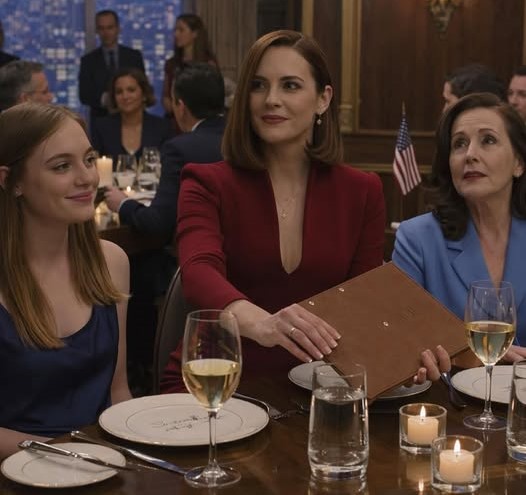
The check didn’t arrive loudly.
It didn’t slap the table or come with an announcement. There was no clearing of throats, no nervous cough from a waiter trying to read the room. It simply appeared—placed neatly, deliberately, in front of me—like this was how things had always been done.
Like this was normal.
We were in the private dining room at The Monarch, one of those Chicago restaurants people mention casually to signal status. Not “we went out to eat,” but “we did The Monarch,” as if it were a verb. The kind of place where the lighting is warm enough to flatter everyone and the prices are high enough to discourage questions.
It was my sister Lauren’s birthday. Or rather, her moment. She had turned thirty-five, but that wasn’t what we were celebrating. We were celebrating her. Her brand. Her “launch.” Her feature in a glossy local magazine that described her as a visionary creative without ever explaining what she actually did.
Lauren sat at the head of the table, positioned just so beneath a pendant light that made her hair gleam like it had been edited in post. She wore a cream blazer over a silk top, minimal jewelry, perfectly imperfect waves. Effortless. Expensive. Studied.
Behind her, leaning against the wall like an altar piece, was a poster-sized print of the magazine spread. Her face, airbrushed and serene. The headline floated above her like a blessing.
RISING STYLE VISIONARY
I’d come straight from work.
From my classroom on the South Side, where the heat sometimes didn’t work and the kids argued over broken pencils and whose turn it was to read aloud. I still smelled faintly of dry-erase markers and copy paper. My blazer was from Target. My shoes were sensible. I hadn’t had time to change.
I was already out of place before I sat down.
My mother, Susan, stood to give the toast. She always stood. Even when it wasn’t necessary. Even when everyone could hear her just fine. She liked the way it made people look up.
She tapped her fork against her champagne flute with a practiced smile.
“To Lauren,” she said, voice thick with pride that felt rehearsed down to the syllable. “The bravest person in this family. The one who isn’t afraid to dream big and do something about it.”
She raised her glass toward my sister, eyes shining.
Everyone followed suit. Applause filled the room. Not wild, not messy—polite, admiring. Lauren smiled modestly, the way you smile when you want people to know you’re used to being celebrated.
I clapped too. Softly. Automatically.
This was the rhythm of our family. Lauren shines. We orbit.
Then the waiter arrived.
Tall. Impeccably dressed. The kind of man who moved through the room like he belonged there but never drew attention to himself. He carried the leather check presenter with one hand, balanced perfectly.
He didn’t go to my mother.
He didn’t go to my father.
He didn’t go to Lauren.
He walked straight to me and placed it gently beside my water glass, angling it so it opened toward me.
For a second, I didn’t move.
I stared at it, hoping—irrationally—that it was something else. A menu. A wine list. A mistake.
I opened it.
$3,450.00
The number sat there calmly, confidently. No apology. No explanation.
Just expectation.
My mother leaned in, her perfume—something floral and expensive—wrapping around me like a warning.
“Teacher salaries are stable,” she murmured, patting my arm with a manicured hand. “Support your sister. It’s the least you can do.”
The words landed softly. Gently. Like this wasn’t a big ask. Like this wasn’t the thousandth time.
Across the table, Lauren watched me over the rim of her glass. Not worried. Not embarrassed.
Amused.
I thought of the last-minute flights I’d covered. The “emergencies.” The Venmo requests that never came back. The quiet assumption that if something needed paying for, I would handle it.
Because I always had.
My heart didn’t race.
It slowed.
I closed the check presenter and slid it back across the table until it touched the stem of my mother’s champagne flute.
The clink was small. Precise. Loud enough.
The room went still.
My mother stared at the folder like it had personally betrayed her. Lauren’s smile faltered as she glanced around, suddenly aware of the silence.
I stood.
“I think the brand should pay for the launch,” I said.
My voice was calm. Steady. The same voice I used when my classroom was about to spiral and I needed thirty teenagers to know I meant business.
I didn’t wait for a response.
I turned and walked out.
The cold air hit my face like a reset. The city moved around me, indifferent and alive. Jacob followed without a word, opened the car door, and waited until I was inside before getting in himself.
We drove home in silence.
I waited for guilt. For panic. For the urge to apologize.
It never came.
When we pulled into our driveway and I stepped into the quiet of our apartment, I realized something had shifted.
I hadn’t just refused to pay the bill.
I’d closed an account.
And for the first time in years, my balance—emotional and otherwise—was finally my own.
The first thing I noticed when we got home was how quiet our apartment sounded.
Not the eerie quiet of loneliness, but the kind of stillness that comes when no one is performing. No one is competing for the spotlight. No one is nudging you with their elbow and whispering instructions about how to behave.
Jacob turned the key in the lock behind us, and the soft click felt like punctuation.
I stood in the entryway with my coat half off, my shoulders slowly lowering as if they had been braced all evening and were only now realizing they could unclench.
My phone started vibrating almost immediately.
At first it was a single buzz. Then two. Then a steady angry pulse against the wood of the nightstand where I’d tossed it. The screen lit up in spasms, bright as lightning in the dim room.
Lauren first.
Are you insane? You humiliated me in front of everyone.
Then my father.
Your mother is crying. You need to fix this now.
Then my mother, Susan, in a voicemail I didn’t listen to, but the preview text was enough:
I don’t know who you think you are, but you’re not going to ruin this family…
The words stacked so quickly I couldn’t even read all of them.
It was familiar, the barrage. The coordinated pressure. The tone that implied I’d committed a crime by doing something as simple as refusing to be used.
I should have felt guilty. I should have felt shaken.
Instead, I felt strangely detached, like I was watching a storm through thick glass.
Jacob walked into the kitchen without saying anything, filled the kettle, and set it on the stove. He moved calmly, deliberately, like he was giving my nervous system something steady to mirror.
When the kettle clicked on, he leaned back against the counter and looked at me.
“You okay?” he asked.
I stared at my phone again, the notifications still coming.
“I don’t know,” I said honestly. “I think I just… quit.”
Jacob let out a short breath that sounded almost like a laugh, but there was no humor in it. “Good,” he said. “It was about time.”
I sank onto the edge of the couch and finally listened to the silence inside myself.
Not emptiness.
Relief.
The kind that feels wrong at first because you’ve been trained to believe relief means you’re selfish.
The phone buzzed again. I didn’t pick it up.
Instead, I walked to the bedroom and laid it facedown on the bed like I was putting a lid on something toxic. Then I went back into the living room, grabbed my laptop, and opened it on the coffee table.
Jacob raised an eyebrow. “What are you doing?”
“Math,” I said.
He didn’t question it. He just brought me a mug of hot water and sat on the other end of the couch, close enough to be present but not close enough to crowd me.
The screen glowed blue in the dim room. I opened a blank spreadsheet.
My cursor blinked in the first cell like a heartbeat.
I titled the sheet: HENDERSON FAMILY LEDGER.
Then I started typing.
Date. Item. Amount. Notes.
At first it was slow, because I didn’t keep records the way an accountant would. I kept memories. And memories have to be turned into numbers carefully, like translating something emotional into something cold.
But once I started, it poured out.
Lauren’s first apartment security deposit. $1,200.
Her move-in fees when she decided she “couldn’t” live with roommates anymore. $850.
Her “networking trip” to L.A. that was actually a week of selfies and brunches. $2,400.
My father’s “unexpected tax issue.” $3,100.
The lawyer consult after his DUI, the one my mother insisted had to be handled discreetly. $5,000.
My mother’s Sedona trip, framed as a “mental health reset.” $800.
The time she cried in my kitchen because she “just needed one more month,” and I paid the credit card bill she’d been hiding from my father. $4,500.
And then the little things.
The phone plan I’d been paying for since college because “it’s easier if it’s bundled.” $110 a month, for years.
The streaming services. The subscriptions. The occasional “can you cover this and I’ll pay you back next week” that turned into silence.
As the numbers grew, my throat tightened.
Not because of the money, exactly.
Because of what the money represented.
Every time I’d dipped into my savings. Every time Jacob and I postponed something we wanted. Every time I took on an extra tutoring gig, not because we needed the income, but because I had a sinking feeling my family would need another rescue soon and I wanted to be ready.
I added a new column and titled it: COST TO ME.
The missed weekends.
The ruined anniversaries.
The emotional labor of constantly managing their crises while pretending I was fine.
By the time I finished, the total at the bottom made my stomach flip.
$42,350.
Jacob leaned forward slightly, eyes narrowing as he read it.
“That’s just the last five years,” I whispered.
He didn’t say anything for a moment. Then he said, quietly, “That’s not help. That’s a dependency.”
I stared at the total again until it stopped being a number and became a shape: a chunk of my life missing.
Then Jacob shifted and reached for his own phone.
“Hold on,” he said, and I watched him scroll through his camera roll.
He’d taken a photo at the restaurant, the moment the waiter placed the check down. I hadn’t even noticed him doing it, but Jacob always noticed things. It was one of the reasons I loved him.
He zoomed in and handed the phone to me.
“Look at the bottom,” he said.
I leaned closer.
Past the steaks and wine and sides, in small print, there was a line item that made my skin go cold.
Private room deposit. Future event hold. $1,500.
“What is that?” I whispered.
Jacob shook his head. “It’s dated. Next month.”
My first instinct was to deny it. To tell myself it was a mistake, some restaurant policy, some random charge.
But I knew better.
A $1,500 deposit wasn’t random. It was planned. It was intentional.
I called the restaurant before I could talk myself out of it.
The manager answered with that polished calm voice people in luxury service develop, like nothing ever surprises them and everyone is always slightly wrong.
“Thank you for calling The Monarch,” he said. “How can I help?”
I kept my voice light. Normal. The way you sound when you’re confirming something harmless.
“Hi,” I said. “I’m calling to confirm the details of the deposit on the Henderson receipt from tonight. We just want to make sure the date is correct.”
I heard keyboard clicks.
“Yes,” he said. “The Tuscany Room is reserved for Susan and David Henderson’s thirtieth anniversary celebration on the fifteenth. The $1,500 deposit secures the room.”
My fingers went numb around the phone.
“The fifteenth,” I repeated.
“Yes, ma’am.”
I thanked him and hung up.
For a moment, I just sat there with the phone in my lap, the apartment suddenly too warm, my skin buzzing.
My mother had told me their anniversary celebration was canceled this year. She’d said money was tight. She’d said they were cutting back.
They weren’t cutting back.
They were cutting me in.
They tried to slide a $3,450 check in front of me and tucked a private room deposit inside it like a hidden blade.
They had expected me to pay for my sister’s launch and their anniversary party without even telling me it existed.
I looked at Jacob, my voice barely working. “They weren’t even going to invite me.”
Jacob’s jaw tightened. “No,” he said. “They were going to invite your wallet.”
I sat very still, because if I moved I might start shaking.
This was bigger than one dinner.
This was a system.
A machine they’d built around me, a machine that took and took and then demanded gratitude for the privilege.
And tonight, I had jammed my hand into its gears.
I should have been proud.
Instead, I felt something close to grief.
Because somewhere inside me, a small part had still believed my family loved me. Not just what I provided, but me.
Now that illusion was cracking, and cracks are loud even when no one else can hear them.
Sunday afternoon proved it.
My dad texted: We’re downstairs. Buzz us up. We need to settle this.
I stared at the message until the letters blurred.
Jacob stood at the counter, arms crossed, watching my face.
“You want me here?” he asked.
“Yes,” I said immediately. Then I exhaled. “But stay in the bedroom. I need to do this alone.”
I needed them to see me standing on my own. Not behind Jacob. Not with backup.
Just me.
I buzzed them in.
When I opened the door, the hallway seemed to shrink as they stepped in, bringing their energy with them like a draft.
My father entered first, shoulders squared, expression heavy with disappointment. My mother followed, holding her purse tight and wearing pearls, as if she’d dressed for moral authority. Lauren came last, oversized sunglasses still on, the dramatic flourish of someone making sure her suffering was visible.
They didn’t take off their coats.
They didn’t say hello.
They walked into my living room like they owned it.
“Sit,” my father said.
Not a request.
A command.
I didn’t sit immediately. I walked to the coffee table and placed a manila folder down with a quiet thud.
“Before you start,” I said calmly, “we’re going to talk about money.”
My mother’s eyes narrowed. “Madison—”
“No,” I said softly. “You’ve talked long enough.”
I sat then, slow and deliberate, across from them.
They looked at the folder like it was a threat.
It was.
My father leaned forward. “Your mother is humiliated,” he said. “Lauren is devastated. You walked out on a bill in front of people. That’s not who we raised.”
Lauren pulled her sunglasses off dramatically, eyes suspiciously dry. “My investors saw that,” she said. “Do you understand how bad that looks?”
“Investors,” I repeated.
My mother cut in quickly, voice tight. “We’re willing to move past this if you apologize. Pay what you owe. And stop acting like you’re the victim.”
I stared at them, surprised by how steady I felt.
This used to terrify me. Their disapproval used to feel like the end of the world.
Now it just felt… predictable.
I opened the manila folder and slid the receipt photo out first.
I set it on the table with the deposit circled in red.
Then I looked at my mother.
“I called the restaurant,” I said. “Your anniversary party is booked. Next month. The Tuscany Room. Fifteen hundred dollar deposit.”
My mother’s face froze.
Lauren blinked. “What anniversary party?”
My father shifted, suddenly interested in the rug.
My mother recovered quickly, like she always did. “We didn’t want to burden you,” she said, voice softening into that familiar guilt-laced tone. “We knew you were stressed, sweetie.”
I leaned in, my voice still calm. “You didn’t want to burden me, so you hid it inside a bill you expected me to pay.”
Silence fell.
Then I slid the spreadsheet out.
Five pages.
Single-spaced.
A ledger of every “help” that had been a demand.
Lauren’s rent.
Dad’s DUI.
Mom’s trips.
Subscriptions.
Bailouts.
Emergency loans.
Forty-two thousand dollars in five years.
My father’s face reddened. “We raised you,” he said. “You owe us.”
The old line. The one that used to snap my spine into obedience.
I shook my head once. “I don’t owe you my adulthood,” I said quietly. “And I don’t owe Lauren a lifestyle.”
Lauren’s mouth opened in outrage. “Lifestyle? You’re calling my work a lifestyle?”
“I’m calling your funding plan a lifestyle,” I replied.
My mother sat forward. “This is disgusting,” she hissed. “You’re keeping score like some stranger.”
“I’m keeping score because you’ve been charging me interest,” I said.
The words hung in the air, and for the first time, I saw them realize something.
I wasn’t reacting.
I wasn’t pleading.
I wasn’t collapsing.
I was done.
My father stood slowly, looming. “So what, Madison? You’re cutting us off? Over one dinner?”
“Over a decade,” I corrected. “Over a pattern. Over you treating me like an account, not a person.”
My mother’s voice trembled. “You’re being cruel.”
I looked at her, and the sadness rose again, sharp as a blade.
“No,” I said. “I’m being honest.”
Then I pointed at the door.
“Leave,” I said. “And leave your keys.”
My mother blinked fast, trying to recalibrate. “Madison—”
“Now,” I said, still calm.
My father’s jaw tightened, but he reached into his pocket and dropped the key onto the coffee table. The small metallic clink sounded like something ending.
My mother followed, her key landing with a sharper click.
Lauren hesitated, chewing her lip, then tossed hers down last, eyes bright with fury.
They left without another word, coats still on, shoulders stiff.
The door closed behind them, and the apartment fell silent again.
This time, it didn’t feel lonely.
It felt like air.
Jacob came out of the bedroom slowly, like he’d been holding his breath too.
He looked at the keys on the table. Then at me.
“You okay?” he asked again.
I sat back on the couch and exhaled.
“I think,” I said quietly, “I just paid off a debt I didn’t know I’d been carrying.”
Jacob crossed the room and sat beside me, taking my hand. His palm was warm, grounding.
Outside, the city moved as it always did. Cars passed. Wind brushed against the windows. Someone somewhere laughed.
Inside, my phone stayed silent for the first time in years.
And in that silence, I felt something settle in my chest.
Not victory.
Freedom.
The silence after they left didn’t rush in.
It settled.
Slowly. Carefully. Like dust after a door slams.
I stood there for a moment after the click of the lock, staring at the empty space where my family had been, my eyes landing on the small pile of keys on the coffee table. Three keys. Three identical cuts of metal. Three quiet confirmations that something permanent had just happened.
Jacob didn’t speak right away. He never did when he knew words would cheapen the moment. He just stood near the doorway, watching me the way you watch someone who’s just crossed a narrow bridge in the dark.
I sat back down on the couch and rested my elbows on my knees. My hands were still steady. That surprised me more than anything else.
I had always imagined that cutting them off would feel dramatic. Explosive. That I would cry or rage or collapse into Jacob’s arms sobbing about how unfair it all was.
Instead, I felt… empty. But not hollow.
Clean.
Like a room that had finally been cleared of furniture that never belonged there.
Jacob crossed the room and sat beside me, close but not touching at first, giving me space to feel whatever was going to land next.
“Do you want tea?” he asked softly.
I shook my head. “Not yet.”
He nodded and stayed anyway.
For the rest of the evening, we didn’t do much. We folded the manila folder back together, slid it into the drawer where I keep important documents, and left the keys on the table overnight like a boundary marker. Neither of us touched our phones. Neither of us turned on the TV.
At some point, I realized my shoulders didn’t hurt anymore.
I hadn’t noticed how tight they’d been for years.
That night, I slept deeper than I had in a long time. Not dreamless, but calm. No arguments looping in my head. No imaginary conversations where I practiced what I should have said.
When I woke up the next morning, the apartment felt different.
Not bigger. Not brighter.
Just quieter.
My phone was still on the nightstand, facedown. When I picked it up, there were missed calls. Voicemails. A few texts that had slipped through after they left.
Mom: This is not how families behave.
Dad: You’re making a huge mistake.
Lauren: Don’t bother calling me when you need something.
I read them once, then archived the thread.
Not deleted. Archived.
I didn’t need to pretend they never existed. I just didn’t need them in my daily life anymore.
I went to work that Monday like normal. Same commute. Same classroom. Same kids pretending they hadn’t done their homework.
But something subtle had changed in me, and the kids noticed it before anyone else did.
“You look different today,” one of my students said as I handed back essays. “Like… lighter.”
I almost laughed.
“Did I get a better grade?” he asked hopefully.
“No,” I said, smiling. “But good try.”
During my lunch break, I opened my banking app.
I’d done this unconsciously for years, checking it the way some people check the weather—bracing for a storm, expecting damage.
This time, the number didn’t trigger panic.
It just sat there.
My paycheck. Untouched. No surprise withdrawals. No automatic payments for things I didn’t use. No mental math about which emergency might come next.
For the first time since my early twenties, my money was doing exactly what it was supposed to do.
Supporting my life.
Not theirs.
That evening, Jacob and I cooked dinner together. Nothing fancy. Pasta. Garlic. A bottle of wine we’d been saving because it never felt like the right moment.
We ate at the small kitchen table, knees bumping, music playing quietly from his phone.
“So,” he said casually, “what’s the first thing you want to do with your newfound freedom?”
I thought about it.
Not trips. Not revenge purchases. Not dramatic gestures.
“I want to stop apologizing,” I said finally.
He smiled. “For what?”
“For taking up space,” I replied. “For saying no. For not being the solution to problems I didn’t create.”
He raised his glass. “I’ll drink to that.”
The weeks that followed were… strange.
There was no immediate fallout. No screaming messages. No surprise visits. No social media posts aimed at shaming me.
At first, that made me uneasy. I’d been trained to expect escalation. Retaliation. Emotional whiplash.
But as the days passed, I realized something else was happening.
They were recalibrating.
Without my money, my time, my emotional labor, the family machine was stalling. Lauren’s “brand launch” stalled too. A mutual acquaintance mentioned she’d been looking for “new investors.” Translation: new wallets.
My parents’ anniversary party happened without me. I saw photos later through someone else’s Instagram. The Tuscany Room. Champagne. Smiles a little too tight.
They looked fine.
But they didn’t look triumphant.
They looked… strained.
And for the first time, that wasn’t my problem to solve.
One Saturday morning, Jacob found me at the dining table with my laptop open, not working, just… thinking.
“What’s going on in there?” he asked, tapping my temple gently.
“I’m deciding something,” I said.
“Dangerous,” he teased. “Should I be worried?”
“No,” I said, closing the laptop. “You should be excited.”
I’d been offered a summer program abroad through my school district—a professional development opportunity I’d turned down twice before because it didn’t fit with my family’s needs.
Japan. Three weeks. Teaching exchange. Housing covered.
I’d always told myself it wasn’t practical.
What I’d meant was: my family would need me.
“I think I’m going to apply again,” I said.
Jacob’s grin was instant. “I think you should.”
I sent in the application that afternoon.
Two weeks later, I got the acceptance email.
I stared at the screen for a long moment, feeling the old reflex—Who will need me while I’m gone?—rise and then dissolve before it could take hold.
No one.
And that was okay.
Before I left, I did one last thing.
I took the keys from the drawer and walked them down to the hardware store. I handed them over to the clerk.
“Can you recycle these?” I asked.
He nodded. “Sure.”
I watched as he dropped them into a bin behind the counter, the metal clinking softly against others that had once unlocked something important.
When I stepped back outside, the air felt lighter.
On my last night before the trip, Jacob and I stood on the balcony of our apartment, city lights stretching out below us.
“You know,” he said, leaning against the railing, “most people don’t get a clean break like this. They carry the guilt forever.”
I thought about my mother’s voice, my father’s disappointment, my sister’s smirk at that dinner table.
“I didn’t get a clean break,” I said. “I just stopped bleeding.”
He reached for my hand.
In Tokyo, I learned how to exist without being needed.
I walked unfamiliar streets. Ate meals alone without checking my phone. Sat in silence without filling it for someone else’s comfort.
I realized how much of my identity had been built around being reliable, responsible, available.
And how little of it had been built around being happy.
When I came home, jet-lagged and glowing in that quiet way travel gives you, there was one new message waiting.
From my mother.
Just one line.
I hope you’re happy.
I stared at it for a long moment.
Then I typed back.
I am.
And that was the truth.
The account was closed.
The ledger balanced.
And for the first time in my life, the future belonged to me.