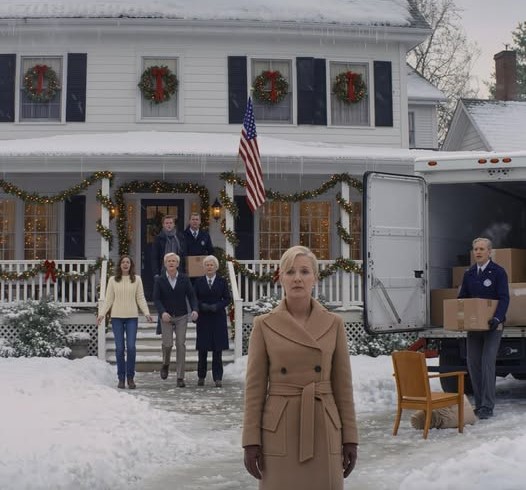
If you think the worst thing parents can do on Christmas is forget a gift, try standing on a marble porch while they order security to throw you and your eighty-two-year-old grandfather into a blizzard.
My name is Phoebe Gray. I was twenty-eight years old that winter, and my entire life fit into a dented ten-year-old sedan that smelled like fryer grease and old coffee. I worked as a line cook at a Denver diner called the Rusty Lantern Grill, the kind of place where the heat clings to your skin and never quite leaves. Even on my days off, I smelled like oil and soap.
The night everything broke, I smelled like that grease while driving through a snowstorm toward Crest View Heights.
The windshield wipers scraped uselessly against the glass, fighting heavy, wet snow that blurred the world into streaks of white. My heater coughed out lukewarm air that smelled faintly of burning dust. My hands were cracked raw from winter air and dish soap, knuckles split open, gripping the steering wheel so hard my fingers throbbed.
I should have turned around.
Every instinct I had, sharpened by years of rejection disguised as concern, told me to go back to my cramped Eastfield apartment and pretend the invitation had never happened.
But I kept driving because of my grandfather.
Arthur Hail had called me two days earlier. His voice, usually steady and dry, had sounded thin, like paper worn soft by time.
“Just this Christmas, kid,” he’d said. “Sit next to your old grandpa one more time.”
I couldn’t say no. Not to him.
He was eighty-two, his body failing in quiet, humiliating ways, and he lived in a ten-thousand-square-foot house that only felt humane when he was inside it. Without him, it felt hollow. Too big. Like a museum dedicated to other people’s egos.
The iron gates of my parents’ estate loomed out of the snow like something alive. Beyond them, the house glowed gold against the storm, stone and glass lit from within, defiant and warm while the wind howled outside.
This was the kingdom of Graham and Vivien Hail.
My father, Graham, was the CEO of Hail Horizon Properties, a man who looked at city skylines and saw numbers instead of neighborhoods. My mother, Vivien, ran what she called the “hospitality division,” which meant she curated wealth the way other people curated art.
A valet stepped toward my car, his uniform sharper than anything I owned. His eyes flicked over my sedan with open disdain. I handed him the keys without comment. I didn’t warn him about the clutch. I just wanted to get inside, endure the night, and leave.
The moment I stepped through the massive oak doors, warmth slammed into me. Heat. Pine. Roasting meat. Perfume so expensive it made my head ache.
The foyer buzzed with sound. A string quartet played Vivaldi in the corner, their music swallowed by the chatter of politicians, bankers, donors. Crystal chandeliers spilled light onto marble floors. A towering spruce tree dominated the great hall, decorated with ornaments that looked hand-blown and fragile enough to shatter if you breathed wrong near them.
I felt instantly, crushingly out of place.
I wore a black dress I’d found at a thrift store. It pulled awkwardly at the shoulders and rode up when I walked. On my feet were black non-slip work shoes because I couldn’t afford heels that wouldn’t destroy my feet after twelve-hour shifts.
I tucked my hands behind my back to hide the scars and burns and scanned the room. Family friends recognized me, then looked away, as if poverty were contagious.
I found Grandpa Arthur in the far corner of the dining room, well away from the fireplace.
He sat in his old wheelchair, the metal frame scuffed and tired, wearing a beige cardigan that had lost its shape decades ago. His head was bowed slightly, shoulders slumped, as if apologizing for existing.
“Grandpa,” I whispered, kneeling beside him.
His cloudy eyes cleared when he saw me. A smile broke across his face, slow and genuine, and his thin hand closed around mine. His skin felt like paper, cold despite the warmth of the room.
“You came,” he said.
“I promised,” I replied.
Across the room, I felt my mother’s gaze lock onto my back like a blade.
For the first hour, we might as well not have existed.
I fetched Arthur sparkling water because Vivien had forbidden whiskey, claiming it interfered with his medication. I knew the real reason. She didn’t want him smelling like alcohol in front of the senator.
We watched the performance.
My father held court near the fireplace, glass of amber liquid in hand, laughing too loudly. His silver hair was perfect, his suit immaculate. He looked like a man magazines loved.
Vivien moved through the crowd with practiced elegance, adjusting centerpieces, whispering instructions, ensuring every guest felt important.
Then dinner was announced.
We were seated at the far end of the long mahogany table, the place reserved for children and expendable relatives. Belgian linen so white it hurt the eyes covered the table. The smell of roast duck and cherry reduction made my stomach tighten with hunger. I hadn’t eaten since dawn.
Arthur struggled with his utensils. His Parkinson’s had worsened, something my parents pretended not to see because acknowledging it would require effort.
The clink of his fork against fine china echoed louder than it should have. Conversation dipped.
“Let me help,” I whispered.
“I can manage,” he said, jaw tight. “Just need a moment.”
He reached for his wineglass.
I saw the tremor start.
It happened slowly, painfully slow.
His hand jerked. The glass tipped. Red wine spilled across the white tablecloth, blooming outward like a fresh wound. The crystal struck the plate and shattered, shards skittering. Cherry sauce splashed onto the centerpiece.
The quartet stopped.
Laughter died.
Silence swallowed the room.
I grabbed napkins, blotting uselessly.
“It’s okay,” I whispered. “It’s just a cloth.”
Vivien stood. Her chair scraped loudly.
She didn’t look at me. She looked at Arthur.
“Look what you’ve done,” she said.
Her voice was calm, precise, and cruel.
“Vivien, it was an accident,” I said, standing.
“An accident?” She laughed, brittle. “He is an accident, Phoebe. A walking disaster. This linen was custom-ordered.”
Graham approached, irritation flushed across his face.
“For God’s sake, Dad,” he snapped. “Can you not get through one meal without embarrassing us?”
Arthur stared at his lap.
“I’m sorry,” he murmured. “My hand slipped.”
“It always slips,” Vivien said sharply. She turned to the guests. “Do you see what we deal with? We took him in when he had nothing. And this is our reward. He’s useless. Just a useless old man.”
My blood went cold.
“Stop,” I said.
Graham’s gaze swung to me.
“Sit down, Phoebe.”
“No,” I said. “You don’t talk to him like that.”
My father scoffed and turned to the table.
“Let me explain,” he said smoothly. “This man never built anything. I found him living in squalor. I saved him. And for twenty years, he’s dragged us down.”
“That’s not true,” Arthur whispered.
“He’s a prop,” I shouted. “You use him.”
Vivien’s face went pale with rage.
“You ungrateful little—”
“I want you to apologize,” I said. “Right now.”
Graham stepped closer. He smelled like scotch and anger.
“You want an apology?”
“Yes.”
He slapped me.
The sound cracked through the room. Pain exploded across my cheek. My head snapped sideways and my ears rang. Gasps rippled, but no one moved.
“Get out,” he snarled. “Security.”
Two men appeared.
“And take your old man with you,” Graham shouted. “You’re cut off. Both of you.”
Arthur looked at me, tears shining.
“Leave me,” he whispered.
“I’m not losing my family,” I said quietly. “I’m leaving it.”
I pushed his wheelchair toward the doors. No one met my eyes.
Outside, the cold slammed into us. Snow whipped sideways. Vivien stepped onto the balcony above, wrapped in fur.
“You forgot something,” she called.
A maid dropped my coat and a trash bag over the railing. It split, spilling Arthur’s clothes, medication, and a framed photo of my grandmother into the slush.
“Trash belongs with trash,” Vivien said, and went back inside.
Arthur was shaking violently by the time I got him into the car.
“I’m sorry,” he whispered.
“Don’t,” I said, voice tight.
We drove into the storm with nowhere to go.
The apartment in Eastfield was small, loud, drafty, and smelled like old paint and cabbage from the hallway.
It was the warmest place I’d ever lived.
That night, as the radiator clanged and Arthur slept on a thrift-store cot, I stared at the ceiling and felt something new burn in my chest.
They thought they’d ended us.
They had no idea they’d just started something that would crack their world wide open.
The radiator screamed like it hated us.
It banged and hissed through the night, a violent metallic rhythm that rattled the walls of my fourth-floor walk-up in Eastfield. The paint above the baseboards flaked a little more every time it kicked on, as if the apartment itself were trying to shake us loose.
pub-ad-placeholder-127″ data-inserter-version=”2″ data-placement-location=”under_first_paragraph”>
I lay awake on my mattress on the floor, staring at the water stain on the ceiling that looked vaguely like a continent. My cheek still burned where my father’s hand had landed. The skin felt tight, swollen, like it didn’t belong to me anymore.
In the corner of the room, Grandpa Arthur slept on the fold-out cot I had dragged up three flights of stairs earlier that evening. I had nearly collapsed at the top landing, lungs on fire, the metal frame biting into my palms. But I’d gotten it inside. I always did.
The apartment was small enough that every sound carried. His breathing was shallow but steady. Each exhale felt like proof that I hadn’t failed yet.
That first night, fear came in waves.
Rent.
Heat.
Medication.
Food.
I did the math over and over in my head, the way I always did when panic set in. My savings were thin. My tips at the Rusty Lantern had been terrible lately. Arthur’s heart medication alone cost more than my electric bill.
I rolled onto my side and stared at the dark outline of his cot.
They threw us out like garbage, I thought. Into the snow. On Christmas Eve.
The thought should have broken me.
Instead, it hardened into something sharp.
By morning, survival took over.
I woke before dawn, the air in the apartment icy despite the radiator’s tantrum. I wrapped my coat tighter around myself and shuffled into the kitchenette, careful not to wake Arthur. The fridge hummed loudly when I opened it, revealing three eggs, half a red onion, and a container of potato soup I had brought home from the diner the night before.
I stared at it for a long moment, then started cooking.
By the time Arthur woke, the smell of onions filled the room.
“You didn’t have to,” he said, his voice rough with sleep.
“I wanted to,” I replied, sliding a plate toward him.
I gave him more than I took. He noticed but didn’t comment. He never did.
The days blurred into a grind.
I worked mornings at the Rusty Lantern, afternoons bussing tables at the Copper Fox downtown, and overnight shifts washing dishes at a twenty-four-hour diner near the highway on weekends. Eighty hours a week when I could get them. My body lived in a constant state of ache.
The smell of grease clung to me no matter how much I showered. My hands became a map of burns, cuts, and cracked skin. I wrapped them in bandages at night and watched them split open again by morning.
Arthur watched quietly.
Sometimes, when I came home late, I’d catch him pretending to sleep. His breathing would hitch just slightly, like he was waiting to see if I’d notice. I always did.
One night, I stood at the sink at two in the morning, drinking water straight from the glass, legs shaking from exhaustion. I glanced toward his corner and saw his eyes open, just a crack.
He was awake.
He was letting me think he wasn’t.
I turned away so he wouldn’t see my face crumple.
The breaking point almost came on a Tuesday.
I was pacing the bathroom, whispering into my phone while gripping it so tightly my fingers went numb.
“I get paid Friday,” I said to the electric company representative. “Please. My grandfather is sick. He needs heat.”
Policy. Deadlines. Extensions.
“I can pay fifty now,” I pleaded. “Just don’t shut it off.”
They gave me until noon Friday.
When I stepped back into the living room, Arthur sat by the window, staring at the brick wall outside like it held answers.
“We can’t keep doing this,” he said quietly.
I froze.
“I’m bleeding you dry,” he continued. “There’s a state facility on the south side. Medicare would cover it. You could save yourself.”
“No,” I said, dropping to my knees beside him. “Never.”
“This is logic, Phoebe.”
“I don’t care about logic,” I snapped, tears spilling. “They wanted us gone. They wanted us broken. If I put you somewhere like that, they win.”
He studied me for a long time, then brushed a tear from my cheek with his thumb.
“You’re stubborn,” he murmured.
“We’re Hails,” I said through a shaky laugh. “That’s the one thing they didn’t manage to take.”
Joy, when it came, came small.
We burned cookies and laughed until the smoke alarm screamed. We watched old black-and-white movies on my cracked phone, arguing about actors like it mattered. Arthur taught the neighbor’s kid how to fold cardboard into sturdy shapes, explaining angles and balance like he was building something sacred.
Late at night, though, I noticed things.
Arthur stayed up after I fell asleep. I’d wake for water and see him hunched over a plastic crate, sketching on graph paper I hadn’t bought. He circled dates on the calendar. He stared at his old pocket watch like it was counting something down.
One morning, an envelope slid under the door.
Thick paper. No return address.
Arthur moved faster than I’d ever seen him move, wheeling over and snatching it up before I could ask what it was.
“Just junk,” he said too quickly.
Weeks passed. Winter deepened. My body adapted to the exhaustion in the way desperate bodies do.
Then, in late February, I came home from a double shift so tired I couldn’t feel my feet. Snow clung to my coat. My eyelashes were frozen together.
The apartment was warm.
Arthur sat at the table with a mug of tea and a grilled cheese sandwich waiting for me. He had made it himself.
I broke.
I sat down and cried the kind of sobs that shake your ribs, the kind you can’t stop even when you want to. Arthur waited. When I finally looked up, the tremor was gone from his hands.
“Listen to me,” he said, his voice suddenly clear. Strong. “This is not the rest of your life.”
I stared at him.
“This is just a chapter,” he continued. “I promise you.”
I didn’t know it then, but he wasn’t comforting me.
He was preparing me.
Spring crept in quietly. Then summer.
By June, the cold was gone, replaced by heat that pressed into the apartment and made the air taste stale. I had saved ninety-two dollars in a coffee can under my mattress. It felt like a fortune.
One Tuesday morning, Arthur was already dressed when I woke up.
“I want to go for a drive,” he said.
“Grandpa, I have work,” I replied, already reaching for my uniform.
“Call in sick,” he said. Not a request. A decision.
Something in his tone stopped me.
We drove west. Past the city. Past warehouses. Past places that looked nothing like my parents’ neighborhood.
Stone walls rose along the road. Pines thickened. The air felt different.
“Turn here,” Arthur said.
I slowed as iron gates appeared ahead, towering and intricate, bearing a crest I didn’t recognize but somehow knew.
A camera whirred.
The gates opened.
Men stepped forward, tailored coats crisp, eyes sharp. They didn’t look at me.
They bowed to Arthur.
“Welcome home, Mr. Hail.”
My breath caught.
Arthur straightened in his seat. His back no longer curved. His hands were steady.
“Well,” he said gently, turning to me. “Drive, kid.”
As I eased forward onto the gravel drive, heart pounding, I realized the winter they tried to use to erase us had been something else entirely.
It had been a test.
And we had passed it.

The gravel crunched under my tires as I drove through the iron gates, my hands locked so tight on the steering wheel that my knuckles went white.oic=”1″>ezstandalone.cmd.push(function () { ezstandalone.showAds(127); });
I kept waiting for someone to shout. For alarms. For a voice to boom from the sky telling us to turn around because there had been a mistake.
Nothing happened.
The gates closed behind us with a soft, deliberate finality.
We followed a winding drive lined with ancient pines and sculpted hedges. Everything felt intentional. Not flashy. Not loud. Just… certain. Like this place had been here long before my parents’ mansion and would still be standing long after it crumbled.
At the end of the drive stood a stone manor that didn’t glow. It didn’t need to. It held its presence the way mountains do, calm and immovable.
I stopped the car without being told.
Before I could open my door, the front entrance opened. Not one person stepped out. Many did.
Men and women in immaculate uniforms formed two quiet lines. A silver-haired man in a tailored suit moved forward and opened the passenger door.
“Welcome home, sir,” he said.
He bowed.
Behind him, every single member of the staff bowed too.
My throat closed.
Arthur took a slow breath and looked at me, his eyes clear in a way I had never seen before.
“There’s no mistake, Phoebe,” he said gently. “This is my home.”
The world tilted.
Inside, the air smelled of lemon polish, old books, and something warm I couldn’t name. Marble floors reflected light like water. Paintings lined the walls, not flashy portraits but scenes of craft, hands at work, wood being shaped into something useful and beautiful.
Arthur was wheeled into a study that felt less like an office and more like a sanctuary. Floor-to-ceiling shelves bowed under the weight of books. A massive desk sat at the center, worn smooth by decades of use.
“Sit,” he said.
I did, my legs trembling.
Then he told me everything.
About the company he had built with his own hands. About how my father had learned at his side. About the betrayal that came quietly, dressed as ambition. About signatures forged by trust. About a company gutted while he lay broken in a hospital bed. About silence chosen out of hope. About twenty years spent watching, waiting, recording.
While my parents paraded wealth, Arthur rebuilt an empire in the shadows. One built on craftsmanship, loyalty, and patience. One worth more than anything they had ever stolen.
Northrest Designs.
The name landed like thunder.
He showed me documents. Photos. Contracts. Financial reports so clean they felt unreal.
One number sat at the bottom of the page.
1.3 billion.
I stood so fast the chair scraped loudly across the floor.
“You let me starve,” I said, my voice breaking. “You let me beg the electric company. You let me work myself sick.”
Arthur didn’t flinch.
“I let you choose,” he said softly. “And you chose kindness. You chose loyalty. You chose to stay.”
He met my gaze.
“I needed to know who you were before I handed you something that could destroy you if you weren’t ready.”
Anger burned hot and fast. Then it cooled into something clearer.
Understanding.
He laid two folders on the desk.
One held everything. Safety. Wealth. Silence.
The other held evidence.
Proof of fraud. Proof of theft. Proof that my parents had built their empire by bleeding everyone beneath them.
“You can walk away,” Arthur said. “Or you can end this.”
I didn’t answer that night.
I worked in his factories under a false name. I learned wood the way he had. I listened. I watched. I saw how his company treated people. Paid them when they were sick. Protected their families. Built things that lasted.
I saw how my parents’ company did the opposite.
Then I saw the eviction notices.
Families pushed out in winter. Rent tripled. Heat left unrepaired. Children coughing in cold apartments while gala invitations were printed on thick paper.
That was when the choice stopped being theoretical.
The trap was simple.
I called my father. I apologized. I played the role he expected. The broken daughter crawling back.
He invited us to his Christmas Eve charity gala.
The night meant to celebrate his empire.
The night it would die.
The ballroom glittered. Cameras flashed. Champagne flowed.
Arthur rolled in beside me, quiet and dignified.
When the lights dimmed and my father introduced a video meant to glorify himself, the screen behind him changed.
Arthur’s face filled it.
He spoke calmly. Clearly. He told the truth.
About the company he built. About the theft. About the lies. About the people frozen out so others could profit.
The room shattered.
Phones came out. Voices rose. My father screamed.
I walked onto the stage and held up the documents.
“You had choices,” I said into the microphone. “You made the same one every time.”
Federal agents poured in through the doors.
Handcuffs clicked shut.
My parents were led out through the crowd they had spent decades trying to impress.
The next morning, their faces were everywhere.
The trial moved quickly. The evidence was overwhelming. Witnesses lined up. Records spoke louder than excuses.
My father was sentenced to decades in federal prison.
My mother lost everything.
Arthur transferred the company to me quietly.
No press. No celebration.
A year later, we sat together on the balcony at Hailrest Manor, snow drifting softly through the air.
He pressed an old employee badge into my hand. His name scratched out. Mine written in its place.
“Build something good,” he whispered.
I promised him I would.
They threw us into the snow because they thought we were nothing.
They never realized the man they called a burden was the foundation of everything they owned.
And when the truth finally stepped into the light, it didn’t shout.
It simply stood.