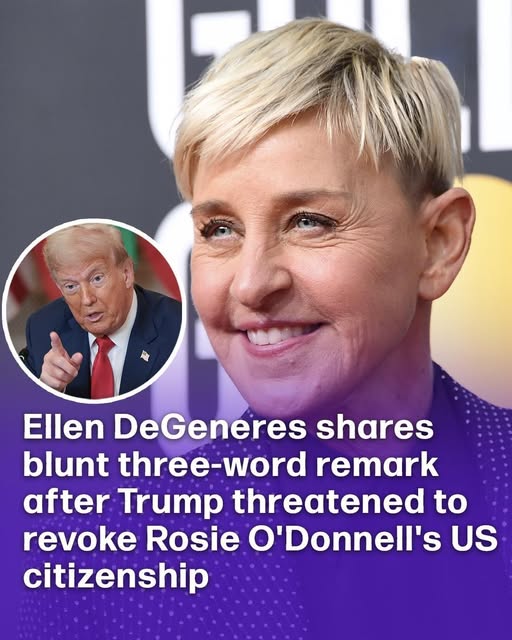
The world of entertainment collided with high-stakes politics this week in a fiery clash that reignited one of America’s longest-running celebrity feuds—now with explosive new stakes. What began as a war of words between Donald Trump and Rosie O’Donnell has morphed into a full-blown political spectacle involving threats of citizenship revocation, international relocation, and unexpected celebrity solidarity.
From Words to Threats: Trump Escalates Decades-Old Feud
It all began—again—when President Donald Trump took to Truth Social over the weekend, aiming his latest outrage at longtime nemesis Rosie O’Donnell. But this time, the rhetoric reached a new high—or low, depending on your view.
“Because of the fact that Rosie O’Donnell is not in the best interests of our Great Country,” Trump wrote, “I am giving serious consideration to taking away her Citizenship. She is a Threat to Humanity, and should remain in the wonderful Country of Ireland, if they want her.”
Even for Trump, this was extreme. Legal experts were quick to point out the constitutional impossibility of stripping a U.S.-born citizen of her nationality for criticizing a sitting president. But the underlying message was clear: political dissent, particularly from loud, queer, female voices, would be met with maximum presidential scorn.
O’Donnell in Ireland: Coincidence or Calculated Escape?
As it turns out, Trump’s target had already made her move—literally. O’Donnell, now 63, relocated to Ireland after Trump’s second inauguration, citing safety concerns and a desire to distance herself from what she viewed as an increasingly hostile U.S. political environment.
The move wasn’t just symbolic. With her father hailing from County Donegal, O’Donnell qualified for Irish citizenship and quickly secured dual status—perhaps anticipating that her long-running feud with Trump was far from over.
Critics were quick to note the irony: Trump, whose own mother emigrated from Scotland, attacked O’Donnell for leveraging a family tie that mirrors his own heritage.
Rosie Strikes Back—with a Photo and a Punchline
O’Donnell didn’t mince words in her response. On Instagram, she posted a photo of Trump and the late Jeffrey Epstein, the disgraced financier whose connections to powerful men remain a lightning rod of speculation. Her caption? Razor sharp:
“Hey Donald—you’re rattled again? 18 years later and I still live rent-free in that collapsing brain of yours.”
But the zinger that had social media buzzing came next: “You’re King Joffrey with a tangerine spray tan.”
The comparison to the infamous “Game of Thrones” tyrant wasn’t just savage—it was symbolic. King Joffrey, known for his cruelty, narcissism, and erratic abuse of power, has become a cultural shorthand for unchecked authoritarianism. And O’Donnell’s choice of metaphor underscored how she views Trump: as an unstable leader clinging to power and punishing dissenters with reckless abandon.
“I Am Everything You Fear”: Identity as Resistance
O’Donnell leaned into the insult, reclaiming the “threat” label with pride. “I am everything you fear,” she declared. “A loud woman, a queer woman, a mother who tells the truth.”
This reframing cast Trump’s attack not as a personal vendetta, but as a broader cultural conflict—one that pits conservative backlash against progressive, outspoken identities. It was a call to arms for anyone who feels silenced or targeted by the current political climate.
Ellen Enters the Chat
In a surprise move, Ellen DeGeneres added her voice—briefly but forcefully. Sharing O’Donnell’s post with a simple three-word message, “Good for you @rosie,” DeGeneres positioned herself firmly in Rosie’s corner.
While subtle, Ellen’s post carried weight. The 67-year-old comedian has weathered her own controversies in recent years and has remained relatively quiet on political matters. Her decision to publicly support O’Donnell signals both solidarity and risk, especially given her past criticisms of Trump-era policies targeting LGBTQ+ communities.
It’s also personal: like O’Donnell, Ellen briefly relocated abroad after Trump’s re-election, reportedly taking refuge in the UK before returning to Montecito, California. The two comedians share more than fame—they share fear, frustration, and the will to fight back.
LGBTQ+ Voices Under Fire
Both DeGeneres and O’Donnell have long been trailblazers for LGBTQ+ visibility. Their exchange isn’t just a spat between celebrities—it reflects rising concern over potential rollbacks of civil rights under Trump’s renewed leadership.
O’Donnell’s framing of herself as a queer mother who tells the truth is no accident. In today’s America, identity is political—and hers has become a symbol of resistance.
The Legal Fallout—and the Bigger Picture
Legal scholars quickly dismantled Trump’s threat, noting that revoking the citizenship of a native-born citizen without due process is not only unconstitutional, it’s authoritarian.
Yet the damage may already be done. When a sitting president threatens to strip a critic of their citizenship over personal grievances, the message to others is clear: dissent at your own risk.
This is more than a feud—it’s a warning shot across the bow of free speech.
Celebrities in Exile
O’Donnell and DeGeneres aren’t alone. In recent years, a number of celebrities—frustrated or frightened by rising authoritarianism—have considered or pursued life abroad. From Canada to France, Ireland to the UK, the “celebrity exodus” has become a quiet but telling protest.
It’s not about avoiding taxes or chasing leisure. For many, it’s about survival—mental, emotional, and sometimes literal.
Final Thoughts: When Comedy Collides with Power
This isn’t just about Trump, Rosie, or Ellen. It’s about how politics and pop culture have become inseparable—and how entertainers, once dismissed as mere distractions, are increasingly front-line figures in the fight over democracy, power, and personal freedom.
Rosie O’Donnell may no longer be on U.S. soil. But her voice—fiery, fearless, and unapologetically her—remains firmly planted in the American conversation. And thanks to allies like Ellen, that voice just got louder.