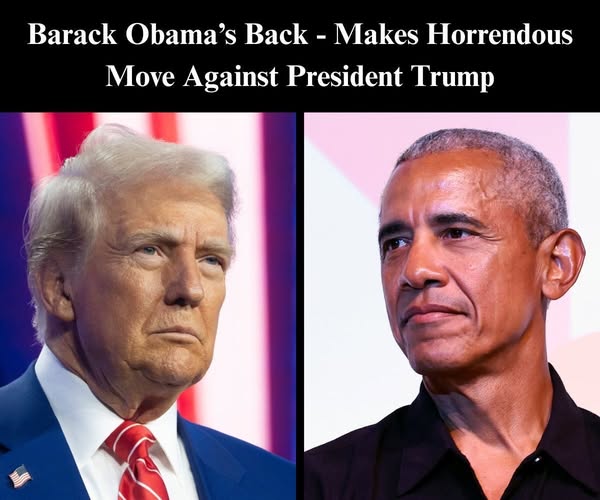
In a pointed critique of the modern digital landscape, former President Barack Obama has reignited a fierce national debate over the boundaries of online speech and the role of federal oversight. Speaking at The Connecticut Forum on June 17, 2025, Obama argued that the unchecked spread of disinformation has become a structural threat to American democracy, suggesting that the era of total digital laissez-faire may need to give way to government-led “restraints.”
The conversation, held alongside noted historian Heather Cox Richardson, served as a platform for Obama to warn that the erosion of shared truths is no longer a peripheral issue, but a central crisis of governance.
The “Lawnmower” Litmus Test
Obama utilized a stark metaphor to illustrate the breakdown of objective reality in the social media age. While healthy debate is the lifeblood of a republic, he argued that the current environment has moved beyond mere disagreement into the realm of the absurd.
“You and I can have a disagreement about a table’s design,” Obama told the audience, “but if I say it’s a lawnmower, and believe it, we’ve got a problem.”
He explained that modern disinformation campaigns—citing both Russian geopolitical tactics and the media strategies of figures like Steve Bannon—do not necessarily aim to convert the public to a specific ideology. Instead, the goal is to “flood the zone” with a chaotic volume of falsehoods, effectively paralyzing the public through confusion and apathy.
A Veiled Critique and a Call for Regulation
While the former President focused on systemic issues, he appeared to take aim at his successor, Donald Trump, warning of the specific danger posed when high-ranking political figures repeat falsehoods until the electorate becomes desensitized to the truth.
However, it was Obama’s pivot toward policy that has drawn the sharpest reactions. While affirming his foundational support for free speech, he suggested that the “harmful impacts” of platforms that amplify extremist content may require a legislative remedy. He proposed that government regulation—if executed in a manner “consistent with the First Amendment”—could be necessary to curb the algorithmic amplification of falsehoods.
The First Amendment Tension
The remarks have immediately polarized constitutional scholars and free-speech advocates. Critics argue that any move toward government-defined “restraints” on speech, even in the name of accuracy, sets a dangerous precedent for state-sponsored censorship.
To counter this, Obama urged society to view the problem through multiple lenses:
- Civic Education: A renewed focus on media literacy to help citizens distinguish fact from opinion.
- Journalistic Innovation: Experimenting with new models of reporting to rebuild local trust.
- Algorithmic Responsibility: Addressing how platforms prioritize engagement over veracity.
The Growing Divide
As the 2026 election cycle approaches, Obama’s comments underscore a deepening rift in the American consensus regarding digital media. Where some see a necessary intervention to save democracy from a “tsunami of lies,” others see an elite-driven effort to gatekeep information and silence dissenting voices.
The former President’s appearance in Connecticut makes one thing clear: the battle over the digital town square is no longer just about technology—it is a fundamental fight over the nature of truth itself.