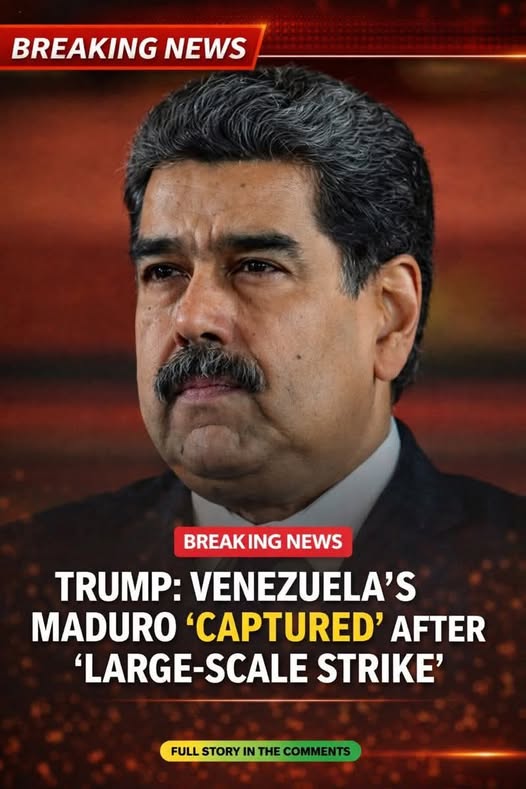
The night sky over Caracas lit up before most people understood what they were seeing. Explosions echoed. Communications fractured. Fear moved faster than facts. Within hours, Donald Trump claimed victory—asserting that Venezuelan leader Nicolás Maduro had been captured. The declaration arrived with force, but without independent confirmation.
What followed was not clarity, but fracture.
In Venezuela, streets filled with confusion, anger, and disbelief. State media denounced foreign aggression. Opposition voices urged restraint while quietly searching for proof. There was no verified footage, no public appearance, no clear transfer of authority. In moments like these, absence speaks as loudly as declaration.
Beyond the country’s borders, reactions split sharply. In Florida and among segments of the Venezuelan diaspora across Latin America, jubilation poured out online. For many who had lived through exile, hunger, and repression, the claims felt cathartic—framed as a long-delayed reckoning, even compared by some to a “Berlin Wall moment.” Trump’s allies described the strike as surgical and justified, citing executive authority and longstanding criminal indictments tied to narcotics trafficking.
Elsewhere, caution dominated. Foreign capitals divided along familiar lines. Some welcomed the possibility of accountability; others warned that the action—if confirmed—would represent a grave violation of sovereignty and international law. Calls for verification, restraint, and emergency consultations followed, underscoring how thin the margin is between intervention and escalation.
Between celebration and condemnation lies a dangerous vacuum. Regime change, when driven by force, rarely resolves itself cleanly. Without confirmed custody, without a recognized successor, and without a lawful transition framework, power does not disappear—it fractures. And fractured power has a way of finding civilians first.
What remains unresolved is not only the fate of one leader, but the legitimacy of the path taken. Justice declared without process risks becoming something else entirely. Liberation promised without consent can curdle into instability. And in the fog between claim and proof, ordinary people bear the cost—through fear, disruption, and the quiet erosion of trust.
History cautions against believing that an ending has arrived simply because someone announced it. What follows matters more than what is said. The true measure of this moment will not be found in speeches or slogans, but in whether violence gives way to law, uncertainty to institutions, and whether the lives of Venezuelans move closer to dignity rather than deeper into chaos.
Until facts replace assertions, restraint remains the only responsible posture.