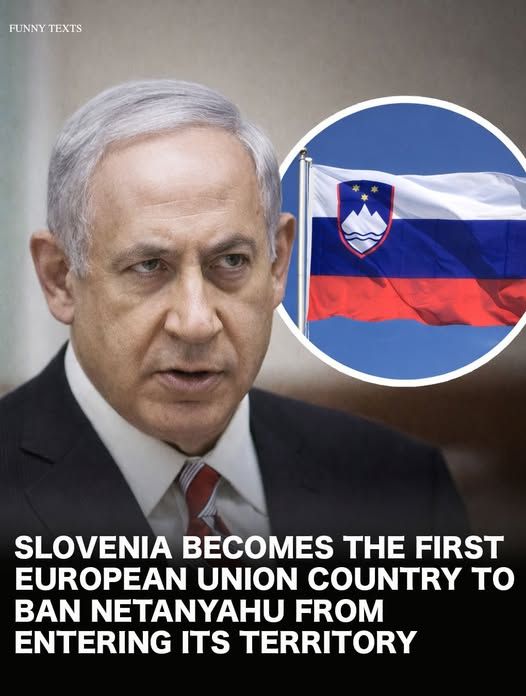
The International Criminal Court (ICC) issued an arrest warrant for Benjamin Netanyahu, accusing him of war crimes and crimes against humanity connected to the military campaign in Gaza. The allegations relate to specific actions taken by the Israeli Defense Forces during operations that caused widespread civilian casualties, destruction of homes and infrastructure, and other violations of international humanitarian law. While some European countries have taken a cautious stance, avoiding direct enforcement or official condemnation, Slovenia chose a path that marked a significant departure from the broader European response, signaling a firm commitment to legal accountability and international norms.
On September 25, 2025, Slovenia formally declared Benjamin Netanyahu persona non grata, meaning that he is officially banned from entering Slovenian territory under any circumstances. This action positioned Slovenia as the first European Union member state to impose such a restriction on the Israeli prime minister, drawing international attention and prompting discussions about the limits of diplomatic immunity in cases involving allegations of serious human rights violations. Slovenian officials emphasized that the decision was directly linked to the ICC arrest warrant and the broader principles of international law, framing it as a demonstration of Slovenia’s commitment to the authority of international courts and the enforcement of global legal norms.
The Slovenian government explained that the measure was a symbolic yet substantive step toward upholding justice in situations where national authorities might otherwise allow political leaders to evade accountability. It was part of a broader trajectory of Slovenia asserting an independent foreign policy approach that prioritizes human rights and compliance with international legal standards. According to statements from government spokespeople, the ban was intended to send a clear message: countries that respect international law must also be willing to act when violations are credibly documented, regardless of the political consequences or the prominence of the individuals involved.
This decision did not emerge in isolation but was preceded by several other notable moves in Slovenian foreign policy related to the Israeli-Palestinian conflict. In June 2024, Slovenia officially recognized the State of Palestine as an independent entity, aligning itself with nations advocating for a two-state solution and emphasizing the importance of Palestinian sovereignty and self-determination. The recognition was accompanied by public statements highlighting Slovenia’s view that lasting peace in the region requires adherence to international law and the protection of civilian populations, particularly in conflict zones such as Gaza and the West Bank.
The following year, in July 2025, Slovenia took additional steps to reinforce its critical stance toward Israel. The government barred two high-ranking Israeli ministers, Itamar Ben-Gvir and Bezalel Smotrich, from entering Slovenian territory. Slovenian officials cited public statements made by the ministers that were widely interpreted as encouraging or justifying violence against Palestinians, describing their exclusion as a measure to uphold human rights and prevent the endorsement of extremist rhetoric. The move drew attention across Europe, highlighting the contrast between Slovenia’s proactive approach and the more restrained actions of larger EU member states, many of which have maintained diplomatic engagement without imposing sanctions or travel restrictions.
In August 2025, Slovenia further escalated its position by introducing an arms embargo on Israel, reportedly the first of its kind by any European Union member state. This embargo prohibited the sale, transfer, or facilitation of weapons and military equipment to Israel, signaling the country’s strong disapproval of ongoing military operations in Gaza and emphasizing the need for restraint and compliance with international humanitarian law. Analysts suggested that the embargo could influence other EU nations to reconsider their own policies and raise questions about the EU’s collective responsibility in addressing conflicts and potential violations of human rights.
During the same period, Slovenian President Natasa Pirc Musar addressed the United Nations General Assembly, delivering a speech that called for increased international scrutiny and accountability in the Israeli-Palestinian conflict. She urged the global community to respect the rulings of international courts, protect civilians, and take concrete steps to prevent further violations of human rights. Her remarks underscored Slovenia’s position as a small but determined actor willing to challenge more powerful nations on legal and moral grounds, emphasizing that adherence to the principles of justice should not be selective.
Reports following the ICC warrant and Slovenia’s actions suggested that Netanyahu’s travel plans were carefully adjusted to avoid the airspace of countries that might consider enforcing the arrest order. International observers noted that such precautions highlight the tension between national sovereignty, diplomatic norms, and the enforcement of international law, raising complex legal and political questions about the mechanisms available to hold high-ranking officials accountable for alleged war crimes. While some states may have opted for silence or diplomatic caution, Slovenia’s actions have been interpreted as a precedent-setting moment, demonstrating that even small nations can assert influence on the global stage when guided by principles of justice and human rights.
The combination of legal proceedings, diplomatic measures, and public statements has amplified international attention on both Netanyahu’s alleged actions in Gaza and the broader question of how the international community addresses accountability for leaders accused of serious violations. For Slovenia, the persona non grata declaration represents a carefully considered statement that law and morality must coexist with diplomacy, and that failing to act in the face of credible allegations risks undermining the legitimacy of international institutions designed to uphold justice. As the case continues to unfold, Slovenia’s actions are likely to remain a focal point for discussions about the intersection of law, politics, and human rights enforcement in conflicts around the world.