
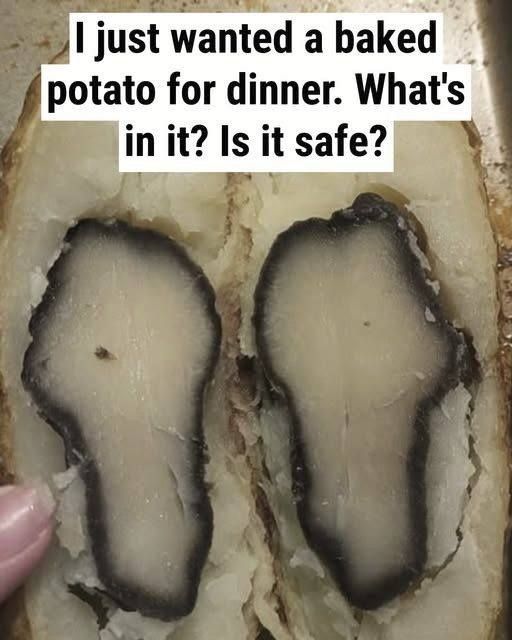
Finding a black ring inside a potato can be unsettling at first glance. You slice into what looks like a perfectly normal potato, expecting a simple ingredient for dinner, and instead you’re met with a dark, unfamiliar circle or patch hidden inside. It’s the kind of moment that immediately raises questions about safety and spoilage, especially because the outside often gives no warning at all. Naturally, the first assumption is that something has gone wrong—that the potato has rotted from within or become unsafe to eat.
In reality, these dark rings are usually caused by a condition known as internal black spot or internal bruising, and they are far more common and far less dangerous than they appear. Potatoes are sensitive vegetables, and even though their skins look tough, the inner flesh is surprisingly vulnerable to stress and damage. When potatoes are dropped, stacked too heavily, or bumped during transport and storage, the internal tissue can bruise without any visible mark on the outside. That hidden damage often shows up later as black, gray, or sometimes purplish rings once the potato is cut open.
Another common cause is poor storage conditions. Potatoes need steady airflow and stable temperatures to stay healthy. When they are kept in overly cold environments, such as refrigerators, or in areas with little ventilation, the internal chemistry can change. In more extreme cases, the center of the potato can darken significantly due to oxygen deprivation, a condition sometimes referred to as blackheart. Mild versions of this process appear as rings or scattered dark patches rather than full discoloration.
Temperature fluctuations and natural oxidation can also play a role. Just like apples turning brown after being cut, the vascular tissues inside potatoes can darken when exposed to stress or air over time. This process is natural and does not necessarily indicate spoilage.
In most cases, potatoes with these internal spots are still safe to eat as long as they smell normal, feel firm, and show no signs of mold or slime. The darkened areas can simply be cut away before cooking. Only when potatoes become soft, smelly, green, or heavily spoiled throughout should they be discarded entirely.