
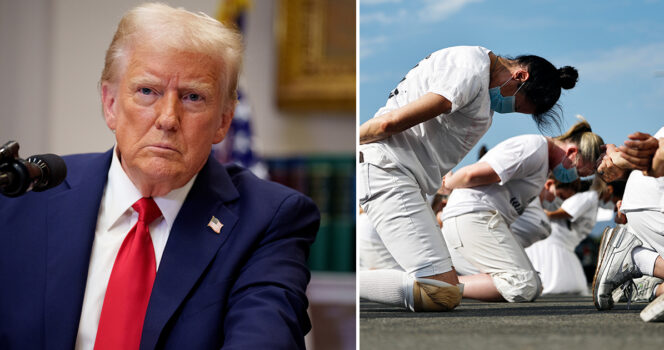
Donald Trump’s position on immigration has pulled global attention toward one of the most controversial prisons in the world, a facility critics warn is designed “to dispose of people without formally applying the death penalty.”
El Salvador’s CECOT, short for the Centre for the Confinement of Terrorism, sits about 70 kilometers east of San Salvador and spreads across a 23-hectare site.
Built in February 2023 as the centerpiece of President Nayib Bukele’s aggressive crackdown on gangs, the facility can hold up to 40,000 inmates, making it the largest prison complex in the Americas.
The $115 million project forms a key part of the 44-year-old president’s security strategy, which has driven a sharp drop in homicide rates across El Salvador.
‘Concrete and steel pit’
Bukele’s policies have drawn both praise and alarm. Supporters point to improved public safety, while critics warn that mass arrests and detentions risk sweeping up individuals without sufficient evidence.
The prison itself has become central to that debate. Analysts from the SAIS Review of International Affairs note that the facility prioritizes “security and isolation over rehabilitation, reflecting a punitive approach to incarceration.”
In an interview with BBC, Miguel Sarre, a former member of the United Nations Subcommittee for the Prevention of Torture, described the mega prison as a “concrete and steel pit,” underscoring concerns about conditions inside.
Trump’s deportation fuels controversy
The issue took a sharp turn when Bukele offered the Trump administration a deal to house “dangerous criminals” deported from the United States in the “notorious” prison.
Inspired by the invitation, President Donald Trump used a little-known 18th-century wartime law to justify deporting foreign nationals accused of crimes in the United States, arguing the country faced an “invasion” by violent organizations.
According to Reuters, the White House paid roughly $6 million to imprison about 300 alleged violent criminals to El Salvador for one year.
“President Trump and I have a clear message to criminal illegal aliens: LEAVE NOW,” Kristi Noem, the former Secretary of Homeland Security, warned in a March 2025 social media post.
“If you do not leave, we will hunt you down, arrest you, and you could end up in this El Salvadorian prison.”
Although a federal judge attempted to block the deportations, the ruling came after flights were already in international airspace. The administration has maintained that its actions were lawful.
‘Black hole of human rights’
Human rights groups and international observers have strongly criticized the arrangement. Reports cited by the BBC describe CECOT as a “black hole of human rights,” where international standards for prisoner treatment are not followed.
Sarre also warned that the prison appears to function as a system “to dispose of people without formally applying the death penalty,” highlighting fears that inmates may never leave once they enter.
Life inside
“Here are the psychopaths, the terrorists, the murderers who had our country in mourning,” a prison director told BBC correspondent Leire Ventas during her 2024 tour of the facility.
The reality inside CECOT reflects that message, with daily life tightly controlled and strict rules enforced without exception.
One of the most visible requirements is uniformity. All inmates must wear white shirts and shorts, and their heads are shaved every five days to maintain a standardized appearance.
Packed prisoners
Ventas described rows of inmates with shaved heads packed tightly together, reinforcing its reputation as one of the most extreme detention facilities in the world.
“What is the maximum capacity of each cell?” she asked the prison director, who chose not to be named.
“Where you can fit 10 people, you can fit 20,” he replied of the windowless cells, with bare metal bunks and no mattresses.
Surveillance is constant, with cameras and guards monitoring every movement. Prisoners spend 23.5 hours a day confined to their cells, receiving only 30 minutes of exercise in a windowless corridor.
There is little to occupy their time. Each crowded cell reportedly contains just two Bibles, and meals are minimal – rice, beans, hard-boiled eggs or pasta – eaten by hand without utensils.
“Any utensil can be [fashioned into] a deadly weapon,” said the director.
‘In hell’
“When you get there, you already know you’re in hell. You don’t need anyone to tell you,” one deportee told 60 Minutes, explaining he was beaten so badly by the guards when he arrived at CECOT that one of his teeth was knocked out.
The college student was speaking in a leaked segment of the controversial CBS segment that was abruptly pulled from the air at the last minute.
The report featured interviews with migrants sent to El Salvador’s notorious Terrorism Confinement Center, or CECOT, under Trump’s aggressive immigration crackdown.
Two deportees reported torture, beatings and abuse, PBS writes, while a Venezuelan man said he was subjected to sexual abuse and placed in solitary confinement as punishment.
How do you feel about people being sent to a prison like this without a proven conviction? Please let us know your thoughts and pass this story along so we can hear from others!