
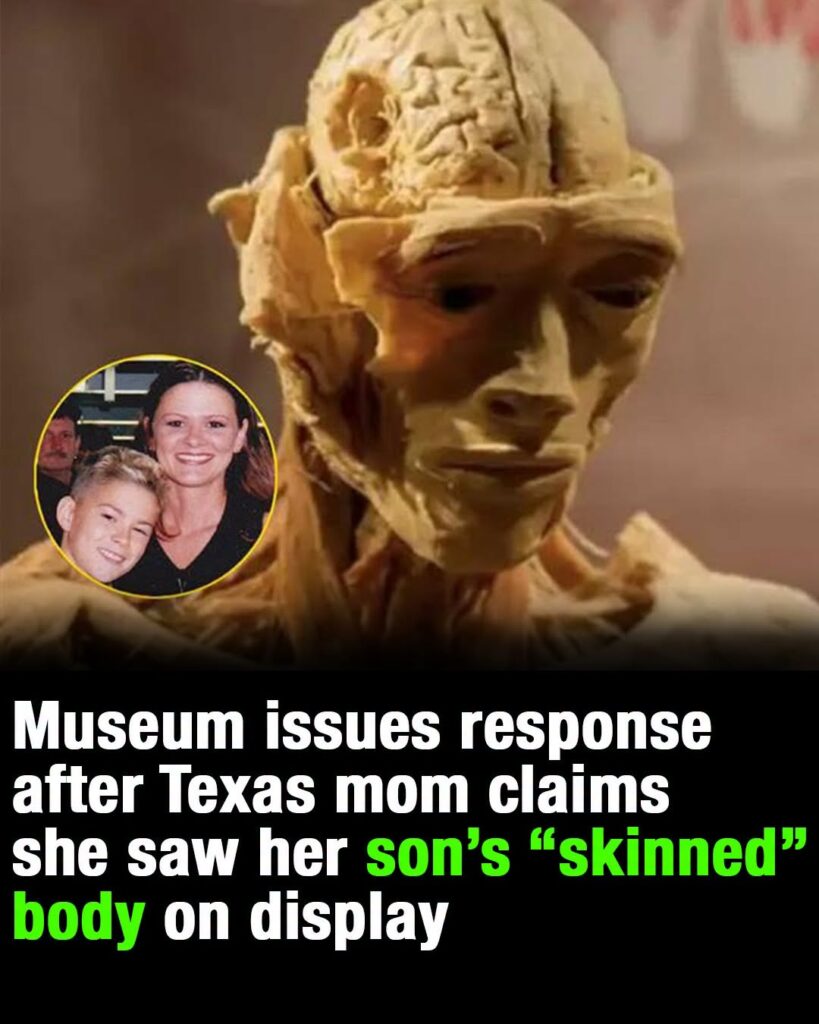
In the quiet, sterile halls of anatomy exhibitions, millions of visitors have gazed upon the preserved, flayed remains of human beings. To the casual observer, these displays—preserved forever through the plastic-infusion process known as plastination—are marvels of science and education. But for one grieving mother, a trip to a Las Vegas exhibition hall turned into a sudden, shocking descent into a personal horror movie.
For years, Kim Erick has carried a heavy, agonizing conviction: that her son, Christopher Todd Erick, did not rest in the decorative urn on her mantelpiece, but was instead skinned, chemically preserved, and posed as a star attraction in a traveling museum.
It is a claim that forces a chilling collision between a mother’s relentless, grief-driven intuition and the strict, legally documented timelines of the global human remains trade. While the museum’s owners have vehemently dismissed the allegations as biologically and chronologically impossible, the mystery has only deepened for a family refusing to let their son’s memory be quietly swept away.
The Death on New Year’s Eve and the Ashes That Didn’t Quiet the Doubt
The nightmare began in 2012. Chris Erick, a vibrant 23-year-old, was living with his grandmother in Midlothian, Texas—a quiet town just south of Dallas. On a tragic morning, he was found unresponsive in his bed.
Local police delivered a devastating verdict to Kim: her young son had died in his sleep from a double heart attack, brought on by an undiagnosed, silent heart condition.
While Kim was still paralyzed by the initial shock of the news, Chris’s father and grandmother moved quickly, arranging for a rapid cremation. Later, they handed Kim a memorial necklace, assuring her that the heavy metal pendant held a portion of her son’s ashes.
But Kim could not shake a cold, creeping sense of dread. When she finally obtained the official police scene photographs of her son’s bedroom, her doubts hardened into panic. She claimed the photos revealed troubling physical details—bruises and marks—that were entirely absent from the initial police reports.
“Something very bad happened in that room!” Kim later wrote in an emotional Facebook post, laying out her harrowing theory. “They had Chris in there for two days before he died… In my opinion, Christopher was tortured for the two days he was held in his grandmother’s house. That is where Christopher died.”
Though a formal homicide investigation in 2014 concluded there was absolutely no evidence of foul play, Kim rejected the findings entirely, convinced of a local cover-up.
A Shocking Discovery: “The Thinker”
Four years later, in 2018, Kim’s search for answers took her to the Bally’s Hotel and Casino in Las Vegas, which was hosting Real Bodies—a popular, highly successful exhibition showcasing preserved human cadavers.
As she walked through the dimly lit galleries, she rounded a corner and stopped dead in her tracks.
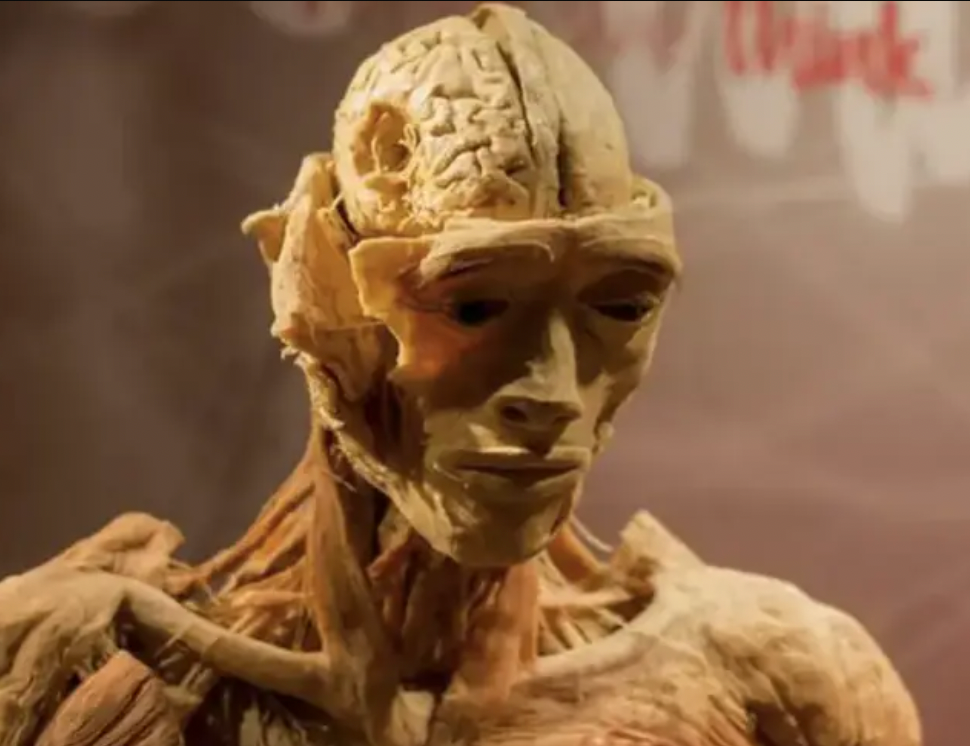
Before her sat a skinned, muscular male figure permanently posed in a pensive stance, known to the exhibition as “The Thinker.”
“I knew it was him,” Kim told reporters, describing the visceral shock of that moment. “It was unbelievably painful. My words cannot describe how this shook me and my family to its core. I was actually looking at pictures of my son’s skinned, butchered body. It is gut-wrenching.”
To Kim, the evidence of her own eyes was overwhelming. She noted that the specimen’s skull displayed a distinct fracture on the right temple—matching a childhood injury recorded in Chris’s medical history. Furthermore, she observed that the skin over the specimen’s right shoulder had been deeply gouged out. Chris had a prominent tattoo on that exact shoulder; to Kim, the gouge was a deliberate, calculated attempt by the suppliers to erase her son’s identifying marks.
The Museum’s Defense: A Chronological Impossibility
Armed with her conviction, Kim launched a public crusade, demanding that the museum permit independent DNA testing on “The Thinker.”
The exhibition’s organizers firmly closed the door on her requests. Imagine Exhibitions, Inc., the parent company behind the touring show, issued a strong statement to fact-checking organization Lead Stories, denying her claims entirely and offering deep sympathy alongside cold hard facts.
“There is no factual basis for these allegations,” the company stated. “The referenced specimen has been on continuous display in Las Vegas since 2004 and cannot be associated with the individual named in these claims. All specimens are ethically sourced and biologically unidentifiable.”
To put the final nail in the theory, investigators pointed to a simple, unbendable timeline:
- The 2004 Archive: Archived promotional photographs of “The Thinker” prove the exact specimen was on display in Las Vegas in 2004—eight years before Chris Erick died in Texas.
- The Plastination Timeline: The chemical process of plastination, which replaces bodily fluids with liquid plastics, takes up to a full year of laboratory preparation. It would have been physically impossible to preserve Chris’s body and place him in a traveling exhibit in the months following his 2012 passing.
Lost in the Desert: The Search Continues
Shortly after Kim’s allegations began circulating online, “The Thinker” was quietly disassembled and removed from the Las Vegas exhibit. Kim claimed she tracked the specimen briefly to an exhibit in Union City, Tennessee, before losing its trail entirely.
“Chris was never abandoned in life, and I don’t want him abandoned in death either,” she insisted, her maternal instinct refusing to yield to the museum’s timeline.
Her search for answers took another bizarre, grim turn in July 2023, when hikers discovered more than 300 piles of abandoned, unidentified cremated human remains dumped in the Nevada desert.
For Kim, the bizarre discovery offered a new avenue of hope. She is now petitioning forensic scientists to test those abandoned ashes for traces of specific chemical compounds used in the plastination process. If she can find those compounds, she believes she can finally prove that the ashes she was given in 2012 were a lie, and that her son’s real journey ended not in a cemetery, but under the harsh spotlights of a museum stage.