
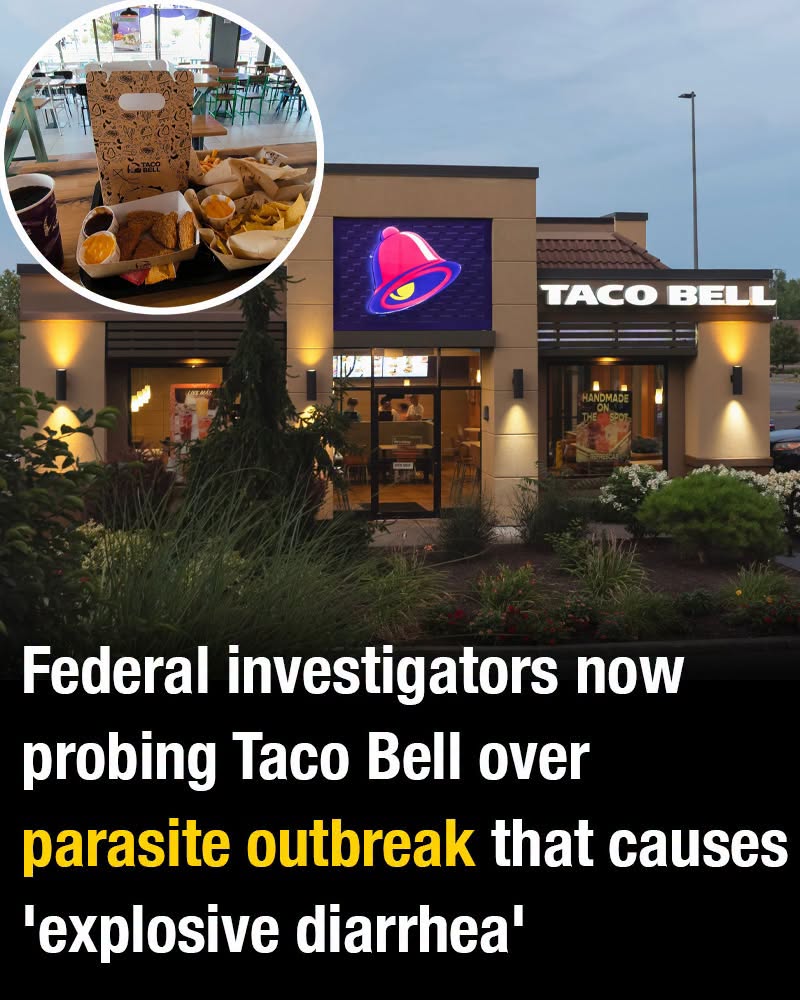
The next time you pull up to a Taco Bell drive-thru, you might notice something crucial missing from your cheesy double-decker taco.
Federal and state health investigators are quietly trying to untangle a massive, multi-state medical mystery, tracing the footsteps of a microscopic parasite that has left thousands of Americans gripped by severe, agonizing gastrointestinal illness. At the center of this medical detective work is one of the nation’s largest fast-food giants.
While health officials caution that no definitive link has been proven, the hunt for the source of a major Cyclospora outbreak has led investigators straight to Taco Bell’s supply chain—prompting the brand to abruptly yank some of its freshest ingredients from menu boards across the country.
The Microscopic Culprit: What is Cyclospora?
At the heart of the panic is a tiny, single-celled parasite known to scientists as Cyclospora cayetanensis.
Unlike typical foodborne bacteria like E. coli or Salmonella, Cyclospora is a parasite that thrives on fresh, imported produce irrigated with contaminated water. Once inside the human digestive tract, it unleashes an infection called cyclosporiasis.
The symptoms are notoriously brutal and stubborn, often lasting from a few days to a month or longer if left untreated. The hallmark of the infection is watery, frequent, and sometimes violently explosive diarrhea.
But the misery doesn’t stop there. Victims of the parasite typically report a exhausting list of symptoms:
- Severe abdominal cramping and bloating
- Profound, body-aching fatigue
- Loss of appetite and rapid weight loss
- Nausea and vomiting
- A persistent, low-grade fever
“Sorry, No Lettuce”: Taco Bell’s Preemptive Strike
As federal agencies worked behind the scenes to track the surge in illnesses, Taco Bell took immediate, voluntary action to protect its customers—and its brand.
In select locations across the country, hungry patrons were greeted by sudden, handwritten signs taped to drive-thru menu boards. The notices laid out a stark reality:
“We are currently unable to sell Lettuce, Cilantro Onion, Pico de Gallo and Guacamole due to a nationwide recall.”
Initially, it was unclear whether these sudden menu omissions were directly connected to the wider federal investigation. However, reporting from The Washington Post confirmed the connection: federal and state health authorities are actively probing whether Taco Bell’s fresh produce supply chain acted as a super-spreader for the parasite.
By removing these fresh garnishes, Taco Bell effectively cut off the primary vehicles for Cyclospora transmission, a move that public health experts have lauded as a smart, defensive play. “Even if the chain is ultimately cleared of any wrongdoing,” one source close to the investigation noted, “it is a very good thing they stopped serving these high-risk items immediately.”
The Ground Zero in Michigan
While cases of cyclosporiasis have popped up in Illinois, Virginia, Ohio, and New York, the state of Michigan has borne the absolute brunt of the crisis.
The numbers coming out of the Great Lakes State are staggering. Michigan health officials have reported more than 3,000 cases of the parasitic infection. To put that in perspective, the state typically expects to see a mere 50 cases in an entire year.
Nationwide, the outbreak has resulted in more than 80 hospitalizations. Fortunately, no deaths have been reported, but the sheer volume of severe illnesses has stretched local health departments to their limits.
The Puzzle Facing Investigators
Proving a direct link between a fast-food giant and a farm-level parasite is an incredibly complex task.
According to sources close to the investigation, at least one hospitalized patient explicitly recalled eating at a Taco Bell shortly before their symptoms began. However, the trail is muddy. Investigators have also interviewed dozens of sick individuals who swear they haven’t eaten fast food in months.
Because large-scale produce suppliers distribute their crops to hundreds of different grocery stores, restaurants, and wholesale distributors, it is highly likely that Taco Bell is just one of many victims of a contaminated batch of lettuce or cilantro from a shared, yet-to-be-identified farm.
Taco Bell Responds
For its part, Taco Bell is cooperating fully with the ongoing investigation while emphasizing that the link remains unconfirmed. In a statement addressing the probe, the company reiterated its commitment to safety:
“The health and safety of our guests is our top priority. Public health officials have not confirmed a link to Taco Bell or any specific ingredient, supplier, restaurant or retailer.
While authorities continue their broader review, Taco Bell has voluntarily and temporarily removed limited ingredients at select restaurants as a precautionary measure. We will continue to closely monitor the situation and follow the guidance of public health authorities.”
For now, the investigation remains open, and the nation’s food safety experts are advising consumers to stay vigilant. Until the federal government pinpoints the exact farm behind the contaminated greens, you might want to skip the extra cilantro on your next taco run.